Study Abroad Seminar | 9th July 2025
Blue Whale Hall | A Report
By Ms. Lekhaa M. S

On Wednesday, the 9th of July 2025, the Office of the Dean of International Programs hosted its second study abroad seminar of the academic year at the Blue Whale Hall, MMIP.
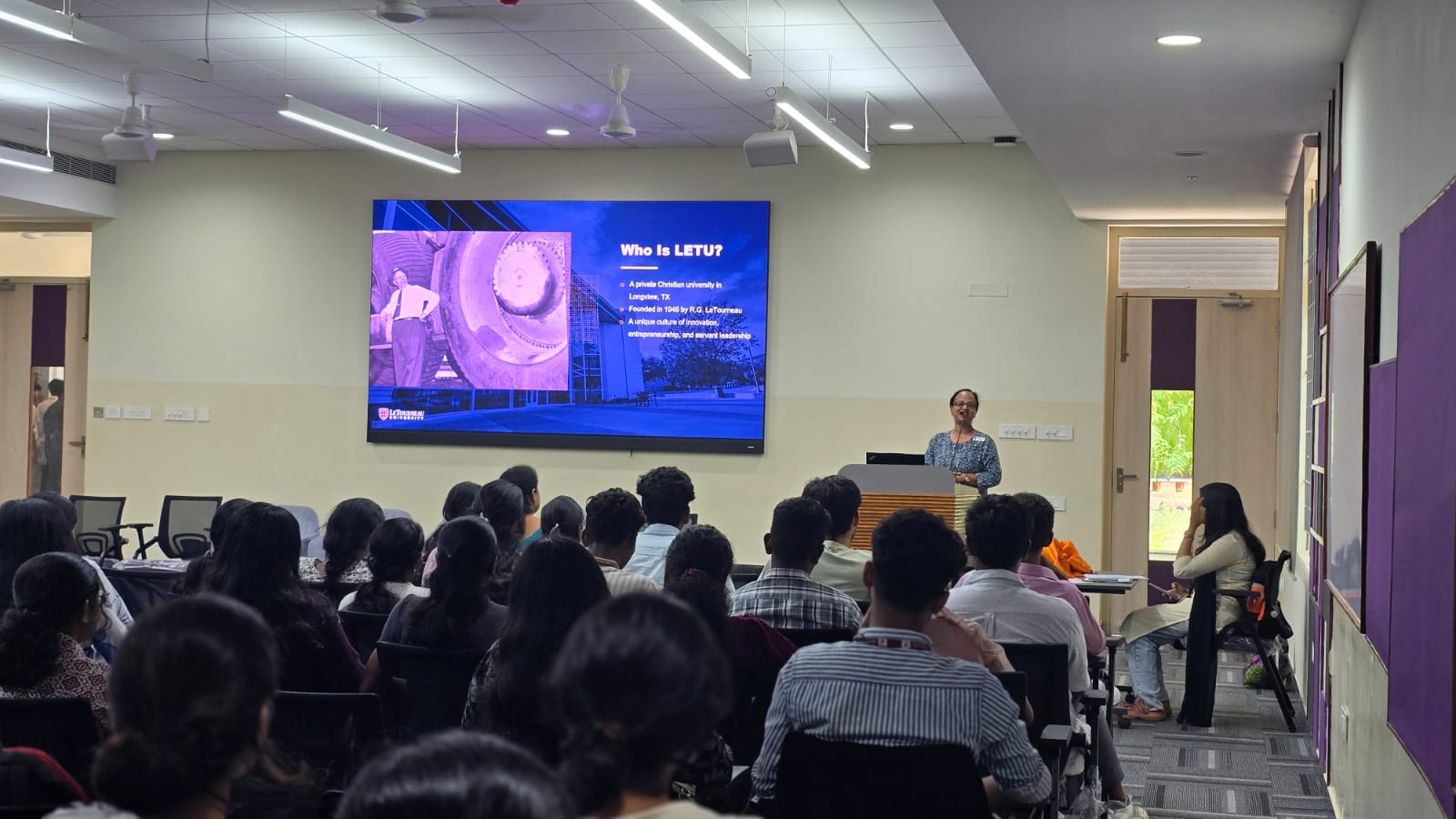
This seminar focused on the semester exchange program at LeTourneau University, Longview, Texas. The resource person of the program was Dr. Suma Jayakar, director of South Asian Initiatives, LeTourneau University, Texas.
Ms. Aakhila Fathima, intern at the Office of International Programs, was the MC of the event. The event started with an opening prayer by Ms. Prisella, followed by a welcome address from Dr. Samuel Rufus, Dean of International Programs.
Following the Dean’s address, Dr. Millicent Serena, Associate Dean of International Programs (SFS), felicitated the guest, Dr. Suma Jayakar with a shawl.
Then, the Controller of Examinations Dr. Ravi Shankar presented LeTourneau transcripts to the exchange program returnees, Ms. Pearlina, Ms. Arsha, and Ms. Lynette.

Ms. Rishita talked about her experience interning at the American Center, US Consulate center from May 7th to July 13th. She told the group about her tasks and how she felt there was a culture exchange through her experience.
Then, the returnees from LeTourneau University talked about their experiences abroad, including academic differences, travel, food, and the experience of living along.
Dr. Millicent Serena, Associate Dean of International Programs (SFS), introduced the speaker of the day, who followed with her talk.
Dr. Suma Jayakar began with a short history of her University, highlighting certain similarities it shared with Madras Christian College. The two instituitions’ relationships with each other started in 2019. LeTourneau University has a sprawling 162 acre campus, with over 100 degree programs. It is famous for its aviation program, UG research, and hands on learning experience.
She shared pictures of the campus, highlighting the dorms and the on-campus apartments. The mentioned the Belcher center for performing arts and the dining options on campus. LeTourneau houses around 150 international students.
She also talked about how to apply for the exchange program, highlighting the steps involved, preparing for the VISA interview and cost of attendance.
She quickly mentioned a short cultural immersion
program, before opening the floor for questions.
Following this, the vote of thanks was delivered by Ms. Rishita.
Think Tank
The Staff-Student Study
Circle
Session summary
[09/07/2025]
Report by Ms. Lekhaa M.S

Topic: Reimagining Part IV for Skill Enhancement
The session began with a brief introduction of the topic by Ms. Lekhaa.
Dr. Sudarvizhi listed the part IV programs in each year; GC for first years, ID and PD for second years, and GE for third year UG students.

Dr. Joshua Jayaseelan stepped forward to say that the self-financed stream’s departments offer many skill based courses, naming certain courses offered in his department.
Ms. Lekhaa suggested that there should be a short description of each part IV course offered, when students are asked to select them, since many students do not select courses outside their discipline as they don’t know what the course expects of them.

Dr. R Padmamala posed a question to the students asking why students change their part IV course after one or two classes. To this, a student replied that arts students are only allowed to choose arts courses and the same with science, which forced them to choose something that they are not interested in. Students are also forced to learn Tamil for two semesters.
The staff quickly replied stating that learning Tamil is a prerequisite from the government and can not be changed.
Mr. Iniyan proceeded to give a talk on experimental learning, differentiating it from other types of learning.
Following which Ms. Afreen talked about service learning programs and their types.
The conversation then moved on to whether or not Environmental Studies could have a syllabus tailored to each department. Further, the group discussed how EVS can be improved, including suggestions like taking EVS out of the classroom and into the environment.
Next, the group discussed developing AI skills.
Dr. Nirmal started by saying he used AI to help in setting question papers, as a smart assistant.
Professor Arun Kumar reminded the group that AI, while it is smart and useful, has been known to give misleading information at times. He advised the group to take care while using AI.
Dr. Jannet asked students what kind of training they would want for AI skill development. She received answers like they want to learn domain-specific AI tools. Here, a very hands-on workshop for each department was suggested.
Dr. Nirmal vetoed the idea stating that it would be impractical to conduct individual workshops for each department. He proposed a faculty workshop, where staff would be taught about the domain-specific AI tools, which they would pass on to their students.
Ms. Safa took over to speak about her famed podcast and her journey as a podcaster. She spoke about how podcasts came to be popular and the topics she discusses on her channel.
Ms. Lekhaa re-invisioned an idea for community outreach at Chitlappakam Lake, as previously mentioned in another edition of Think Tank, mentioning the impact it would have on the community and the students involved.
When asked again about what they expected from their Part IV courses, students mentioned that they wanted a course on resume building or about LinkedIn.
Further, that mental health should be an important part of Personality Development and that communication skills should be developed.
Finally, the session concluded with a vote of thanks by Ms. Lekhaa.

The Day Today
#reflections
7th July 2025
Today we had a rewarding time
of interactions in the I MA & II MA Class.
In the II MA Class today, Ms. Pooja gave a lovely talk on feminism, which resulted in a lot of engaging discussions and deliberations.
I also gave them a few suggestions, outlining the five salients of spoken communication – viz.,
It is Spontaneous, Repetitive, Interactive, Involves Use of Body Language and Eye Contact.
At 10.20 am we had the inauguration of the newly renovated washroom facility for men staff members, near Vice Principal’s Office.
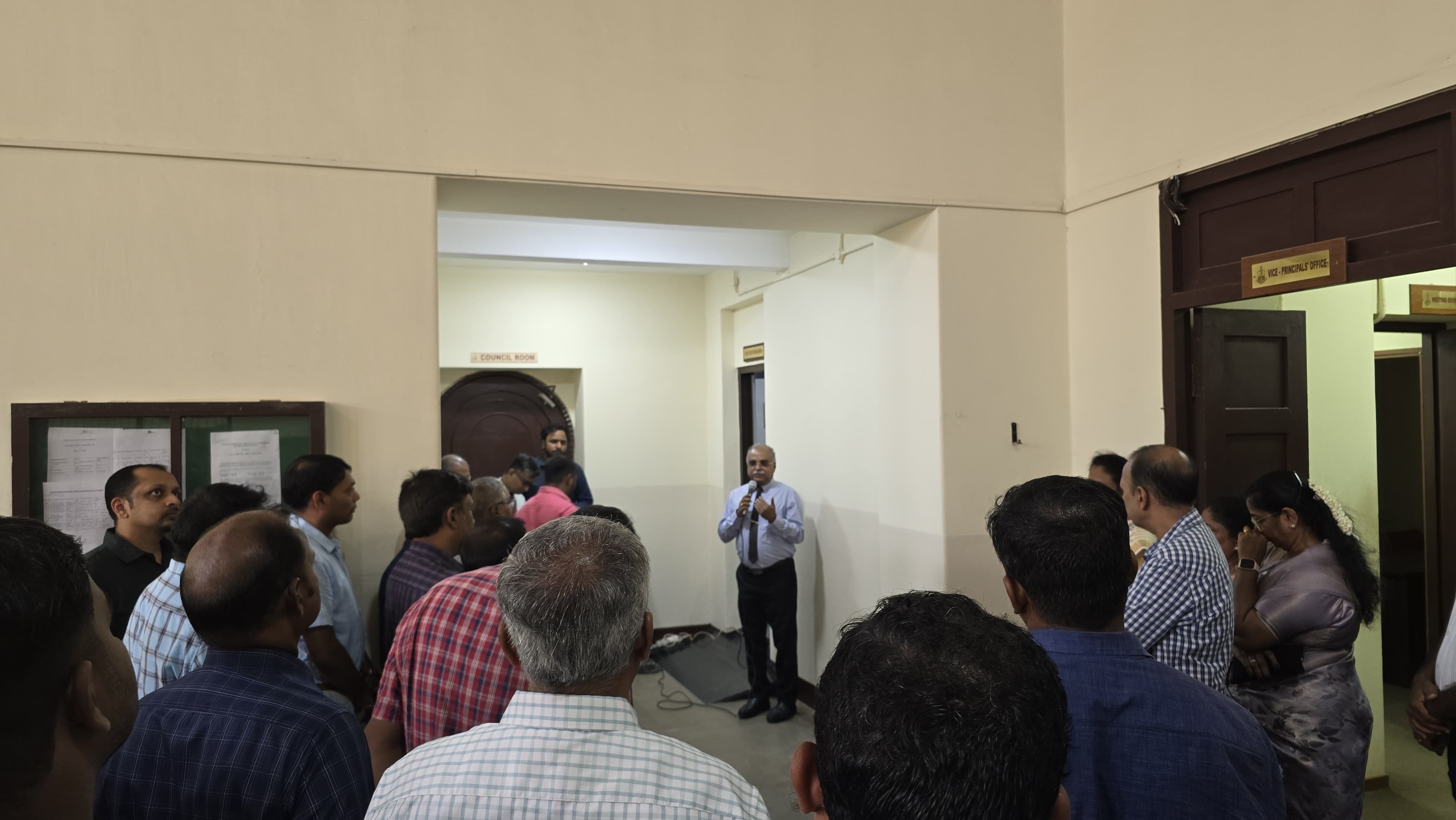
At 12.30 pm we had the first edition of this year’s SKY Programme [Sharing Knowledge You’d Abroad Programme].
Today we had Dr. G. Gnanasekaran as the resource person. He spoke about his rewarding visit to the Natural History Museum. This was followed by a photo session and a fellowship lunch. More than 70 staff and students participated in the programme today.

Today Mr. Nitish from II MA English has resolved to do a 100-Day Blogging Challenge. His brand new blog can be found HERE.
.png)
Think Tank
The Staff-Student Study
Circle
Session summary
[02/07/2025]
Presented by: Ms. Shannon Patricia

Topic: From Idea to Implementation: Navigating Innovation Roadblocks
The session began with a brief introduction of the day’s topic by Ms. Lekhaa. Dr. Amirthavalli was the one to kickstart the session as she delved deep into the topic. She started by highlighting the difference between innovation and novelty.
The former being need-based and the latter being value-based. She also opened the floor for the students to spell out the challenges that they face in the realm of innovation.
Ms. Lekhaa stepped up with her views on the idea of Trust as the major issue as stealing credit would become an overarching threat in this regard. She also stressed on the difficulty in finding passionate people who share the same goal.
Apart from this, she also highlighted that people get extremely lazy in dealing with tasks which are to be fuelled with consistency.

Dr. Amirthavalli also sided with Ms. Lekhaa as she underlined the significance of finding people with a similar motive. “Trust and like-mindedness go together” said she. She encouraged the students to approach the officials as they can then be exposed to birds of the same feather. While there’s always room for disagreement, passion drives the group together. She also presented the significance of approaching a counsellor which is often labelled as a taboo.
Ms. Pooja presented the inevitable need for mentors which serves to be the major hindrance in the realm of innovation. She also presented her journey of self-learning in working at the MMIP.
Dr. Amirthavalli pitched in to highlight the lack of expertise at all levels.
Dr. Justin pitched in to present the hiccups in pulling people out and suggested that it would be better to find someone from the department. He also responded to the former’s queries on the policy as there’s room for someone outside the institution to be involved as well.
Dr. Nirmal advocated that it is better to send our students there to be mentored. He also highlighted the significance of finding a suitable mentor and stressed that the students must work with clarity.
Dr. Justin presented the vein of the discussion as he said “Mentoring and Networking” are the towering issues that we need to address.
Ms. Lekhaa shared her experience on her service learning program and also presented the lack of mentorship which ultimately results in lack of support. Dr. Samuel Rufus highlighted the importance of ‘hand holding’ the students.
Dr. Vijay Solomon highlighted the lack of culture of reading the scientific literature which often derails the students from generating a constructive outcome.
Dr. Amirthavalli highlighted the practice of a well planned demonstration that is observed in some of the departments in college.
Dr. Nirmal pitched in to present the popular notion of being overtly interested in the appearance and not the foundation.
Dr. Vijay Solomon once again presented the factors of availability, aptitude, altitude and attitude that play a pivotal role in this regard.
Dr. Logamanya Tilak was swift to express his views on the factor of passion in staffs and highlighted the significance of practicality where the mentors should be open to both receiving and mentoring.
Ms. Lekhaa advocated that it would be better if the ideations are presented on behalf of the Think Tank team themselves so that it would be taken seriously.
Dr. Amirthavalli said that it is the lack of awareness on innovation that drives this sad state of affairs as she also highlighted the dwindling number of students who visit the MMIP. She also suggested that it would be better if the ICA component is strengthened to accommodate the aspects of innovation as well. Dr. Tilak addressed the issue of complacency where students are not interested “to go to the uncharted territories”. He also gracefully juxtaposed the notions of ‘mindset’ and a ‘set mind’.
Dr. Samuel Rufus also acknowledged the factor of fear/ embarrassment that often hinders the process of innovation. Dr. Justin encouraged the students to work on the basics and thereby identify a problem to be solved. He also highlighted the importance of mentorship in the realm of innovation.
Dr. Vijay Solomon stated that the students lack an understanding of the dynamics of the innovation park which was followed by Dr.Justin’s observation on the significance of cultivating the mindset in faculty members.
The topic then moved on to the idea of patenting as Dr. Amirthavalli quoted Dr. Aarthi’s observation as to how people have really misunderstood the concept of patenting. “Innovation must be presented in the Faculty Colloquium so that it can be carried on to the students” said she.
Dr. Vijay Solomon accelerated the session as he proposed an idea of an ‘Innovation Day’ which can aid in tapping the potential within oneself. The factor of credibility was also addressed. Moreover, Dr. Amirthavalli criticised the notion of posters as it could raise concerns of reliability. She also advocated for a nodal point to collaborate all the ideations and thereby facilitate its progress.
Dr. Nirmal presented counter arguments when he said that basic outline of ideas when aptly presented can never be stolen. Dr. Amirthavalli persevered that even though the idea is unique it is still very much likely to be stolen. Dr. Nirmal countered that one must be smart in choosing what to share and what not to.
Dr. Hanumantha Rao stepped in to highlight the quintessence of patenting an idea. He also presented the complexities that are involved in funding and added that the college would only provide the connections that are necessary for the ideation to thrive.
Dr. Jojan Job pitched in to present his notions on making the creative ideas more popular. He also addressed that there is a lack of awareness in students. He advocated for ‘diffusion of innovation’ and heralded for publication campaigns and sustained interventions.
Dr. Amirthavalli continued the vein of thought as she suggested that a QR code can be placed on a link to the MMIP which can in turn serve as campaigning in itself.
Ms. Pooja then put forth her ideas as she said that students aren’t ready to get used to something new. She also added that there’s a prevailing sense of unwillingness to learn which is also combined with intimidation.
Mr. Abishek also added that there’s a certain amount of complacency that stagnates a student’s mind. Ms. Lekhaa presented that there’s a tendency to look everything based on one’s need which in turn leads to expect immediate results.
Dr. Jojan was swift to present his views on providing internships for the students as he also advocated the significance of peer teaching. Mr. Abishek presented that there’s a lack of understanding about the idea of innovation. He also added that it is crucial to disseminate knowledge on startups.
Professor Adarsh Vijay pitched in to throw some light on the language of innovation in the humanities. He presented the crucial question of integrating the non-natural sciences as part of the innovation cycle.
He went on to share his experience on working with the board for the Young Scientist Conclave. He advocated for an expert exchange happening across sectors which he also termed as ‘Interagency Pollination’. He suggested that the MMIP act as a nodal point for further programs where other diplomats can also pitch in.
He also presented the underlying challenge in nurturing the students from their first year of study. He reinstated the need to re-imagine the idea of innovation as something which isn’t limited to the natural sciences. In the context of this, he also stated that “correlation isn’t causation”. “There are so many ways to come together but the students must find a way to come together” he said.
The ensuing part witnessed a brief encapsulation of the industrial expectations in today’s job market by Ms. Benita.
She began with a saying “CVs are the Facebook of students”. She also suggested that the students can only adopt a similar pattern but should always refrain from presenting the same format. She also suggested that it is essential to tailor the curriculum vitae according to the requirements of the company that one is applying to.
The significance of honing one’s skills were also highlighted. She also recommended that it is essential to document every skill and achievement in your resume. She also managed to address Ms. Lalitha’s queries on tailoring a resume in an educational background.
The session then witnessed a repertoire of insights from Dr. Allen Freddy. Dr. Allen presented that innovation shouldn’t be confused with the intellect and added that anyone with a different perspective can innovate. “Ideas can be stolen only at a higher level” he said. Through real life examples, he encouraged the students to see beyond things.
“Don’t hesitate to ask questions but know whom to ask” he said. He also advocated that each idea is unique and is nested in the brain so it can never be stolen.
Ms. Pooja highlighted the need for research internships on campus which was also addressed by Dr. Justin. Furthermore Dr. Tilak suggested that placing an LED screen in the staff tiffin room would prove to be pertinent as it can be used to display innovation-related activities on campus across departments.
Finally the session concluded with a vote of thanks by Ms. Lekhaa.

Sree
Abiraami Arts and Science College for Women, Gudiyattam, Vellore
PG Department of English organises a One-Day International Conference on
Beyond
Binaries: Exploring the Intersectional Identities
On 18th July 2025
Orientation Day for PG
Freshers
The Day Today
2nd July 2025 | #Reflections
Five important events happened today, that are worth mentioning.
Firstly, morning while on my way to College, I alighted as usual, near the sprawling wet-land adjacent to the Porur lake, which attracts a host of migratory birds.

I was delighted to spot the Pied Kingfisher - a striking kingfisher known for its distinctive black and white plumage! Clicked a few other storks as well.

The second one is the Orientation Programme for the PG Freshers in the Anderson Hall.
The third
one is the rewarding interactions we had today in the II MA English class.
The fourth one is
the Second Edition of Think Tank that happened today at 3 pm at Writers’ Nook.
The fifth
and final one – the icing on the cake – is the VISA Meet featuring our
illustrious alumnus Mr. Renjith Mathew Roy, who gave a soulful talk to our juniors.
Coming back -
Today MCC hosted the Orientation Programme for the PG Freshers in the Anderson Hall, from 8.30 am.
Students of all hues from various parts of India and abroad had started congregating in the good ol’ Anderson Hall right from 8 am today.
The programme started at 8.15 am, and our Principal Dr. Paul Wilson oriented the PG freshers on life in MCC.
Smart students start building their CVs right from their first semester of their PG Programme.
How many internships have you done?
How many papers have you
presented?
What are the extra (value-added)
courses you have done?
What are the skillsets you
have developed?
These experiences are very important to build your personality and thereby your career.

In MCC we have formative assessments and summative assessments. Out of three CIAs, you have one innovative assessment, in which you can ideate and present your ideas to the department, or to the IIC.

We give a cash prize of one lakh rupees for the best innovative presentation. If your idea is scalable or monetizable, we will help prospective investors connect with you and help you with entrepreneurship.
Try to step out of the confines of your department, and be part of the vibrant campus life. Be part of the various Units/Activities in Campus, and thereby involve yourself in skill-building activities, and develop your leadership skills.
In MCC, we value academic excellence! We also value freedom with responsibility,
said our Principal.
Dr. Selvakumari, Dean of Women Students was the Master of Ceremonies for the day and she carried the entire programme with such dignity and grace.
In MCC, we don’t just call a person intellectual or intelligent. More than that, we call them Ladies and Gentlemen of MCC. Wherever you go, be it in the bus station or railway station, be it in Campus or outside, you carry the ethos of the College with you. Always remember that,
she observed.
Dr. Huldah, Dean of Student Affairs spoke on the various activities of the Deanery of Student Affairs, and the Controller of Examinations Dr. Ravi Shankar elaborated on the functions of the Examinations Office.
Major 70 Credits
Electives 20 Credits
Soft Skills 8 Credits
Internship 2 Credits
This was followed by a briefing on campus etiquette by the Dean of Women Students. Then, the Dean of International Programmes outlined the various programmes and activities of the Office of International Programmes.
The orientation was followed by class orientation for the freshers in their respective Departments.
In the meantime, at 10.30 am, we had a surprise rendezvous at the Coffee Room, where most of us – Professors of the Dept of English vibed over coffee in a longgg time. So we also snapped a lovely shot for memory’s sake of this surprise rendezvous over the cuppa! 😊

Today in my II MA Class, we had an interactive session on what is ‘CRITICAL’ about Critical Theory. Was so happy to have our lovely, illustrious alumnae Ms. Jaysudha and Ms. Lalitha joining us in class.
So what is ‘Critical’ about Critical Theory? 😊
Challenges assumptions, challenges status quo, challenges capitalist subjugation, challenges class struggle, challenges commodity fetishism.
Reveals hidden power structures, and imbalances of power.
Identifies Injustice and various forms of oppression.
Transformative action in society is envisioned – by not only understanding societal problems, but involve in transformative action from what is to what ought to be!
Interdisciplinary – Critical Theory is interdisciplinary, beginning with Marx, and then Freud, it encompasses a whole lot of disciplines.
Class / Caste Struggles, Economic systems and ideological systems are examined.
Analyses how power
operates through dominant belief systems.
Liberative Tool to examine society – liberates not only individuals but also societies from conditions that bind them into conformities.
Mr. Reji Jacob wins a prize for instantly volunteering to take up the challenge of coming forward and explicating on the eight salient features of critical theory. Congratulations Reji.
Then, we had a quick recapitulation of the seven functions of language. Ms. Shobhana Prakash was the first to volunteer responding to the challenge. Ms. Lalitha, her vibrant senior followed, with a beautiful explication on the seven functions of language, as outlined by David Crystal.
Two students spontaneously volunteered to give a lecture in class tomorrow. Congratulations to you both, Catherin and Nivedha. So proud of you guys.
Today we had the second edition of Think Tank: Staff-Student Study Circle, at Writers’ Nook, MCC-MRF Innovation Park. The topic for discussion today was ‘From Idea to Implementation: Navigating Innovation Roadblocks’.
.jpeg)
Ms. Shannon documented the event, and Ms. Lekhaa was the coordinator for the event.
Ms. Benita, Placement Officer gave an impressive talk on How to Write an Effective CV, and also outlined on the demands of the job market today.

The interactive session we had today had students from both the Day and SF Streams.
Dr. Amirthavalli
Dr. J. Logamanya Tilak
Dr. Allen J Freddy
Dr. Hanumantha Rao
Dr. Vijay Solomon
Dr. Nirmal Thyagu
Prof. Vijay Adarsh
Prof. Tony Thomas
Dr. Shiny
Ms. Benita Alex
Dr. Samuel Justin
participated actively in the discussions we had with our students. The report of the event follows.
After the Think Tank session today, we had a lovely time of coffee with participants, at the Korean Café that’s quite adjacent to Writers’ Nook.
We also had surprise showers cooling the woods this evening.
.jpeg)

At 7 pm today, we had the much-awaited VISA Event for today.
Mr. Renjith Mathew Roy, our illustrious alumnus, presently pursuing his PhD in Stuttgart University, Germany, joined us LiVE via Zoom Meet, and gave a lot of valuable information on how to pursue a study abroad programme with specific reference to Germany.


He also outlined the rudiments of writing an effective SoP. “I had even given my draft SoP to my English Professors to fine-tune it”, he remarked.
[The Vibrant Writing Interns with our Office are documenting the final report].
In the meantime, I would like to give a few inspiring takeaways from Mr. Renjith’s talk today.
Renjith played a video from Richard Feynman’s talk –
“You ask me if an ordinary person—by studying hard—would get to be able to imagine these things like I imagine.
Of course. I was an ordinary person who studied hard.
There’s no miracle people. It just happens they got interested in this thing, and they learned all this stuff. They’re just people.
There’s no talent or special miracle ability to understand quantum mechanics or a miracle ability to imagine electromagnetic fields that comes without practice and reading and learning and study.
So if you take an ordinary person who’s willing to devote a great deal of time and study and work and thinking and mathematics, then he's become a scientist.”
says Richard P. Feynman.
“I used to watch this at least once in a month for my quota of inspiration”, added Renjith.
He also cited from Malcolm Gladwell’s famous book titled, Outliers, where Gladwell outlines the 10,000 hour rule.
“The 10,000-hour rule suggests that 10,000 hours of deliberate practice is the key to achieving world-class expertise in any field.”
Make friends with your calendar and clock
Do your
own research
Then you
network and discuss
I remember doing a
lot of course era courses just for fun,
he added.
Dr. Nirmal Thyagu, Assistant Professor of Physics, MCC, who facilitated the discussions today on VISA Meet, was quite impressed when Renjith showed a notebook in which he regularly jotted down all that he read and did, every single day.
Both of them exhorted students to have personal note books for themselves, and write down valuable ideas that they come across every day.
Showing his own personal notebook, Dr. Nirmal remarked,
“Write them down. Every day. Don’t rely only on Chat GPT. Until you make things yours, you cannot be a master of something”, he said.
Prof. Arun Kumar, Associate Dean of International Programmes (Aided) gave the Special Announcements from the Office of International Programmes.
Dr. Serena, Associate Dean of International Programmes (SFS), gave the Vote of thanks.
Ms. Rishitha did the Master of Ceremonies.


.jpeg)

.png)