Showing posts with label Journal/Publications:. Show all posts

Sunday, 28 December 2025

Cultivating the Basis of 'Academic Capital' - The Indispensable Skill Set for the Future of Academia ❤️

Meeting the Demands of Higher Education

What Colleges / Universities across India Expect from Today’s Students!

#newspaperinlearning

Writerly Academics with Professional Readiness

Writing – the Basis of ‘Academic Capital’

Well, this blogpost intends to address a huge pressing demand in academia - expected of academics – students and professors in the field of higher education.

And the spur behind this post is a host of advertisements in today’s English-language dailies.

I was flipping through the pages of The Hindu and The Times of India this morning, when I stumbled upon a host of advertisements that had given a call for ‘Recruitment for the Post of Assistant / Associate Professors’ in various reputed College / Universities across India.

One advertisement from Velammal Engineering College, Chennai in today’s ToI, has a Call for Recruitment of Assistant Professors in English.

And these are their expectations –

A “First Class” or equivalent at either the Bachelor’s or Master’s level with an “exemplary academic/achievement record throughout” one’s career.

Interestingly, the recruitment process places a high value on measurable research output - research and scholarly publications.

The first thing they look out for is the candidate’s publication count - a minimum of six to seven research publications in SCI journals, Scopus, or the UGC-CARE approved list of journals.

Secondly, the candidate’s research orientation, wherein prospective candidates are expected to have a strong research orientation and the ability to mentor students in academic writing and communication.

Beyond their degree certificates, the college expects certain Desired Skills and Attributes from the ideal candidate, as follows –

the candidate should have expertise in Professional Communication with proven ‘Certificates’ to back their credentials. Given the fact that it is an engineering college, there is an emphasis on Business Communication and Technical English.

This apart, the candidate should contribute to the institution through a passion for participating in Faculty Development Programs (FDPs), global conferences, and contributing to the ‘culture of innovation.’

Finally, strong technical knowledge and effective teaching abilities are assessed during the interview process, which include an assessment of the candidate’s soft skills.

PSG College of Arts and Science, Coimbatore has also given a Call for the Post of Assistant / Associate Professors in English and in other subjects.

They have foregrounded the following skills from the ideal candidate –

Surprisingly, a lot of emphasis has been accorded to the candidate’s research and analytical Skills. Since mid-to-senior level academic roles require research leadership, the College has emphasised on the following –

A strong track record of publishing in SCOPUS, Web of Science, or UGC-CARE listed journals.

The ability to design studies, conduct independent research, and analyse both qualitative and quantitative data effectively.

The skill to draft compelling grant proposals and secure funding for departmental research initiatives.

Familiarity with online learning platforms (Moodle, Blackboard, Canvas) and developing MOOCs or digital content.

Exceptional verbal and written communication skills to articulate complex ideas clearly to a diverse audience.

Adapting methods to suit heterogeneous classrooms containing students from both English and non-English medium backgrounds.

Patents are yet another requirement expected in PSG College.

SRM University, Nirma University, VIT University, have all asked for the same rubrics while posting their call for recruitments.

Well, this trend seems to foreground the one great expectation of a good academic in the realm of higher education: Writing!

Writing is indeed considered fundamental and paramount to higher education because it is considered the basis of academic capital.

Human thought is often non-linear and chaotic. Writing hence helps in organsing one’s thoughts into a coherent, logical and linear manner.

In this regard, publications are the quantifiable objective metrics used by academic institutions to measure a person’s impact.

Moreover, academic writing provides proof of ‘continuous learning’  - showing that the student or the educator is an active contributor to their field, by constantly upgrading and updating themselves.

For students, writing is the ‘laboratory’ where they cultivate the practice of becoming scholars.

One reason why, in their ‘Academic Writing’ Classes, we always exhort our students on the two essentials skills for a good academic writing – to argue and to analyse!

To argue is to prove with evidence! Academic writing teaches students that an opinion is not an argument. They must learn to find evidence, cite sources, and respond to counter-arguments - skills that are essential for any high-level career.

To analyse is to synthesise! One reason why a student’s academic writing is expected to take at least 15 to 20 different sources to defend their argument, and weave them all into a single, coherent narrative.

The ability to write clearly and convincingly is what separates a distinguished scholar from the mediocre learner!

One majorly reason why a writerly academic is in great demand in the higher echelons of academia!

Such writerly academics are - in one phrase - professionally-ready or professionally competent to meet the challenges and the demands of academia, feel the statutory academic bodies like UGC and AICTE!

In this regard, I am so happy to note that some of our students – past and present – have taken to writing and publishing consistently in the past few years. To them, writing is the basis of academic capital!

May your tribe increase!

PS: You may want to read our past post on Sharpening Oneself HERE.

Friday, 18 October 2024

Poetics and Politics of Language in Postcolonial Studies: An Insightful Article ❤️

I am so delighted to share with you dear readers, an insightful article written by Dr. Sridevi Meenal Shanmugam, Professor, PSG Krishnammal College for Women, Coimbatore, based on my lecture on the topic, Poetics and Politics of Language in Postcolonial Studies, in their vibrant Institution, on 12th July 2024.

The Link to the Article on Purple Bimonthly Editon 1 HERE.

Saturday, 6 May 2023

A Beautiful New Species Discovered from Tamil Nadu, India

New Species | Tamil Nadu

The joy in discovering a new species of plant is indescribable.

Added joy when it is documented and published by none other than the prestigious Kew Bulletin, an official journal of Royal Botanic Gardens, Kew, UK, by Springer Nature.

Well, the insurmountable challenges and difficulties faced by plant scientists and taxonomists, has never been properly acknowledged or documented. Rarely are their achievements even highlighted in the media.

Indeed, plant scientists from all over the world, have been doing some amazing research in studying plants, with a keen eye on looking out for new species of plants every other day.

According to official estimates, plant scientists discover and publish about 1,850 new species each year worldwide, says the New York Botanical Garden - an ardent advocate for the plant world.

The contribution of plant taxonomists towards conservation and management of natural resources, is invaluable.

Hearty Congratulations to Dr. G. Gnanasekaran, Professor of Botany, Madras Christian College, Chennai, on discovering a new species, Lepidagathis gandhii (Barlerieae: Acanthaceae).

This species has been found in several localities of the Tiruppur district in Tamil Nadu, India.

Thus far, Dr. Gnanasekaran has the unique distinction of publishing a record 14 plant names, including this present one, which is just two lesser than the legendary Edward Barnes's! 

Added, all the plants are indexed in the International Plant Names Index, which may be accessed HERE.

The full text access link may be found here –

https://rdcu.be/dbpdo

Here’s wishing him many more laurels in the years to come.

Saturday, 26 June 2021

‘A work of art is very seldom limited to one exclusive meaning and not necessarily tending to a definite conclusion’

English: A Journal | Memories 💫

[From the Archives]

Memorable Musings on a Research Journal from the Research Department of English, Madras Christian College, founded by our beloved Professor (Late) Dr. P. Rajani.

This morning, after having read through an article on the need and importance of doing research, I thought of doing a post on a High Quality Research Journal brought out by the Research Department of English, Madras Christian College (Autonomous), Chennai from the late 1980s onwards.

This particular issue – [Volume V, 1993-1994] is special for many reasons.

Firstly, for the epigraph to this Volume.

Well, the very epigraph that opens this issue, is from Joseph Conrad, and it says,

‘A work of art is very seldom limited to one exclusive meaning and not necessarily tending to a definite conclusion’,

that speaks volumes to the Derridean perspectives to meaning as well!

Secondly, the Editor Dr. P. Rajani, a distinguished scholar of such great academic repute.

Thirdly, this volume has a particular theme to it – Women’s Studies. One reason why this volume in particular, has been published in collaboration with the Centre for Women’s Studies, MCC.

Fourthly, the rich and highly original thoughts of all the contributors. Well, there are fifteen articles of such high merit, contributed by eminent scholars which include - 

Vaasanthi,

C. T. Indra,

Rajam Krishnan,

Swathi Thiagarajan,

Lakshmi Ramachandran,

Kadambari,

E. S. Latha,

Hannah Swamidoss,

Nirmal Selvamony,

Chidambarakumarasamy,

A. Sudha,

S. Mythili, etc.

Fifthly, almost zero typographical or spelling errors in the entire volume of research articles. 

To quote Goldsmith to my defence, 

‘The more I gazed, the more my wonder grew’, as to how meticulously the volume has been prepared, taking utmost care of even the most minute details in this important aspect, that goes in sync with readability. 

Sixthly, a word about the printing. The Journal has been printed by the Printing Technology Unit, at Madras Christian College, a Printing Unit that’s been around for decades to further the cause of publishing.

Finally, what I loved most about each of the articles, is their quality and their originality.

Each of the writers has written down their highly original thoughts and ideas in such coherent, well-structured and neatly graded paragraphs.

ONE paragraph discusses just ONE idea. NOT more than that.

In other words, each paragraph is devoted to the discussion of just one idea! Not an idea more!

In addition, their writing ‘speaks’ volumes to the enormous reading that they must have done all by themselves, and the passionate research that must have gone into the making of such well-organised articles.

As they say, a  ‘well-constructed article speaks for itself.

If we could then use the analogy of an architect here –

The very first impression that we have of a building or a house will surely ‘speak’ volumes to the enormous planning and the immense effort that has gone into the designing of the building, aint it?

In the same vein, great palaces the world over, are known for their ‘astounding sense of originality. People from all walks of life literally flock by the thousands to such ‘places of originality’ mostly because of the inexpressible, ecstatic joy that they obtain when they see this something that’s so unique, something that’s so original, something that they can NEVER see anywhere else, at any point of time!

That’s one reason why, heritage structures, palaces of the good old past, monuments and memorials of yore, have a great impact on us all of the time, chiefly and exclusively because of the huge planning and the effort that must have gone into its making!

That’s the difference between a spectacular grandiose palace, and a very shabby mediocre house, ain't it? 

These legendary scholars, (our forerunners in academics) had this conviction on them – that they were building spectacular grandiose palaces of high renown, that had to withstand the test of time, articles that will ‘speak’ volumes to their passion, their sincerity, their originality and their commitment towards their construction.

What T. S. Eliot would call, the ‘thisness’ of a text, or what Walter Benjamin would call, the ‘aura’ of a work of art!

They believed that, this originality is something that a writer needs to cherish, nurture and cultivate!

Harold Bloom calls it, ‘original strangeness’, a term that he quite popularized in his sensational book titled, The Western Canon, when writing on Shakespeare.

Bloom here defines ‘originality’ this way -

Originality then would be a ‘strangeness, a mode of originality that either cannot be assimilated, or that so assimilates us that we cease to see it as strange’.

Which means that, the ‘strangeness’ of the work, its inventiveness, is something that prevents it from being compared to any other work, and thereby gives the work its originality, or, to use the words of the eminent critic Scupin Richard, ‘the aura of authenticity’.

So proud to say with all conviction that, English: A Research Journal is solid testimony to this ‘aura of authenticity!’

Journal Musings to be continued…

PS: Thanks a million to Dr. Nirmal Selvamony, who readily and willingly gave me a whole lot of information concerning this prestigious Journal, and also scanned the first page of this particular volume for me, making this post much more comprehensive in its appeal. 🙏

PS: You may also want to read Professor Joseph Dorairaj’s talk at MCC on 04 September 2013, on the Essentials of a Good Research’, HERE.

and

A Workshop on the ‘Nuances of Doing Research’, that Professor Joseph Dorairaj had conducted almost a decade ago, on 29 September 2011, at Gandhigram Research Institute – Deemed University, Dindigul, HERE.

Saturday, 19 June 2021

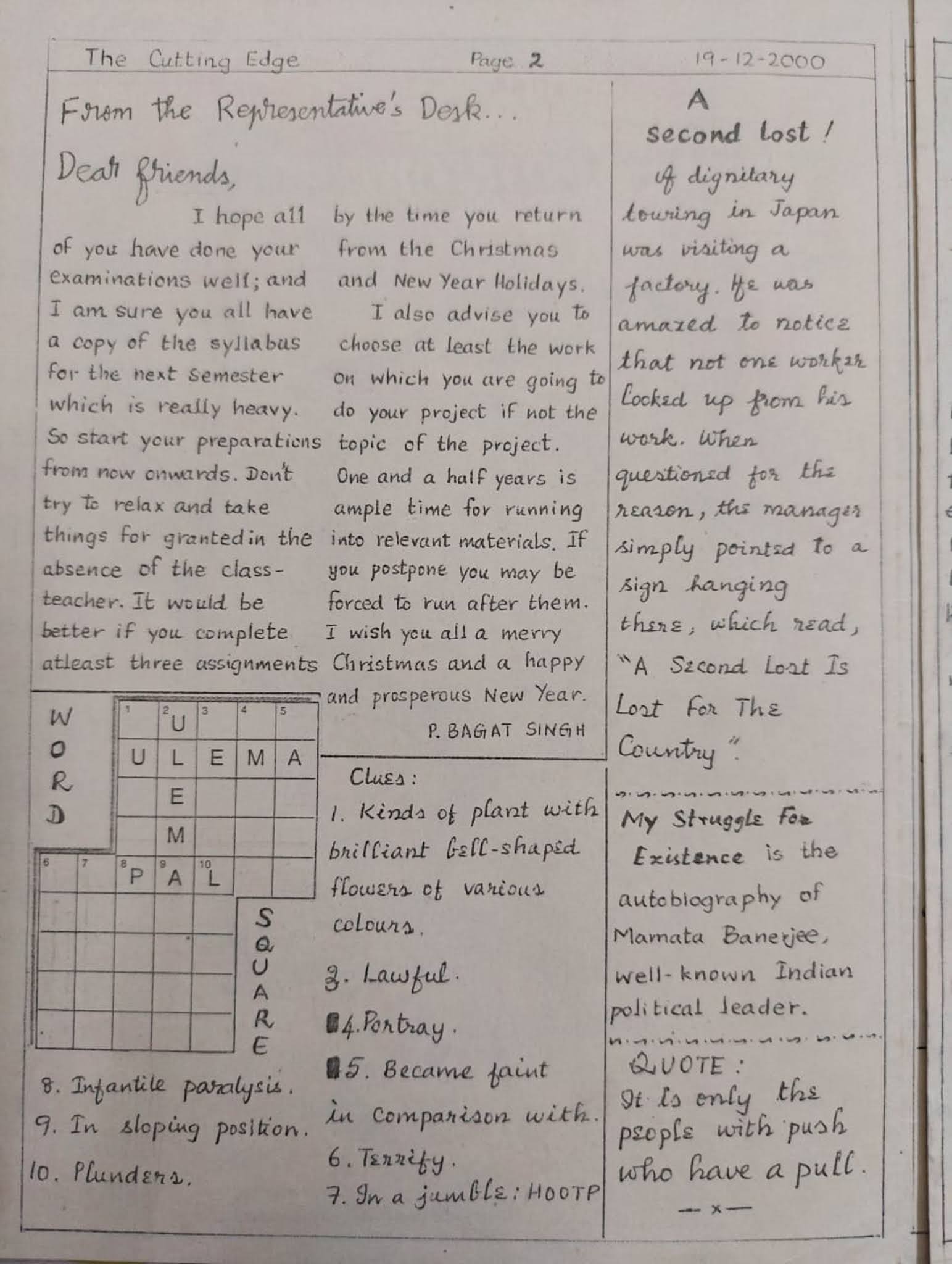
A Pre-Digital Era of 'Handwritten Magazines...'

Of the Class! by the Class! for the Class! 💛✨

A hand-written monthly magazine exclusively for our class! 😊

Well, this was during our PG days!

We were just 20 of us! A close-knit, vibrant class!

Back then, as students, when printing was beyond our reach, yet, as a class we wanted to celebrate literature in our own little ways, we came up with the idea of a class Mag!

It was a monthly magazine! 💛

With twelve pages of creativity from our class mates.

The Class Rep would share his observations in an epistolary style. All of us contributed some creative vibes or the other.

Some of our classmates were good at sports, some at music, and some others at pencil sketching!

This was in the pre-digital era for us, when Google and its cohorts were literally unheard of!

Sharing a few such memorable recollections from the past, here!


From the Class Representative's Desk

On the occasion of National Reading Day today!

Sports Achievers from our Class!

Wisdom magazine was a rage then!

Anecdote & Poetry Corner

 To be continued… 

Wednesday, 28 April 2021

Call for Papers for an Anthology on Science Fiction

 CALL FOR RESEARCH PAPERS

ON

SCIENCE FICTION

 Edited by

Dr. SURESH FREDERICK

&

Dr. SAMUEL RUFUS

Dear CO-RESEARCHERS!

We intend to bring out a Refereed anthology on Science Fiction.

The volume will be published with an ISBN (International Standard Book Number) by a renowned Delhi based publisher.

Authentic, scholarly and unpublished research papers are invited from researchers, Lecturers, Assistant Professors, Associate Professors and Professors from all over the world for this volume.


[A sample of our earlier publications with the reputed Author Press, New Delhi]
Guidelines for your Paper

Ø  Paper size: A4

Ø  Title of the paper: Sentence case (Capitalize each word), centered.

Ø  Font & size: Times New Roman 12.

Ø  Spacing: double line.

Ø  References: Please follow MLA Handbook strictly. Don’t use Footnotes, Use Endnotes

Ø  Titles of books: Italics.

Ø  Articles should be submitted as MS Word attachments only.

Ø  The paper should be around 10-20 pages in 1.5 spacing.

Each paper must be accompanied by

i)  A declaration that it is an original work and has not been published anywhere else or sent for publication 

ii) Abstract of paper about 100-200 words and

iii) A short bio-note of the contributor(s) indicating name, institutional affiliation, brief career history, postal address, mobile number and e-mail, in a single attachment. Please don’t send more attachments. Give these things below your paper and send all these things in a single attachment.

Mode of Submission

Each contributor is advised to send a full paper with brief bio-note, declaration and abstract as a single MS-Word email attachments to my email address: sfheber@gmail.com on or before 31 May 2021.

Selection Procedure

All submissions will be sent for blind peer reviewing. Final selection will be made only if the papers are recommended for publication by the reviewers. The details of the selection of your paper will be informed to you through email. The editor has the right to make necessary editing of selected papers for the sake of conceptual clarity and formatting. Each contributor will get a free complimentary copy from the publisher.

Monday, 1 March 2021

Congratulations Benitta...!

Media Misrepresentation vs Reality | Benitta Linjo Pozhil

Congratulations to Ms. Benitta Linjo Pozhil for having authored a very profound study on the Media Misrepresentation of the Neithal Community, in her book titled, “Media Misrepresentation vs Reality: Neithal Community through Kadal Adi”.

Giving us all snippets from the Foreword to this lovely book – Dr.Ganesh –

I am very happy to write this Foreword to the book written by Ms. Benitta Linjo Pozhil titled, Media Misrepresentation Vs Reality: Neithal Community through Kadal Adi. I have known Benitta for the past seven years and have had many opportunities to see her as a diligent and dedicated student, who has constantly striven for an interface between Literature and Life. This work by her is extremely germane both to the research world and the world at large as it foregrounds the plight and predicament of indigenous people, which need attention as well as redressal. The book states, with utmost clarity, the misconceptions perpetrated about the indigenous people.

The author brings out the meaningful connect between the landscapes and the indigenous people using the concept of Tinai as explicated in Sangam literature of the Tamils. She quite prudently locates a distinct group of the indigenous people, the fisher folk, with Neithal Tinai, a landscape associated with the seashore. Besides this, she positions the indigenous people within the geopolitical world called the Fourth World. Alluding to Shuswap Chief George Manual’s book, The Fourth World: The Indian Reality, this book deals with the language and culture of the indigenous people focusing on cultural memories and orality which preserves the memories.

The book, then, focusses on the indigenous fishing community which has inhabited this world since time immemorial. It convincingly traces the different trajectories of the lives of the Aboriginals using critical parameters such as Double Colonisation to argue that the non-indigenous be it individuals, governments or corporates have treated the aboriginals with disdain. The author implicates the media in the creation of false constructs with regard to the Indigenous peoples. The book also states that those who undermine these peoples do not realise that the distinct worldview of the indigenous peoples show them as a highly evolved people having consequential ties with the world of nature, which has become the bedrock of their metaphysical view.

The significant part of the book concerns itself with the novel Kadal Adi by Kurumpanai C. Berlin. Published in 2017 by New Century Book House, the novel, the book argues, is undoubtedly one of the best documentations of the Kanyakumari District fisher folk’s life. The book also argues that Kadal Adi is a subversive text that radically questions the false constructs regarding the fisher folk. The author brilliantly argues that the fisher folk share the characteristic features of the sea as they live in communion with the sea. In keeping with deep ecological principles, the book argues for the relevance and importance of the fisher folk in the mosaic of human culture. The book makes out a case for the fisher folk by sensitively appraising their lives and demolishing the false constructs regarding them. Kadal Adi, which is studied in this book, is indubitably a significant contribution to Indigenous Studies,

writes Dr. Ganesh.

On behalf of everyone of us at the Research Department of English, Madras Christian College, Chennai, we extend our congratulations to Ms. Benitta, and we also wish her many many more such delightful academic laurels in the years to come.

PS: Copies of the book are now available on Amazon Kindle, HERE.

Sunday, 21 February 2021

Painting Dreams...

Painting Dreams | Prof. Aparna

Imagine a book that paints beautiful dreams ethereal with the brush of positivity, using the vibrant colours of hope, happiness, love, and coffee?

Bliss of the highest order, ain’t it?

And that’s exactly what Prof. Aparna’s anthology of poems titled, Painting Dreams is all about!


‘Poetry is the language of the soul’, says Prof. Aparna. ‘It is also a magic pill that tranquilises the mind’, she adds, in her Editorial to this Anthology.

This anthology proves unique for any many reasons.

Firstly, the poems have been penned by poets from all walks of life – be it authors, professors, doctors, engineers, homemakers or students – you have them all here! Such a kaleidoscopic, variegated sprinkle of poetry of all hues makes this book all the more appealing to the reader.

Secondly, this collection is born of a passion – an intense passion for poetry. ‘As a poet I wanted to do something for the art form I love the most, and hence I wish to dedicate this book to the genre of poety’, says Prof. Aparna, on the reason behind this noble venture.

The Foreword by Dr. P. Jeyappriya, [Head, Department of English & Foreign Languages, Mother Teresa Women’s University, Kodaikanal, TN] also authenticates and attests beautifully to this ‘hope’ and ‘positivity’ quotient that pervades the length and breadth of this lovely poetry Anthology.

‘All the 53 enchanting poems by 49 effervescent poets brim with hope bearing witness to the resilience of the human spirit’, writes Dr. Jeyappriya on the Foreword to the book.

Thirdly, all the poems have been handpicked and curated meticulously in alphabetical order.

Right from Dr. Abdul Hadi’s call for having hope and positivity as one’s forte, every poem has a touch and a sprinkle of either hope or happiness or positivity or love or coffee to its texture!

Finally, the vibrant cover design, along with the excellent paper quality make it a delectable visual treat to the reader. 

Our heartiest congratulations to Prof. Aparna on coming out with this wonderful, inspiring book of poetry, and we wish her many many more laurels in the years to come.

Thursday, 15 October 2020

Congrats Christina!

Asena's Poetry | Christina Lawrence

Hearty congratulations to Ms. Christina Lawrence on launching her debut book titled, Asena's Poetry.

“The book offers an aesthetic appeal, exotic style and profound feelings promising true contentment, inner peace and freedom of thoughts. The poems are written in free verse and has a classic combination of poems to interest a wide range of readers. A book where you can celebrate your truest emotions!” says the blurb to the book.

We are so proud of you dear Christina on coming up with your debut publication.

We wish you many many more laurels and feathers in your cap in the years to come.

Interested readers, may order for yourselves a copy of the book at - 

https://notionpress.com/read/asena-s-poetry

Or at

https://www.amazon.in/dp/1636330819/ref=cm_sw_r_wa_apa_i_b7jAFbRJZ1FXP

Friday, 28 February 2020

An Amazing 'Canvas of Plenty!'

Down Memory Lane with Cornucopia!

Congratulations to Prof. DC and her vibrant team at the ELF for having brought out a pepped up vibrant version of Cornucopia – showcasing the creative vibes of our students.

13 December 2011, When the very first issue of Cornucopia
was released by our Principal in the presence of Shri Arjun C Bali

Takes me back down memory lane, to almost a decade ago, when we had back to back issues of Cornucopia, with Prof. DC doing the vibrant cover design and taking full charge of the host of articles of various hues, with beautiful, catchy titles for each and every volume! And yes! each issue was so unique in that, they had such an amazing splash of creative vibes from students present and past, who adorned the pages of Cornucopia with their talent aplenty! 

Cornucopia 2020 released yesterday!

And today happened to be such a memorable day, when Prof. DC gave me a pepped up version of a rejuvenated Cornucopia, done on a grander scale, with a committed, dedicated team to back her up in all her noble academic initiatives! Was so overjoyed to see such amazing talent dazzling through each and every page of this ‘canvas of plenty!’

Our Principal, flanked by our dear Ganesh Sir! [13 Dec 2011]

Way to go, team DC @ ELF! You rock!

Snippets from my little Prefatorial for y’all –

* Cornucopia has always been the pride, the delight and the creative domain proper of the Department of English (Aided) for almost a decade now. On this momentous occasion, it gives me great joy in congratulating team Cornucopia, on bringing out this lovely splash of creative vibes by our students. I also join all my lovely, vibrant colleagues in the Department of English (Aided) in appreciating Prof. Christina Dhanasekaran and her dedicated student team at the ELF and especially the student editors (Ms. Edwina, Ms. Shivani and Mr. Alan), for all their tireless striving in successfully bringing out this amazing ‘horn of plenty’. We wish team Cornucopia all success in all their amazing initiatives.

* From the Prefatorial note to the latest issue of Cornucopia

You may want to check out - 
A Report on the release of the very first issue of Cornucopia Vol. 1, HERE
The vibrant cover design of our back issue of Cornucopia Vol 3, HERE
A Call from Cornucopia, HERE

We hope to make available past issues of Cornucopia on the web quite soon!
In the meantime, please take some time off to read a sample past issue - July 2012 - of Eclectic Representations, a peer-reviewed International Journal from the Research Department of English, MCC, which we had uploaded online, HERE

Featured post

Upside-Down and Charmingly Unique | Meet the Velvet-fronted Nuthatch 💚

The Headfirst Acrobat | Meet the Velvet-fronted Nuthatch #intothewildwithrufus #birding The Nuthatch is one bird that’s fascinated me skyh...