Showing posts with label Movie. Show all posts

Tuesday, 12 May 2026

When Displaced Daughters Shatter Mirrors | in Bronte & Mani Ratnam ❤️

The Illusion of the Safe Space


When Jane & Amudha Shattered the Mirror

#mirrorsymbolism #reflections

The very first time I studied mirror symbolism with such meditative reverence, was while reading through Bronte’s Jane Eyre.

I had the privilege of teaching Jane Eyre way back in 2002, for the BA English Literature Class in American College, Madurai.

In fact, on hindsight, realisation dawned on me that, the novel sports one of the most famous mirror scenes in all of literature. 😊

Also, I’m in pure awe of Bronte for the richness of her symbolism - a masterful writerly Mani Ratnam of the Victorian Era! 

In Victorian literature in general, and to Charlotte Bronte in particular, mirrors were not just vanity objects. They served as rich psychological devices, representing the duality of human nature, the fracturing of identity, the soul, and the strict societal expectations placed upon individuals (particularly women).

Sample this scene in the Red Room in Chapter Two –

When she was just a ten-year old child, an orphaned Jane is unjustly locked in the terrifying Red Room. When she is alone in the room, she catches sight of herself in the “great looking-glass.” Instead of seeing a familiar child, she sees a strange, ghostly figure of herself in the mirror -


All looked colder and darker in that visionary hollow than in reality: and the strange little figure there gazing at me, with a white face and arms specking the gloom, and glittering eyes of fear moving where all else was still, had the effect of a real spirit...

The mirror reflects Jane’s profound sense of alienation and otherness. She feels disconnected from the wealthy Reed family and even from her own body. The reflection here represents the suppressed, rebellious spirit inside her that Victorian society deems unnatural for a young girl.

Now, let’s try and compare Bronte’s Jane with Mani Ratnam’s Amudha – ‘texts’ that are 155 years apart but still hold a lot of similarities between them.

Both stories host very young girls as their protagonists.

Jane is 10 years old, while Amudha is nine years old.

Both girls grapple with a fractured sense of identity!

Jane Eyre is a literal orphan, treated as an unwanted stranger in the house! However, Amudha who discovers that she is adopted only on her ninth birthday, is deeply loved by her adoptive parents. But still, this revelation shatters her known reality.

Like Jane, she suddenly feels she is an outsider in her own home.

For both protagonists, the realisation of their “orphanhood” triggers an existential crisis!

Interestingly, Neither Jane nor Amudha are passive victims of their circumstances; they are fiercely vocal and rebellious children who refuse to let adults dictate their reality.


When young Jane is unjustly punished, she famously erupts at her Aunt Reed saying –

“I am not deceitful: if I were, I should say I loved you; but I declare I do not love you...”

Amudha too exhibits the exact same fiery, uncontainable and indomitable spirit. When her parents try to gently manage the truth of her adoption, Amudha rebels. She runs away from home, and demands that her parents take her to Sri Lanka.

We find here that, both Jane and Amudha use their voice as a weapon against the trauma of their displacement!

Both girls hence, are out on a quest in search of the ideal maternal figure.

Similarly, both the ‘texts’ use the physical environment as psychological spaces to mirror the internal psychological chaos of their protagonists. (Remember the very first memorable line of Yeats’ ‘A Prayer for My Daughter’?

Mani Ratnam’s Kannathil Muthamittal also sports mirror symbolism in the beginning of the film – quite a regular and habituated trope for Mani Sir! 😊


There’s this intimate scene between Shyama and Dileepan – Amudha’s biological parents - which is mirrored for the viewers.

A beautiful piece of masterful symbolism!

It could connote the fact that the peace and the love and the intimacy which Shyama and Dileepan are experiencing now is painfully temporary, alluding to the fragility of their ‘real’ world, which is as fragile as a mirror!

Just as a mirror is easily shattered, their marriage, their home, and their lives are about to be violently shattered by the erupting civil war!

In that way, the mirror symbolism acts as a kind of visual foreshadowing of sorts!

The mirror here creates a temporary, almost illusionary safe space haven!

And that’s where Lacan comes handy for us  –

To Lacan, when a child first recognises their reflection in a mirror, they perceive a unified, whole self (the Ideal - I). However, this is a misrecognition, that masks the subject’s actual fragmented reality.

The “known reality” of Amudha’s safe Chennai upbringing or Jane’s initial, structured life at Thornfield are these Imaginary, mirror-stage illusions!

That’s hence, Lacan says that, one cannot stay in the Imaginary for long. The mirror must shatter for the subject to have an encounter with the Real – something that is traumatic, and something that disrupts our ‘constructed realities’ for us.

Well, to conclude then, both Jane and Amudha, are ultimately on a journey to resolve the trauma of their displacement and finally they find a true sense of home – by shattering the mirror – resulting in a beautiful transition from the mirror to the real!

One memorable quote that I love a lot, from the only Egyptian Nobel Laureate Naguib Mahfouz would – I’m sure – be the icing on the cake for this little post. So here goes –

Home is not where you were born; home is where all your attempts to escape cease!

Woww! 😊

Sunday, 10 May 2026

Why Did Divya and Devika Look into the Mirror? | From Mouna Ragam to Teacher 💜

Why did Divya and Devika “Look” into the Mirror?

#reflections


The mirror has always been an inevitable part of all good literature across the ages, endowed with rich symbolism, exemplifying the duality between the observer and their reflection - the divide between the ‘self’ and the ‘other.’

That’s hence, in literature and in films, characters looking into mirrors are often shown confronting their divided sense of self! The reflection acts as a doppelganger or the ‘Jungian shadow’ – symbolising a physical manifestation of internal guilt, hidden desires, or a fractured sense of self!

One reason why, feminist literary criticism looks upon the mirror as an instrument of the male gaze, and women in literature are often depicted as “trapped by their reflections”.

Now, let’s together do an analysis on how the mirror functions as a divide between the ‘self’ and the ‘other’, in Mani Ratnam’s 1986 milestone film titled, Mouna Ragam (Silent Symphony).

Yes, I am an avid fan of Mani Ratnam! 😊

Mouna Ragam follows the life of Divya, a spirited and vibrant young woman (privately grieving the tragic death of her former lover, Manohar), who is pressurised by her family into an arranged marriage with Chandrakumar. Not able to resist the marriage because of family pressures, she forces herself to marry Chandrakumar against her wishes and desires!


During her marriage rituals, the women surrounding her are busy taking care of the habituated societal rituals that connect with womanhood and marriage. However, Divya’s gaze is locked onto the mirror, entirely detached from the beehive of activity that’s happening all around her. The scene beautifully mirrors her own fractured identity amidst an environment that is trying to define and dictate her life for her.

After their marriage, she has to relocate to Delhi with her husband. Here, Divya remains emotionally detached from Chandrakumar, and inspite of Chandrakumar’s repeated attempts at being kind and empathetic to her, and even wishes to surprise her with a wedding gift, she shocks him by asking for a divorce as her wedding gift.


In this scene, we find Divya all alone in Delhi, curled defensively, clutching her knees and trying to look toward the mirror. Here, the mirror reflects a wounded individual forced to confront her own helplessness and alienation – her fractured sense of self!

In fact, P. C. Sreeram’s masterful cinematography deserves kudos here, for making the mirror come alive as an effective semiotic tool all through the film - to articulate the internal conflict, and the unspoken trauma of the protagonist, Divya.

I suggest that you watch the film to relive these particular scenes.


There’s also this mirror scene where Chandrakumar is shown standing at the dressing table while Divya is seen in the background – a beautiful picture of framing ‘psychological alienation’.

Rather than framing them side-by-side in the room, Maniratnam pans the camera towards the mirror to create this deep psychological distance. Chandrakumar is in the active foreground, preparing for the day, while Divya is relegated to the distant background reflection, appearing passive, withdrawn, and physically small. What a beautiful framing of “spatial alienation!”

The director here makes us visualise the profound disconnect in their shared domestic life. They are together in the reflection, but poles apart in reality, thus “mirroring” the vast psychological gap between them.


Towards the end, there are two redeeming scenes of the protagonist Divya. They capture a profound shift in the psychological transition from a sense of alienation to a profound sense of reconciliation. If you carefully observe here, you will notice that for the first time she smiles looking at herself in the mirror, and then she turns away from the mirror into reality!

What a memorable frame! 😊

Hats off to the director and to the cinematographer for these memorable frames!

Finally, coming to our next film –


I would like to analyse the 2022 Malayalam film titled, Teacher.

The movie Teacher is about the protagonist Devika a physical education teacher who is shown leading a quiet life with her husband, Sujith. One morning, she wakes up completely disoriented. As she pieces together the hazy events of the previous day, she makes a horrifying discovery -  she was drugged and sexually assaulted by a group of college students, who had also filmed the crime on their mobiles. The crisis aggravates when Devika finds out that she is pregnant. She eventually breaks her silence and confesses the assault to her husband. 

However, instead of offering his empathy, Sujith reacts with anger and disgust. Then, prioritising his family’s honour and reputation in society, he outright refuses to father the child and asks her to keep quiet rather than go to the police. However, Devika refuses to be a passive victim. She finds an unexpected pillar of support in her mother-in-law, Kalyani - a firebrand veteran activist, who encourages Devika to stop hiding in shame and to fight back against her abusers. Having externalised her rage and faced her trauma head-on, Devika realises her own inner strength. 

Quite interestingly, Devika from Vivek’s Teacher (2022) has a lot of interesting convergences and divergences with Divya from Mani Ratnam’s Mouna Ragam (1986).

Both Divya and Devika grapple with an intense internal conflict! However, what differs is the nature of the trauma and how they respond or react to it!


While Divya’s intense internal conflict
stems from unresolved grief over a lost love and the imposition of a forced marriage, Devika’s trauma is violently imposed through a sexual assault and a leaked video.

Hence, Divya’s silence could connote withdrawal and passive resistance, while Devika’s silence here could symbolise her sense of shock and shame at being violated.


Devika’s husband
tries to hush things up, thinking of his family’s reputation. This way, he lacks genuine empathy for his wife. In fact, he is attempting to make her “erase” her trauma without making her “face” the trauma!


Staring into the mirror then becomes an act of facing the trauma head-on, refusing to avert her eyes, in order to shatter the “victim” identity that’s been forced upon her.

The director, in a subtle and masterful frame, tells his viewers that, Devika’s healing cannot come through passive acceptance. She must actively face her deep sense of shock and shame that has been forced upon her, by transitioning from a traumatised victim into an active, vengeful agent. Her intense internal conflict is only resolved when she externalises her rage.


This frame here when she looks at herself in the mirror, happens just before she externalises her rage against her attackers.

To conclude then, whether it is Divya or Devika, as regards films, the mirror has always served as a rich hermeneutic space, reflecting the trauma of the divided self!

For both the women, the mirror is not only symbolic of victimhood, but also the pathway to healing, reconciliation, or reclamation or even rebellion, whatever the case may be, in order to piece themselves back together!

James Baldwin’s lovely quote I’m sure would be apt to sign off on this post -

Not everything that is faced can be changed, but nothing can be changed until it is faced.

Lovely, ain’t it? 😊

Friday, 9 May 2025

'The helping hand that guides you along... whether you're right ... whether you're wrong!' ❤️

Peter Pan | Film

On J. M. Barrie | & His Peter Pan

#onhisbirthdaytoday #mothersday

9th May 2025

In honour of Mother’s Day this Sunday (11th May 2025), today, we’ve got for us all a slice of life from J. M, Barrie, and his lovely creation - Peter Pan and his Neverland.

It’s such a sweet coincidence that J. M. Barrie’s birthday and Mother’s Day come so close to each other.

Well, Peter Pan has made such a lasting impact on the entire landscape of children’s literature. In Peter Pan, Barrie moves beyond the moralistic and didactic to weave an engaging story that embraces the worlds of fantasy, imagination and adventure.


In fact, Barrie’s works carry a strong sense of sentimentality in his portrayal of children, exploring themes like loss and longing, and the bliss of childhood!

There is a distinctive element of magical realism as well, that’s the hallmark of Peter Pan – something that makes the extraordinary feel believable, and the mundane magical!

I am sure we all musta sure watched Barrie’s Peter Pan (that was made into a movie - the good ol’ 1953 Disney’d version) who dances and flies around delightfully not only in the movie, but also in our little hearts as well, ain’t he?

Well, Wendy, the eldest girl of the Darling family, who lives in a quiet street, in Bloomsbury, London, gets so excited and delighted when Peter Pan appears at the window of her house one fine night!

And in the course of their animated conversations, when Peter asks her who’s a ‘mother’, she gives him, her delightful definition of a ‘mother’ –

Here goes the conversation between Wendy and Pan, Peter Pan -


Wendy: My name is Wendy, Wendy Moira Angela Darling.

PETER PAN: Wendy’s enough.

Wendy: What were you doing there?

PETER PAN: I came to listen to the stories.

Wendy: My stories? But they’re all about you.

PETER PAN: Of course. That’s why I like ‘em. I tell ‘em to the Lost Boys.

Wendy: I'm so glad you came back tonight. I might never have seen you.

PETER PAN: Why?

Wendy: Because I have to grow up tomorrow.

PETER PAN: Grow up?

Wendy: Tonight’s my last night in the nursery.

PETER PAN: But that means no more stories.

Wendy: (SNIFFLING) Mm-Hmm

PETER PAN: No! I won’t have it! Come on.

Wendy: But where are we going?

PETER PAN: To Never Land.

Wendy: Never Land!

PETER PAN: You’ll never grow up there.

Wendy: Oh, Peter, it would be so wonderful. But wait! What would mother say?

PETER PAN: Mother? What’s a mother?

Wendy: Why, Peter, a mother’s someone… who loves and cares for you and tells you stories –

PETER PAN: Good! You can be our mother. Come on.

And towards the end of their wondrous adventures in Neverland, Wendy yet again bespeaks to the grandeur of a mother!

When Wendy tells them all that they’ve to get back home to London, the boys are quite unhappy!

Wendy then gives them a beautiful discourse on a ‘mother’, to everyone who’s eagerly gathered around her, a sweet little discourse that’s iced with a wonderful song too!

[And when Wendy sings them all the song, even the inimical Pirate captain and his men who are eavesdropping on their conversation, are so moved to sobs and tears as she sings the song!]

Giving y’all the conversation sequence that leads up to the song -

Here goes -

Wendy: Oh for goodness sake. Please, boys. Do you want to stay here and grow up like - like savages?

Michael: Of course.

Wendy: But you can’t. you need a mother. We all do.

Michael: Aren’t you our mother, Wendy?

Wendy: Why, Michael, of course, not! Surely you haven’t forgotten our real mother.

Michael: Did she have silky ears and wear a fur coat?

Wendy: Oh no, Michael. That was Nana.

Lost Boys: I think I had a mother once. What was she like? What was she like? I forget. I had a white rat. That’s no mother!

Wendy: No, no, boys. Please. I’ll tell you what a mother is.

Lost Boys: Yeah tell us. Tell us. Please Wendy.

Wendy: Well, a mother, a real mother is the most wonderful person in the world. She’s the angel voice... that bids you good night, kisses you cheek, whispers ’sleep tight’.

Your mother and mine
your mother and mine
the helping hand that guides you along
whether you're right
whether you're wrong!
Your mother and mine
your mother and mine
what makes mothers
all that they are
might as well ask what makes a star!
Ask your heart
to tell you her worth
your heart will say
Heaven on Earth
another word for divine
your mother and mine!

John: I propose we leave for home at once.

Lost Boys: Could I go too, Wendy? Me too, Wendy! I wanna go!

Wendy: All right boys. All right. I’m sure mother would be glad to have you. Uh, that is, if Peter doesn’t mind.

Happy Mother’s Day folks!

Tuesday, 14 February 2023

"So think of this as time travel, from then, to now, to find out what you're missing out on..."

My Favourite Five for Today!

Well, I’ve always been a greattt fan of romantic comedies.

Yes, rom-coms have always been my cuppa of coffee anytime!

Of late, I should also admit that, I’ve got this fascination for watching thrillers [investigative thrillers in particular] as well! [thanks to some solid encouragement on the family front].

But but but… I’ve never taken a fascination for those evil-dead-like horror movies... nayver! 

Interestingly, my ward [just last year] did her entire thesis exclusively on Horror Movies, and I gladly gave her the go-ahead for that!

On an added note, well, I had to interview her a full hour to get to know what interested her the most about horror movies. And her answers were so persuasive and convincing enough! More power to her!

Pardon me if I’ve hit a slightly discordant note here. But but but... as for me and my heart, horror movies are nayver our kind! ;-) Even Pizza, that ‘pranky’ horror movie starring Vijay Sethupathy in the lead role, couldn’t gel well with the likes of my temperament. 

On an aside, you may want to read a very humorous take on this movie, that we colleagues in our Department, went along to watch in Mayajaal, on our past post here. 

Light-hearted comedies that double up as romances, where all’s well that ends well have always been my pick!

So considering the added inspiration on such a beautiful day as this, me thought of giving my favourite five movies of all time – that are also available on OTT platforms, I guess!

First and foremost –

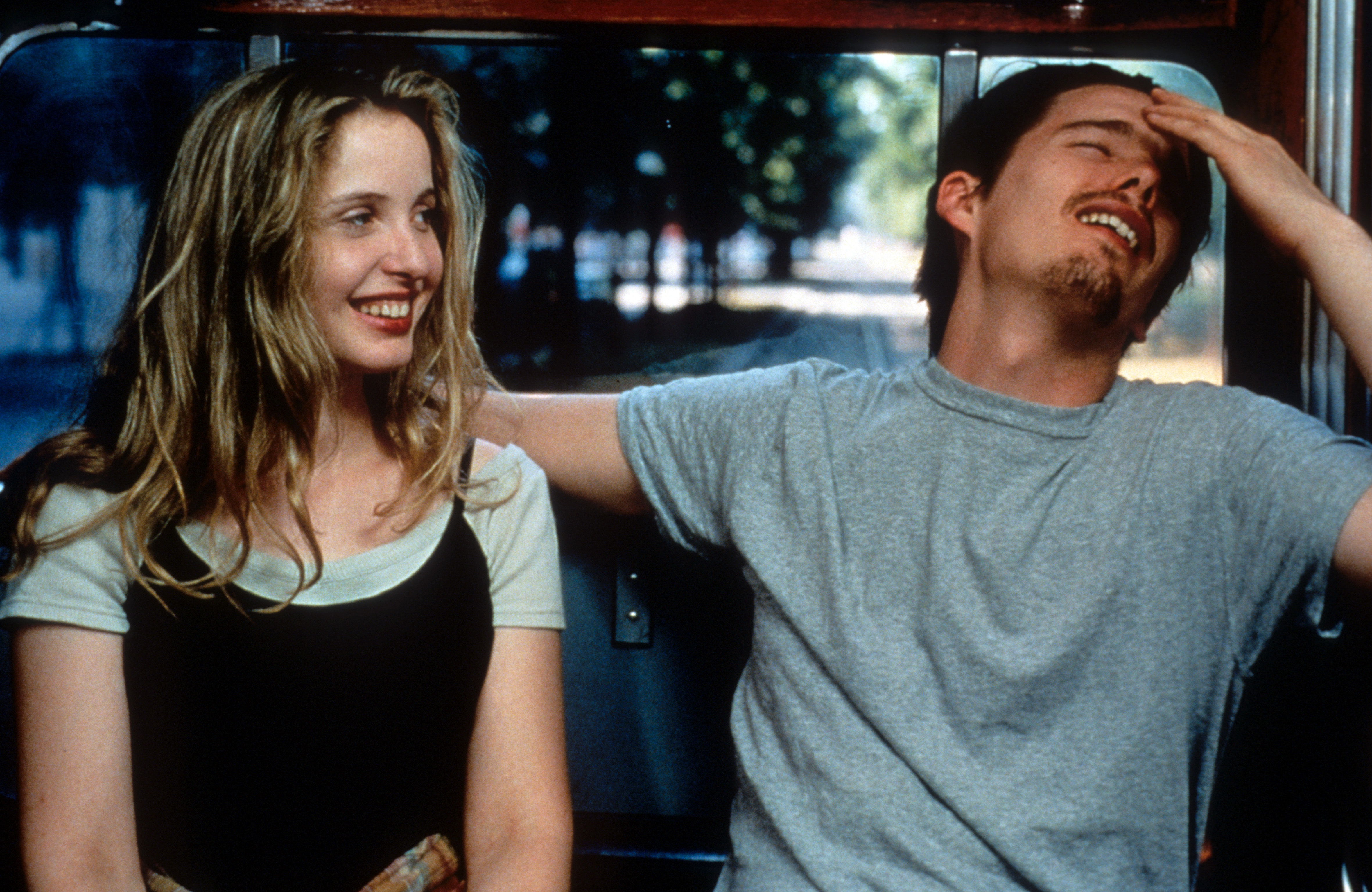
Before Sunrise!

What a movie! What a movie! A movie on this scale I guess can never be made yet again. Never!

A thoroughly romantic masterpiece with such amazing, awe-inspiring dialogues.

If at all there’s one movie that’s got just two characters all through the movie, who capture our attention and our hearts, just through their stunning dialogues, it’s Before Sunrise, hands down!

That amazing chemistry between Ethan and Julie (as Jesse and Celine) should be seen to be believed.

Sample these awesome lines from the movie –

Jesse : Alright, I have an admittedly insane idea, but if I don't ask you this it's just, uh, you know, it's gonna haunt me the rest of my life.

Celine : What?

Jesse : Um... I want to keep talking to you, y'know. I have no idea what your situation is, but, uh, but I feel like we have some kind of, uh, connection. Right?

Celine : Yeah, me too.

Jesse : Yeah, right, well, great. So listen, so here's the deal. This is what we should do. You should get off the train with me here in Vienna, and come check out the capital.

Celine : What?

Jesse : Come on. It'll be fun. Come on.

Celine : What would we do?

Jesse : Umm, I don't know. All I know is I have to catch an Austrian Airlines flight tomorrow morning at 9:30 and I don't really have enough money for a hotel, so I was just going to walk around, and it would be a lot more fun if you came with me.

And if I turn out to be some kind of psycho, you know, you just get on the next train.

Jesse : Alright, alright. Think of it like this: jump ahead, ten, twenty years, okay, and you're married.

Only your marriage doesn't have that same energy that it used to have, y'know. You start to blame your husband. You start to think about all those guys you've met in your life and what might have happened if you'd picked up with one of them, right?

Well, I'm one of those guys. That's me y'know, so think of this as time travel, from then, to now, to find out what you're missing out on.

See, what this really could be is a gigantic favor to both you and your future husband to find out that you're not missing out on anything.

I'm just as big a loser as he is, totally unmotivated, totally boring, and, uh, you made the right choice, and you're really happy.

Celine : Let me get my bag.

No spoilers though! Do watch this stunning masterpiece of a romantic movie!

The next four movies in line are –

When Harry Met Sally

La la Land

Notting Hill

The Notebook

(in that order).

Details for each to follow, when I get some added me-time on me.

For now, Before Sunriseeee!

Pic courtesy: IMDB

Thursday, 1 July 2021

Because of this ‘fallacy’, criticism ‘ends in impressionism and relativism’...

Affective fallacy & Titanic 🚢

#memoriesfromdiaries 💜

[01 July 1998]

Well Titanic ‘came’ to India in 1998! [although it saw a late 1997 release in the US].

The rave reviews for the movie, impelled us bigtime to go watch the movie! 

And hence with my friends Prabhu and Wesley, we had planned to go to Sippy theatre to watch Jack & Rose on board their Titanic!

But you see, at the last minute, Wesley said that he’s not coming with us, a decision for which he later ‘repented’ bigtime! 😋 That forms part of yet another story altogether!

In this diary jotting, I’ve given a super-naïve account of the storyline of the movie, without being aware of the class consciousness and the other key literary takeaways from the movie, that were to have an impact on me quite later on! 

Back then, it was the unalloyed ‘emotional effect’ of the movie on me, that mattered above anything else! 

Nothing more! Nothing less! 😍

I’ve also highlighted the word ‘moving’ that I’ve jotted down at least twice in the diary entry.

And well, this is exactly the bone of contention for our scholarly New Critics of the early twentieth century! 

They seem to ask,

Seriously? Do you guys really evaluate a work of art, (for them a poem!) based on its emotional effect alone? 

Don’t you guys have any better yardsticks for evaluating a work of art?

ask Wimsatt and Beardsley while formulating their own sweet principles for their ‘new’ school of criticism, called New Criticism!

But wait! Doesn’t our good ol' philosopher-guru Aristotle tell us - that the very purpose of tragedy is to evoke a sense of ‘terror and pity’ on us?

Doesn’t Edgar Allan Poe, a later bhakta of the aesthetic domain, talk about a work of art (in his case, poetry) as something that  ‘excites, by elevating the soul’?

W. K. Wimsatt and Monroe Beardsley gently and firmly beg to differ on that count!

Folks, listen, you guys are committing an error of the highest order, (an error of judgment) if you seek to estimate or evaluate a work of art (a text) on the basis of its emotional effects on you!

Come on folks, a work of art is pretty much above and beyond the emotional effect it has on you!

Let’s give criticism the rigour and respect of an objective validation that it rightfully deserves, they say, in such ‘full-throated ease!’

Because of this ‘fallacy’, ‘the poem itself, as an object of specifically critical judgment, tends to disappear’, so that criticism ‘ends in impressionism and relativism’, feel the duo!

To M. H. Abrams,

this doctrine enshrined in the principles of New Criticism then becomes a clarion call and a ‘claim for objective criticism, in which the critic, instead of describing the effects of a work, focuses on the features, devices, and form of the work by which such effects are achieved’.

Continues M. H. Abrams,

An extreme reaction against the doctrine of the ‘affective fallacy’ was manifested during the 1970s in the development of reader-response criticism.

To be continued…

Tuesday, 12 May 2020

'Our deepest fear is not that we are inadequate. Our deepest fear is that we are powerful beyond measure'

Akeelah and the Bee | Film

Yet another delightful treat, a visual one this time, on a child prodigy again, but with an unexpected turn and a twiddle towards the end!

Well, eleven-year old Akeelah is a seventh grader at a black middle school.

Her dad having passed away when she was just six, her mom Tanya works as a nurse to make ends meet.

Akeelah is often mocked at, in school, and hence feels a loner all along!

However, one of her teachers notices that Akeelah has an exceptional talent on her – a unique gift for spelling out even hard words quite effortlessly. Soon, even her school principal gets to know about Akeelah’s talent, and encourages her to participate in the spell champs to win laurels for their school!


But...! the only thing that prevents Akeelah from giving her best on her Spelling talent, is her morbid fear of the people around her – her school mates, and her community mentality where people don’t bother about each other at any point of time!

However, her elder brother Devon encourages her skyhigh on her talent –

- Hey, your principal called Mama. Said you did real good in the spelling bee last week. He said you got a lot of them right. He also said you’ve got an opportunity to go to an even bigger contest next week.

I don’t want to do it.

- Why not?

Everybody’s gonna be looking at me and there’s gonna be tons of words I don’t know.

Friday, 8 May 2020

'You have a gift for bringing joy and laughter to the world'

Bruce Almighty | Film

From Phil Connors the Weatherman in Groundhog Day, we shall now move on to have a little glimpse into Bruce Nolan in Bruce Almighty!  

Much akin to Phil Connors who is the Weatherman for the TV channel named WPBH-TV, Bruce Nolan is again, a television field reporter for Eyewitness News in WKBW-TV!

There are a few other striking similarities between the two, as well!

Remember the conversation between Phil and Rita in Groundhog Day that goes thus -

Phil Connors: I’m a god.
Rita: You are God?
Phil Connors: I’m a god, I’m not the God.

Well, in Bruce Almighty, quite interestingly, Bruce Nolan is asked by God Himself to play God!

The story in Bruce Almighty begins then, with Bruce portrayed as a greedy, self-centred and egocentric person, while his lady love Grace is shown as a positive, cheerful and caring individual! (like their counterparts in Groundhog Day)

One day, when Bruce is about to do a live report from Niagara Falls, news reaches him that his rival Evan has bagged the coveted role of anchoring the evening news.

Since he has had high hopes on the coveted post, he becomes quite vexed and dejected now! His vexation soon turns to anger. As a result, he loses his cool and blows his top, verbally abusing an elderly lady, and even the tour owner whom he was about to interview. His news channel promptly dismisses him from work.

Thursday, 7 May 2020

From being selfish, he now becomes selfless!

Groundhog Day | Film
The Story of Phil Connors, the weatherman

Tom Hanks counts among my top five actors of all time!

And that’s how I ended up watching ‘Groundhog Day’, mistaking Bill Murray for Tom Hanks, decades back! ;-)

Look alikes they seemed to me!

Actor Bill Murray as Weatherman Phil Connors
But trust me, it was a fortunate fumble of sorts, thankfully!

Back then, during our college days, when we watched the movie, no possible hermeneutic joy came out of it! We watched the movie, as we did, JC’s Titanic, just for the joy, the feel and the hang of it!

But later on, in the year 2004, as Course Teacher for a particular paper titled, ‘Experience of Literature’, I happened to screen the very same movie for my students, and asked them to give their own hermeneutical takes on it, giving them all further cues from Aaron Copland’s essay for hints!

The ensuing discussions that we had had, were quite interesting and engaging, by all means!

Wednesday, 6 May 2020

The Perfectionist vs the Optimalist...!

Balachander and Ben-Shahar
Neerkumizhi and Being Happy

‘On what criteria do you choose a film for watching?’ 

Friends quite often ask us this question, ain’t they?

And well, each of us has our own stock-replies to this question! ;-)

Well, for me, personally, I go by friend-recommends! :-)

From friends who double up as film buffs!

In like fashion, I chanced upon legendary film director K. Balachander’s directorial debut movie titled, ‘Neerkumizhi’ (Water bubble), that saw its maiden silver screen release in the year 1965.

Many things about the movie have so intrigued and captivated me! 

That’s because a lot of noble themes run concurrently in the course of this 2 hrs, 09 min and 21 sec movie!

No spoilers though! ;-) 

The movie begins with a famous football player getting injured while playing a crucial decider match, and is then admitted in hospital.

In the seventh ward of this hospital, where he’s admitted, a young and sprightly lady doctor walks up to all her patients and enquires about their health.

Then she comes up to the bed of the injured football player, Arun.

Arun is shown seated on his bed, and he looks quite dejected! 

The doctor then enquires if he’s had a good night’s sleep.

Arun replies with tears in his eyes that he’s not had a good night’s sleep for many days in a row, as he felt cheated at not being able to make it to the International match with the Russian football team due to his sudden injury.

The cheerful doctor then tells him with such positivity brimming in her words,


‘Mr. Arun, this world is like a beautiful book. And the book will not be of any use whatsoever, to a person who doesn’t want to read and understand it!

These words give hope to the footballer and he tells the doctor on a pretty hopeful note,

‘Doctor, if I get to play against the Russian team, I would be so very grateful to you for all of my dear life!’

to which the doctor replies,

‘Yes! you will not only play against Russia, but you are also going to captain the Indian team to Russia’,

she says with such conviction in her tone!

Featured post

Upside-Down and Charmingly Unique | Meet the Velvet-fronted Nuthatch 💚

The Headfirst Acrobat | Meet the Velvet-fronted Nuthatch #intothewildwithrufus #birding The Nuthatch is one bird that’s fascinated me skyh...