Monday, 10 June 2019

'Synchrony is the superhighway that leads to connection and to kindness.'


On Words | Personal Reflections – III

While taking some little time off to delve deep into a few interesting reads that connect with the power of words – both fiction and non-fiction, I chanced upon this lovable read from Brian Goldman, a veteran emergency room physician, who has had quite a highly successful career in ‘setting broken bones, curing pneumonia, and pulling people back from the brink of medical emergency.’ The book is titled, The Power of Kindness: Why Empathy Is Essential in Everyday Life.


I found it so very pertinent a read, more so, as it comes from the pen, the mind and the heart of a practising medical doctor! 

Yes! Although we’ve had the likes of Anton Chekhov, medical doctors by profession, who’ve given us some immortal classics in world literature, still, works of non-fiction from off the pens of such doctors, based on their professional acumen that speak from their rich experience, are quite few and far between!

But before taking the plunge, I would like to make special mention of three lovely people who were quite instrumental in putting down my thoughts on this post that gels well with the power of words in connect with ‘the power of kindness, and the power of empathy vis-a-vis medical doctors and hospitals!’

One is an amazing Professor friend, Dr. Archana Sardana, Head, Dept of English, Anna Adarsh College for Women, Chennai, who’d gifted me with such an intense read, written by a neurosurgeon - a book that, i should confess, has had a profound, transformative impact on my sensibilities altogether. I remember, Dr. Archana’s car driver driving down all the way through the mazy labyrinthine cityscape, with this lovely read on him, and calling me up at least four times before he could ascertain my location and hand it over (this life-changing read,) right in my hands, that particular evening, at around 7 pm, on 31 January 2018! 


The book is titled, When Breath Becomes Air and it was written by Paul Kalanithi, a renowned neurosurgeon who gets terminal lung cancer, and passes away, almost midway through the writing of this, his highly inspiring, moving memoir, which has been in the Numero Uno spot on the New York Times Nonfiction bestseller list for eight weeks in a row! An amazing case of a neurosurgeon turning to the therapies of literature, after learning that from thence on, after having been diagnosed with the disease, each and every breath has become even more precious for him!

After having earned two degrees in English literature from Stanford, Paul Kalanithi attends medical school, where he is weighed down heavily by the question, ‘What makes human life meaningful?’ And this pertinent question makes him take to the pathway to becoming a neurosurgeon, thus helping him see his profession less as a job and more as a sacred calling!

And hence he says with confidence, I don’t think I ever spent a minute of any day wondering why I did this work, or whether it was worth it. The call to protect life  -  and not merely life but another’s identity; it is perhaps not too much to say another’s soul  -  was obvious in its sacredness, he quips!

To cut things short, towards the end of the book he predicates how healthy habits for life, that are highly subjective in their very nature, like empathy, hope, love, striving and virtue are by all means higher and nobler ideals to life, than the ideals enshrined in science, which, though highly objective, and although it may provide us with the most useful way to organize empirical, reproducible data, is yet ‘unable to grasp the most central aspects of human life: hope, fear, love, hate, beauty, envy, honor, weakness, striving, suffering, virtue.’

The tears spontaneously trickle down your cheeks even as you read page by page into this so intense and so realistic memoir of sorts! I would say, each of us as humans, should really go through the pages of this wonderful book with pen in hand and a notebook for jotting down notes!

Thanks much to Dr. Archana, I also passed on this intense Paul Kalanithi read to a few other friends of mine who’ve found it such an amazing, life-changing read!

Bill Gates also endearingly writes about the book in his personal blog, by confessing in the title, ‘This book left me in tears,’ and goes on to add, in his review, ‘I was super touched by it, as was Melinda and our daughter Jennifer. In fact, I can say this is the best nonfiction story I’ve read in a long time.’

Coming back to the power of empathy and how doctors grapple with this wonderful concept in their medical life, Brian Goldman’s phenomenal read titled, The Power of Kindness: Why Empathy Is Essential in Everyday Life, is such a balmy read for the soul! An intriguing read meet for anyone who wants to be healthy, happy and be an empath!

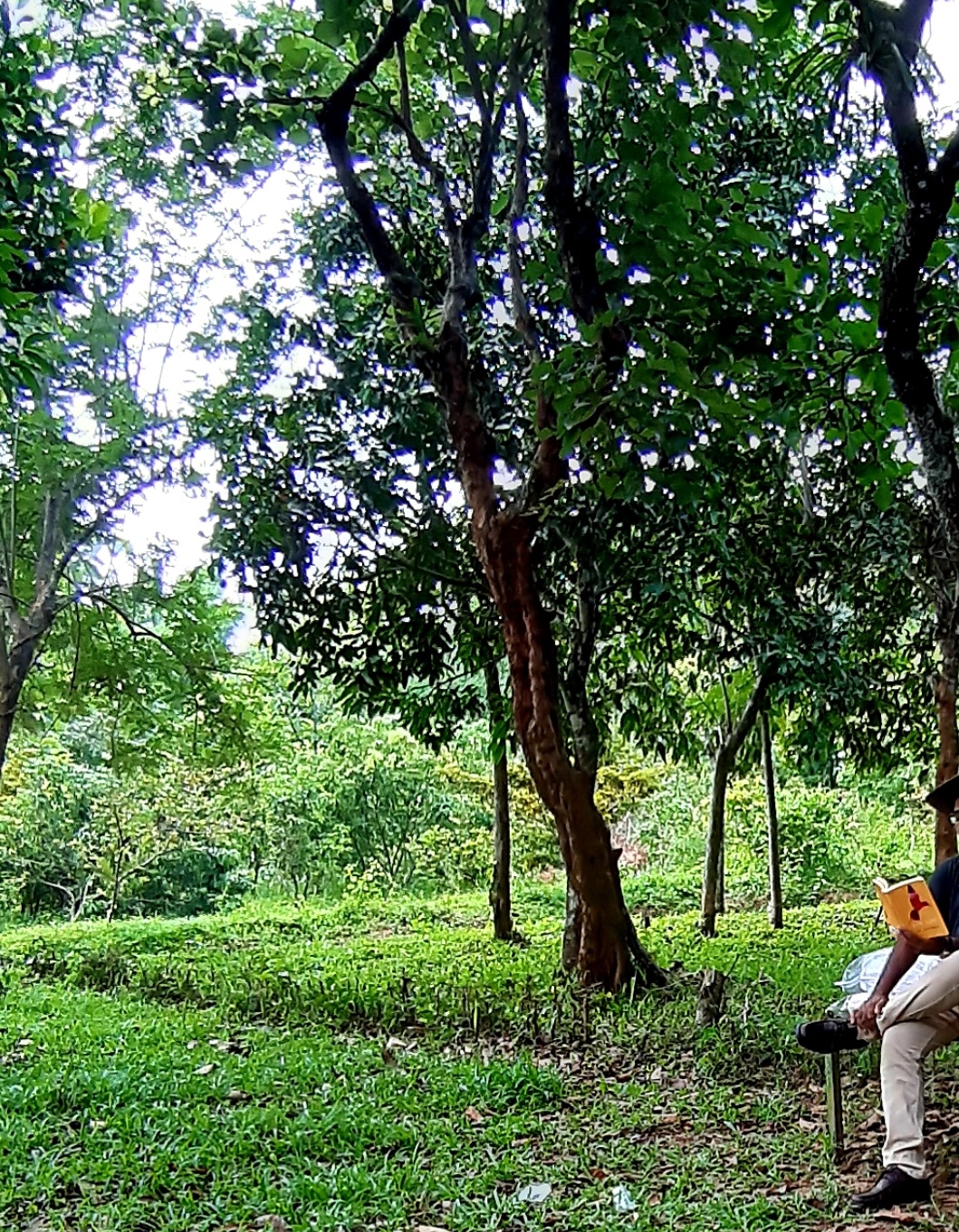
Mr. Madhuvalan is to the far right! Pic courtesy: Ms. Jenny
The second person I’d like to acknowledge on this post would be my cousin Mr. Madhuvalan, a software engineer based in Chennai. A couple of days back, at our little niece’s (CJ as we call her) birthday bash, on 08 June, where we had a memorable rendezvous with kith and kin, we both opened up on various topics galore, culminating in how one could possibly de-stress, and on the benefits of de-stressing! Mr. Madhuvalan is so passionate about the Aviation industry, and so he was waxing eloquent on how Air Traffic Controllers gain their mandated holiday time as ways and means to de-stress themselves, away from their humdrum, daily, habituated grind! He also added to say that medical doctors in particular, needed to de-stress much, as they also, in like manner, deal with the precious lives of their patients. One small stroke with the scalpel, under duress, would spell the difference between life and death, he quipped, talking about the importance of a de-stressing mechanism for people in the medical fraternity.

It is in this connect that Brian’s book assumes greater significance for me! Brian himself admits to the therapeutic effects of a de-stress for his medical career!

As a doctor, I have made plenty of mistakes, most of them due to a fatigue-related failure to make the right diagnosis, he admits!

Thank you Madhu brother! I'm so happy our discussions have proved so highly blogworthy!

Well, yes! Brian begins his book by asking a very pertinent question, that’s so intriguing and so highly validating!

‘Am I a kind soul?’ He asks!

He adds to say,

‘From what I’ve told you about myself, I sound pretty kind. So how come I’m asking? Because doubt has crept into me. I have felt this way for a long time. That I’m too stressed, too busy, too preoccupied with the errors I make at work and in life, too anxious and too self-absorbed to think enough about others to be kind to them. And I’m not alone. As I look around me, I see the same problem everywhere’ he quips.

Then he gives his yummy connect with the robusta, the barista and the bistro in tow!

Brian speaks -

You order a decaf latte. The barista repeats your order word for word. A minute later, he’s forgotten it and asks you to repeat it. When you finally pick up your beverage, one sip tells you he got it completely wrong.

What these and many stories have in common is lack of empathy.

It seems everyone has a painful story or two to tell. A recent study by University of Indiana psychologist Sara Konrath found empathy among today’s college students has declined by about 40 percent compared to their peers 20 or 30 years ago, with the biggest drop after 2000.
Then he opens up on the buzzword amongst developmental psychologists across the world today, on the topic of Interactional Synchrony, which I found so highly interesting!

Over to Brian -

The word synchrony means “a simultaneous action or occurrence.” For instance, it may refer to the matching of rhythmic behaviour between people. Synchrony is an important topic among developmental psychologists. In 1974, William Condon and Louis Sander published a groundbreaking study in the journal Science in which they observed the interaction between newborns and their parents. They found that as early as the first day of life, newborns move in sync with the sound of a parent speaking.

Interactional Synchrony in demonstration!
These are sample snaps from videotape recordings of two-three week infants.
The results have indicated that babies aged 3 to 27 days old
could imitate both facial expressions and manual gestures.
Later, Andrew Meltzoff from Oxford University and M. Keith Moore from the University of Washington demonstrated that babies as young as three days old imitate the facial expressions of their mothers. Thus, newborns mirror their parents’ faces, and their parents mirror theirs. It’s one of the earliest examples of what developmental psychologists refer to as interactional synchrony, an essential part of the process by which babies become attached to their parents.

Synchrony is also found in dance and music and in shared rituals such as chanting in church. If you have ever performed the wave at a baseball or football game, you have taken part in a mass example of behavioural synchrony. Similarly, if you’ve ever met someone and just clicked with them, you have experienced interpersonal synchrony. The next time you visit a coffee bar or a restaurant, watch twosomes who are seated together. It’s not hard to spot those who share synchrony; they’re the ones whose hand gestures and speech patterns mirror one another.  

Studies have shown that people in sync have stronger social bonds. They are more likely to empathize with and be kind to one another. This is true between friends and acquaintances. What may surprise you is that it is also true between therapist and patient.

Sunday, 9 June 2019

'Patience, Humility, Manners, and Taste - Spring from the Children of the University'

On Words | Personal Reflections - II

Before we begin on today's blogpost, let me profusely thank and acknowledge a wonderful feedback that i chanced upon today, on our blog's feedback form, from a passionate Professor of Literature! She had quoted from Atwood's lines, 'A Word after a word after a word is power', and had also added to say, 'Thank you for reminding us of the power of words and our responsibility as litterateurs to use words that refresh, replenish and restore!'


And this, dear ladies and gentlemen, would really be our blessed lifelines and lovely helplines in our tryst with literature, in this lovely literary life that we all have been so graciously endowed with! Ain't it?

We could also cherish them as the '3-R's for life and living, alley? (Words that Refresh, Replenish & Restore)!

If only we, practitioners of literature, would do our kutty-little-might, all through our literary lives, to use words that would refresh, words that would replenish, and words that would restore, how much better humankind could possibly be?

That said, let's now continue with added momentum on our series on the ‘powers’ vested within words, and on the virtuous qualities of words in ‘making’ others, not ‘breaking’ them!

Well, literatures from across the world, offer us on a platter, a plethora of such wonderful characters who encourage and motivate others with their positive calls to action! A sample of such characters and role models for us all, to get to know about the power of words and their wonderful way and sway in encouraging others to give their best!

Right from the days of the good ol’ philosophers and literary minds of yore, the power of motivation and encouragement have long been cardinal qualities that have shaped the advancement and the progress of great minds and hearts over the ages! Their calls to action, with their encouraging words, have always proved significant gamechangers in bettering and in transforming the quality of life in individuals from all walks of life! 

So much for the power and the vigour of positive words that go a long way in the ‘making’ (not the ‘breaking’) and the growth of an individual!

Seneca, the renowned dramatist of yore, was, as we all know, firstly tutor, and then advisor to Emperor Nero, during the first five years of his competent reign. His words that were, again, significant 'calls to action', have always had a very positive effect on the emperor. In his treatise titled, On Clemency that was prompted by Nero's murder of Britannicus, Seneca, gently persuades Nero to leave the path of bloodshed, and advocates the path of clemency or mercy as the path to virtue for a just ruler. (Remember Portia’s famed lines, ‘The quality of mercy is not strained?’]

To Seneca, then, extremes of punishment or torture were indeed the exact opposites of clemency, or mercy, and hence, he feels, leaders should try, as much as possible, to avoid it. [Leaders here could possibly connote to mean, any leader, be it in academia, government, sports, etc] It’s no wonder then that Seneca considered philosophy as a balm for the wounds of life!

On today’s post, we shall look into a contemporary of Booker T Washington, W. E. B. DuBois, and his wonderful work titled, The Souls of Black Folk, which is, till date, considered a cornerstone of African American literature!

After slavery was finally abolished in January 1865, African Americans started coming out of their repressive shells, and they subsequently began flourishing in the world of education, politics, business and commerce! Du Bois’s work The Souls of Black Folk is basically a ‘charter of encouragement’ for Black folks, replete with words of advice and wisdom!

Like Booker T Washington, who had made it mandatory that, when his students graduated from Tuskegee, they were to return to their hometowns, as transformed individuals, who are able to share with their kith and kin their newly learnt knowledge and best practices in agriculture, farming, breeding livestock, and taking care of themselves, DuBois too, in like manner, fervently encourages educated blacks to teach uneducated folks amongst their own community, as a means to empowering them.

In this connect, he's also coined a lovely term titled, “Talented Tenth!” (You may want to look up on our past post on Booker T Washington, HERE. And yes! like a Plato and Aristotle, or a Derrida and Ricoeur, or a Gandhi and Tagore, there were core aspects in which Booker and DuBois had huge differences of opinion! But that I guess, albeit noteworthy, should be meet for a different post, rather!)

The term ‘Talented Tenth’, then, to DuBois refers to educated black folks who would encourage their uneducated fellow folks to come up the ladder of success, through guidance, mentoring, care, and leadership.

Saturday, 8 June 2019

'Life appears to me too short to be spent in nursing animosity, or registering wrongs!'

On Words | Personal Reflections

“It’s only words,” sang Elvis live on stage to a rapturous, electrified fan audience in Las Vegas!

“What’s in a name? That which we call a rose / By Any Other Name would smell as sweet,” said Juliet with reference to the family name of Romeo.
 
“The human spirit thinks with words,” said ‘Spinozist’ Johann Gottfried Herder!

He adds to say that, “Words, by connecting passions with things, the present with the past, and by making possible memory and imagination, create family, society, literature, history. [. . . ] to speak and think in words is to ‘swim in an inherited stream of images and words; we must accept these media on trust: we cannot create them”.

To Vico, who came a generation earlier, again, ‘words’ or ‘linguistic forms’ are keys to the mental, social and cultural life of societies, present and past!

Indeed words shape us! Words make us! Words also break us! Such is the power latent within words! In short, words, carefully used, become the basic building blocks of a beautiful relationship too!

Such is the power, such is the lure! Such is the charm and such the grace contained within  our ‘words!’

This series, hopes to tap a wee bit into this grandiose power that lay behind ‘words,’ in their myriad facets and avatars, from literature to linguistics!

Cardinal Newman, like Stephen Leacock, and other educationists of his ilk, had his own ideals and ideas for a University. In this regard, he stood an opportunity to give a host of lectures on the topic, ‘The Idea of a University,’ in Ireland, way back in 1852.


And in this wonderful lecture series, Newman provides a powerful articulation for a liberal arts education. To him, the primary aim of education is to develop and to nurture the mind of the learner, and NOT to churn out information in chunks to the student. (And today, Google and Wikipedia combined, as we would all well agree, can do that with ease, much better than the teacher!)

In this regard, his definition of the term ‘gentleman’ has such intense rubrics that seek to bring out the power latent within ‘words!’

The first time I came across this wonderful definition to the term ‘gentleman’ was in a lecture class by late Dr. Ranjan Samuel!

Dr. Ranjan was such a passionate and committed professor who used to inculcate in his students a sense of discipline and decorum in such suave and elegant ways that highly endeared him to us all! Never once have we seen Dr. Ranjan getting angry with his students ever! His words were always so dignified and gentle! And he had in ample measure, what Bertrand Russell in his ‘Education and Discipline’ would call ‘tact’, and he also knew full well the Jidduji dictum that, the key to discipline is NOT in the hands of the teacher, but in the hands of the student! And so his classes always had an ennobling effect on the student’s conduct!

His refrain, in each of his classes was on the power of ‘words’ on people! Quoting Newman, he used to say,

‘A gentleman is one who never inflicts pain on anybody by his words or actions!’

How beautifully he’s summed up a gentleman for us all!

For more on his elucidations concerning the virtues of a gentleman, you may want to read from our earlier blogpost on Newman HERE.

Newman, as I further learnt, goes on to compile some indispensable attributes that qualify a person to be a gentleman!

‘The true gentleman in like manner carefully avoids whatever may cause a jar or a jolt in the minds of those with whom he is cast,’ says Newman.

‘He respects piety and devotion; he even supports institutions as venerable, beautiful, or useful, to which he does not assent; He is a friend of religious toleration, and that, not only because his philosophy has taught him to look on all forms of faith with an impartial eye, but also from the gentleness and effeminacy of feeling, which is the attendant on civilization.’

‘He never speaks of himself except when compelled, never defends himself by a mere retort; he has no ears for slander or gossip, is scrupulous in imputing motives to those who interfere with him, and interprets everything for the best.’

‘He is never mean or little in his disputes, never takes unfair advantage, never mistakes personalities or sharp saying for arguments, or insinuates evil which he dare not say out. From a long-sighted prudence, he observes the maxim of the ancient sage, that we should ever conduct ourselves towards our enemy as if he were one day to be our friend.’

‘He has too much good sense to be affronted at insults, he is too well employed to remember injuries, and too indolent to bear malice. He is patient, forbearing, and resigned, on philosophical principles; he submits to pain, because it is inevitable, to bereavement, because it is irreparable, and to death, because it is his destiny.’

‘If he engages in controversy of any kind, his disciplined intellect preserves him from the blundering discourtesy of better, perhaps, but less educated minds; who, like blunt weapons, tear and hack instead of cutting clean, who mistake the point in argument, waste their strength on trifles, misconceive their adversary, and leave the question more involved than they find it.’

‘He may be right or wrong in his opinion, but he is too clear-headed to be unjust; he is as simple as he is forcible, and as brief as he is decisive.’

What lovely qualities laid out for us all in a platter!

And herein, ladies and gentlemen, lies the skyhigh powers of real, ennobling literature. To make a person cultured, civilized, lady-like and gentlemanly, well-groomed in etiquette, dignified in bearing, gracious in manners, and their like.

Ample evidences abound in literatures from across the world, that connect to these lovely virtues exemplified by Newman, chief among which are the qualities of empathy, tolerance, peace, love, goodness etc in great measure!

Maya Angelou in her autobiographical novel, I Know Why the Caged Bird Sings, provides such intense and detailed descriptions of growing up black in a racist society.

Although, initially, she has a growing feeling of abandonment, very soon, even as she joins a bevy of such abandoned children, hunting down unbroken bottles and selling them, (with a white girl from Missouri, a Mexican girl from Los Angeles and a black girl from Oklahoma), she spends almost a month on the streets with these abandoned folk, who, as she later says, “set a tone of tolerance for my life.” 

Hence, her own pain of abandonment has made her extremely sensitive to the pain of other abandoned children around her, and to their emotional turmoil as well! And as the novel proceeds further on, Maya, gradually grows into a lady who could keep her dignity with such finesse, in the midst of insults and injustices, by her sheer perseverance and tolerance. So much so that, she soon starts feeling more comfortable being herself. Now she has evolved as a lady! She is no more the passive, reticent and shy girl that she once used to be! She is now, not a wee bit worried about how others perceive her, or look at her, because she knows with such convincing surety, who she truly is! (phenomenal woman, as she herself says!)

Charlotte Bronte’s Jane Eyre proves another paradigm for this virtue of tolerance! Indeed the power of Helen’s words are so therapeutic on Jane that they transform her life a full 360 degrees!

Helen and Jane
Jane, like Maya, again, struggles with a profound sense of loneliness and abandonment. It is at this point of time, in her loneliness, that her friend Helen’s philosophy of tolerance and her encouraging words act a great stimulus on the impulsive Jane!

At school, Helen is quite often taken to task by Mrs. Scatcherd for no fault of hers.

(On an aside, I should add that, Charlotte Bronte, in this intense story, has woven with such finesse and grace, amazingly valuable lessons for life and living in such great abundance for us all!)

So yes, coming back to Helen, although Helen answers with elegance some of the questions that even her classmates cannot, she is not appreciated or praised by Mrs. Scatcherd anytime. Rather, Mrs. Scatcherd picks on her for being dirty and disagreeable, and has her flogged quite often. But then, now comes out some invaluable lessons for life from Helen Burns to Jane.

Jane cannot comprehend Helen’s philosophy of tolerance at all. Jane hence says,

“If people were always kind and obedient to those who are cruel and unjust, the wicked people would have it all their own way: they would never feel afraid, and so they would never alter, but would grow worse and worse. When we are struck at without a reason, we should strike back again very hard; I am sure we should—so hard as to teach the person who struck us never to do it again. […] I must dislike those who, whatever I do to please them, persist in disliking me; I must resist those who punish me unjustly. It is as natural as that I should love those who show me affection, or submit to punishment when I feel it is deserved.”

Now Helen Burns comes out with her philosophy of tolerance, when she says,

What a singularly deep impression her injustice seems to have made on your heart... Would you not be happier if you tried to forget her severity, together with the passionate emotions it excited? Life appears to me too short to be spent in nursing animosity, or registering wrongs.

I can so clearly distinguish between the criminal and his crime; I can so sincerely forgive the first while I abhor the last… If all the world hated you, and believed you wicked, while your own conscience approved you, and absolved you from guilt, you would not be without friends.

So much for the power of words to ‘make’ people, not to ‘break’ them!

This transformative power of words, this therapeutic power within words, this healing balmy power within words, are the domain proper of any 'practitioner of literature!'

Friday, 24 May 2019

It’s something akin to living ‘others' truths’ versus living ‘your own truth’!

'An Interesting Process of Discovery' 

Practices of insightful, focused, intense and attentive reading have a lot of benefits galore for the avid reader! They not only help create personal and cultural insights for the curious eye, but also help gain for oneself amazing facets of imagination and invention beyond the utmost bounds of one’s ‘blinkered’ and ‘tinkered’ domains of knowledge!

James Joyce’s A Portrait of the Artist as a Young Man speaks to a similar story of the growth and development of its protagonist Stephen Dedalus in like fashion!

Each of the five sections beautifully portrays a portrait of how the artist in Dedalus evolves over a period of time, by walking ahead, in leaps and bounds, on the road towards knowledge and experience!

It’s something akin to living ‘others' truths’ versus living ‘your own truth’ by thinking and reasoning it out for oneself, outside the box, or something to the likes of thinking beyond the bounds of society’s truth, or a family’s truth, or a parent’s truth, or a friend’s truth, or a sibling's truth, or a religion’s truth, etc!

Once Dedalus (we should bring to our mind here, the fact that, Joyce himself once admitted that, he saw Dedalus in himself!) is able to reason out thus, and think ‘his own truths,’ all for himself, he is able to shape a reality of his own freewill outside the dogmatic axioms that have ‘constructed’ versions of realities for him thus far! Hence it is, that he sets out to create a theory of aesthetics that will manoeuvre life and living for him from thence on!

What a beautiful way of steering one’s life forward, ain’t it? And this he does, with such gusto, in his company of books and literature!

And through each stage of his crisis, his mental development, that moves on from innocence to experience, reveals to the reader, an interesting process of discovery that is at the heart of one’s reading!

Hence, thinking literature, reading literature, breathing literature, and feeling literature real helps in enhancing one’s own experience, enabling him/her to shape their own realities outside the dogmatized axioms, and to create theories of aesthetics that will help propel one’s life to realms thus far unfathomed and hitherto unknown to the rest of the world!

Like a gardener who is devoted to her garden, keeps thinking about it all of the time, and makes all her ‘spare’ time as ‘care’ time, tending to her garden, in the interests of her garden, a good reader too likewise, attends to his reading, much akin to the likes of gardening! With such dedicated attention, committed devotion, enriching the garden with all possible nourishment and cherishment all along! In fact, reading, like gardening, is then, a continuous process!

It is here that Med’s delightful takes on reading assumes such interesting significance for us all!

His tips, in this regard, are worthy of a hugey high fiveyyy!

Here goes from what Med has said -

If your learning requires that you do a great deal of reading, here are some tips to help you absorb what you have read:

1. Relate what you read to your own experiences. Slower, more accurate learning is often faster than a speedy effort. You would be wise to think of specific examples that will relate to your studies as you read, rather than just rush to complete each chapter.

2. Take a break when you feel the need for one. This often gives the information time to sink in.

3. Provide yourself with periods of relaxation after attempting some very ‘heavy’ learning. The more complete your relaxation the better, since upsets may cause you to fail to retain your new-found knowledge.

4. Stop studying when you get tired. Learning slows down when fatigue steps in.

5. Use every possible aid to help you absorb information. If possible, turn off the phone. If you are working at a desk, see that it is neither too low or too high so that your body must assume an uncomfortable position. 

Don’t use a chair that is too soft, because learning is something we usually consider a chore, and we may begin to doze off if the chair is too comfortable. Have a good reading light properly placed over your shoulder or over the desk and focused right on the paper. Remember, too, that a temperature of 68 – 70 degrees with humidity at 50 per cent is best for you to stay alert.

6. Your pencil or pen can also be a very valuable study aid. As you read, underline what you think important. Underlining offers you two major rewards. First, you are compelled to stay mentally alert so that you are more apt to find the important. Second, underlining helps you review. The underlined high spots are quickly spotted and digested.

Thursday, 23 May 2019

You can acquire the knowledge of any expert for the simple price of a book!

Don’t Ever Stop Learning!

In this lovely excerpt, Med Serif exhorts us to take full control of our lives by having the eagerness and the desire to learn something new all the way, all through our days!

So let’s call upon Med, to do the talking from here on!

Remember that old notion, “You can’t teach an old dog new tricks?” Well, it’s just not so.

No matter what your age, you can continue to increase your store of knowledge. This is an extremely important ability today because learning does go hand-in-hand with success.

Take a New Look

The first step is to rid yourself of the idea that once you have finished formal schooling, whether at high school or college, your learning is ended except for improving your immediate job skills.

Nothing could be further from the truth. Educators tell us that one of the most desirable times to learn is the period between twenty and forty. But you needn’t stop at the forty mark. If you have the desire to learn and if your learning skills have been kept in reasonably good working order, there is no reason why you shouldn’t be able to learn well beyond the age of forty.

There are three simple guideposts to learning, according to Med!

1. You must want to learn.
2. You must set goals for yourself.
3. You must use every possible technique of learning.

You Had the Desire to Learn

Remember when you were a youngster. You knew the batting average of every member of your favourite cricket team and those of every other leading star.

It was quite easy for you to remember these names and numbers because you wanted to. This is the important secret for learning. By pinpointing your reasons for wanting to master whatever knowledge you need, you’ve given yourself the desire to forge ahead.

Treasure House at Your Fingertips

Books can be real treasure houses of knowledge for you in your efforts to gain knowledge. Currently, many hardcover and paperback editions are available to the learner.

You might as well say that these are your 'personal consultants.'

How true he proves! ain't he?

For a few dollars, or in some cases dimes, you can put the knowledge of the experts at your fingertips. None but the very largest business organizations can afford to hire all the consultants they need. You can acquire the knowledge of any expert for the simple price of a book.

to be contd...

Monday, 20 May 2019

'Wouldn’t it be wonderful to read all those books and publications as soon as they arrive?'

Successful people says Med, are the ones who have learned how to make time ‘work’ for them!

Med, or Med Serif is, as we all know, the author of How to Manage Yourself!

While reading through each line and each page of glorious snippets on time management from Med, I’m so reminded of those immortal lines we all have gotten on our minds from Shakespeare’s Macbeth!

To-morrow, and to-morrow, and to-morrow,
Creeps in this petty pace from day to day,
To the last syllable of recorded time;
And all our yesterdays have lighted fools
The way to dusty death.

Yet another connect would be from Eliot’s “The Love Song of J. Alfred Prufrock,” which brings out the character of Prufrock, who ‘stills’ time, or seeks to arrest the progress of time by never choosing to do anything! Although he seems to grow old, he cannot yet make up his mind! He does not have the necessary courage to act, or to do anything, anywhere, anytime in his life! Rather, he remains a mere passive observer than being a steward or an agent to his own life! Therein lies the overwhelming question of Prufrock: 

Do I dare Disturb the universe?  In a minute there is time For decisions and revisions which a minute will reverse.

How true these mighty lines mean today, decades after they’ve been published!

Just let’s sit back and well, let’s look back on how many times we’ve remained such ‘passive observers’ to what’s happening to our very own lives, subtly entangled in a virtual reality, blissfully unaware of what we’ve really got to do with our precious lives, what with our technological gadgets in hand, whiling away our ‘times and tides’ on all these trifles, that are absolutely inconsequential, inessential and immaterial to our lives in any way, whatsoever! 

In this process of hip, hop, jump and skipping reality, we don’t seem to realize the truth that ‘the one thing that’s really needed’ seems to have taken a huge backseat in our lives! Like Prufrock, we’ve become mere passive observers, than being stewards or agents to our own precious lives!

In this respect, let me share with y’all a wonderful mail that I’d received from one of my students this last week! He had just mailed me to tell me that he has quit a couple of social networking sites, because he felt that he was wasting more than five hours a day on mere trifles that did not mean a thing to the advancement of his goals and achievements! And he listed out a whole number of reasons for his robust resolve, that were so convincing and so in tune with the techno-bakhta (techno-buff) scenario of today's!

In fact, on a similar vein, I remember reading a book that promotes a digital detox, where the writer beautifully brings out this exact awareness! To him, social networking sites like, for instance, facebook or an instagram, pander elegantly to cater to our pleasure, only by making us feel an ‘inherent lack’ deep within us, which, say the zuckerbergs, could be remedied, redressed or addressed only by accessing their ‘therapeutic’ networking sites! However what they fail to tell us is the candid truth that, these social networking sites, that make us consume ‘random pieces of content’ to their own advertisement-driven will and wish, churned out by the minute, and by the hour each passing day, 24 x 7 of our lives, take quite a great toll on one’s mental health!

The simple reason why facebook makes people sad, is when, at that very moment, when they realize, after surfing through its hundreds of posts, that they’ve wasted their productive time in such unproductive trifles. This in fact, makes them sadder and badder each passing day!

Social comparisons of the lived realities of their facebook friends, also led to heartburns, especially when their friends take pride in posting/sharing vacation clicks, dine-outs, selfies and snaps of group picnics et al on their walls! These comparisons led to added depression and failing mental health, experts opine!

In that respect, full plaudits and kudos to this resolute kid of ours, who’s taken a single step, a sure step and a convincing step towards securing his dynamic future in such a noble way, away from unproductive trifles, that have thus far had a debilitating sway over his mental health in the long run!

I for my part, gave him a host of activities that could make him keep tuned to a beautiful reality far far far away from this sickening, maddening, addictive virtual reality!

In this regard, Med Serif’s book, How to Manage Yourself, although written almost four decades back, prove such an invaluable fall-back option for today’s techno-driven society that so innocuously whiles away such precious time on mindless trifles!

It is here, that Med seeks to highlight the fact that, highly ‘successful people’, have proved time and again that others can also learn how to make the most out of each working day!

When you achieve this peak, of amazingly managing on your time, you need no longer fear those Friday or Saturday afternoons with a pile of work left undone, he adds! Time has now become your servant. No longer are you a time-killer!

Med then proceeds to give out his invaluable inspirational nuggets on how to acquire more time, or ‘more hours to our day’!

He says –

You can acquire more time. Yes – time, like any commodity, can be bought!

Here are some helpful hints from Med for us all –

1. Get up fifteen minutes earlier to avoid the morning rush and also streamline the procedure for getting out of your home. You can do this by keeping your personal items grouped together, ready for use. It’s also a help to decide the night before what to wear and to have your clothes laid out. You will arrive at work feeling much more relaxed when you eliminate morning fumbling.

2. Increase you reading and writing skills. Wouldn’t it be wonderful to read all those books and publications as soon as they arrive? You can learn to increase your reading speed too, this way, he opines!

3. Develop the habit of making good notes. Store your ideas, facts, figures, and bits of information. Keep reference files and tickler files to guide you in your everyday activities. The good note-taker finds that she can drop even the biggest problems and come back later to pick up the threads without wasting time trying to remember facts!

Featured post

Reflections on a PhD Defence | Climate Positionalities and Malayalam Cultural Mediations ❤️

Localising the Climate Crisis Through Kerala’s Flood Imaginaries #PhD-Defence #IITM 29th July 2026 | 4 pm Today, I was happy to be a par...