Wednesday, 21 July 2021

One small misstep! And hey presto! You are with St. Peter in heaven! 😄

 21 July 1997 | Main Guard Gate!

 #memoriesfromdiaries 💛

The Main Guard Gate is situated in the heart of Tiruchirappalli City!

I am told that it is also a protected site of the Archaeological Survey of India (ASI).

The Main Guard Gate is a shopper’s paradise too! You can sure get for yourself something of everything once you successfully manage to cruise your way through the narrow, crowded alleys and the by-ways of Main Guard Gate.

The Main Guard Gate also provides an entrance to the beautiful Rock Fort Temple, that’s over 272 feet in height.

And from atop the Rock Fort Temple, you are assured of a panoramic, 360-degree view of the entire city, which includes a host of famous Colleges in and around the vicinity!

Hence, an outing to the Main Guard Gate also included – by default – a jaunt atop the Rock Fort Temple as well! 😍

a 1997 file photo of the four of us, atop the Rock Fort Temple! 

Back then, call it the heights of adrenaline rush if you may, 🙈 we used to get down to those pretty dangerous slopes of the Rock Fort, to try and get a snap for ourselves on those good ol' Kodak KB10 film cameras! 

One small misstep! And hey presto! You are with St. Peter in heaven! 😄

Thankfully, those dangerous slopes have been cordoned off (barricaded) now!

Coming back - 

Yes! we got almost all our College Texts at a few of the amazing Book Shops - in and around the famed Main Guard Gate - which included International Book House, Higginbothams, Palaniappa Brothers, New Century Book House, etc.

On this particular day, I bought Orwell’s Essays, E.M. Forster’s Essays, and a host of NCC paraphernalia, (for our NCC Parades) in the book shops in and around the vicinity of Main Guard Gate.

Coming back to the next diary entry,

Since a few of us had opted for French as part of our Part I requirements, we headed straight to the library during our Tamil classes.

Today we had a condolence meeting in the last hour to the memory of a II BSc student who passed away in a Bus mishap near Tirunelveli - a few days ago - on 18 July 1997. 🙏🏻

We also had a new inmate added to our room today! [Already we were three of us in our room]. (No.40) Now we warmly welcomed the fourth inmate to our home away from home! 🤗

'Every event or incident had lasted only for a brief duration of time...'

21 July 1994 | Time, Diary & Memory

#memoriesfromdiaries 💛

‘Time’ plays a pivotal role in our everyday routines, ain’t it?

Added, we as human beings find it quite easy to remember and recollect events through a sequential ordering in time, ain’t we?

By sequential ordering, I mean, an event that comes before, or an event that comes after another event!  

Let’s call it the temporal sequence!

More on temporal sequencing, after this long time ago’s diary entry is done! 😍

So here goes the diary entry for the day –

Morning [in Temporal Sequencing]

5.25 am – Waking up & Jogging, Gym

5.55 am – Coffee

6.30 am – Study time

7 am – Routine cleaning of the Cubicle, stacking up the books in a neat fashion, and off to school.

II & III hrs – Botany Class & Lab

Afternoon [in Temporal Sequencing]

PT Class (Substitute for Math)

Botany Class

PT Class (Substitute for Math)

Evening [in Temporal Sequencing]

Swimming

[A burning sensation in the eyes because of excessive chlorine in the Pool]

5.35 pm – Ring up my Chithi

6.30 – Study time

7.30  - Dinner

8.15 to 10 pm – Study time

10 pm – Go to bed

A temporal sequence then refers to the order in which events unfold in time.

Through this particular day’s diary entry, let’s learn a few interesting ideas connected with ‘temporal sequencing’ in connect with the concept of Time!

Well, each of the events that I had jotted down on today’s diary entry, (27 years ago), has had a ‘temporality’ a ‘temporal structuring’ and a ‘temporal sequencing’ to it, ain’t it?

In other words, every event or incident had lasted only for a short time or for a brief duration of time.

As such, what was ‘being represented’ possesses a certain fundamental temporal quality on them!

To Kant,

This notion of temporality is fundamental to perception!

Says he, in his Critique of Pure Reason –

I perceive that appearances follow one another, that is, that there is a state of things at one time the opposite of which was in the preceding time.

Thus I am really connecting two perceptions in time.

Now connection is not the work of mere sense and intuition, but is here the product of a synthetic capacity of the imagination, which determines inner sense with regard to temporal relation.

But imagination can combine the two states in question in two ways, so that either the one or the other precedes in time; for time cannot be perceived in itself, nor can what precedes and what follows in objects be as it were empirically determined in relation to it.

Hence to Kant, there is a temporal structuring, and a subsequent temporal sequencing to perception.

Which means to say that, all percepts (or objects of perception) are represented in a temporal sequencing (as in the case of this diary entry), as –

Percepts that are about to happen, percepts happening right now, and percepts having already occurred in a sequenced succession.

To Kant, again, this ‘flow of experience’ is effected only by the ‘faculty of imagination’!

Adorno, who adores Kant, also waxes eloquent on this question of transitoriness and ephemerality, and its relevance to human subjectivity and experience.

To Adorno’s mentor Walter Benjamin, again, what is ephemeral is the real!

Let’s continue to talk Time…!

Tuesday, 20 July 2021

'We believe that the world has 7 billion talents rather than 7 billion issues...'

20 July 1994 | A Sundal by Any Other Name…

#memoriesfromdiaries

Woke up at 5.35 am. [konjam late by warden’s yardsticks] 🙈 

Went for jogging and then to the gym with my friends. 

Then had coffee! 😋☕

Warden wrote down the names of those of us who were late by ten minutes, and later fined us Rupees 5/- per head! [mea culpa]

20 July 1994

Had continental breakfast today!

By 8.20 am, went to post letters. [Those were the good ol’ days of writing letters, ain’t they?]

Came back for our PT class, which was then followed by,

a musical performance in our Auditorium – by the Masterpeace Team!

Just today, with some added curiosity, I looked up the web for more on the Masterpeace team.

Their portfolio looks so catchy and inspiring! It says –

We believe that the world has 7 billion talents rather than 7 billion issues.

Therefore, we use the SOFT POWER of music, art, sports and play to mobilize and inspire young people.

We believe that there is more that we have in common than what separates us.

Therefore, we organize DIALOGUE within and between communities and stakeholders.

Beautiful, ain’t it?

Coming back -

After their mesmerizing performance, I went up to them, all excited, and got their autographs on my slam book!

Last period in the morning session, we had Chemistry.

Post-lunch session, we had Physics Lab, followed by Chemistry class.

Evening had Sundal and Tea! 

Then sat down for writing Class Work!

On this particular day, we had dinner with biryani on the menu.

[One interesting idiosyncrasy I had on me back then was, up until I began my college days, I had a great aversion of sorts for the lovely biryani. Don’t know why! So please don’t ask me why! 😋

Even back at home, when Amma used to make biryani for all of us, she used to make curd rice exclusively for me, since I had some unfounded aversion for biryani back then!]

On this particular day also, I judiciously skipped the biryani part, and had extra curd rice! 🍛

As regards Sundal, I’ve jotted down the entry in its original form – Sundal - simply because the English equivalent did not come to mind back then! 😄Now I realise that the English equivalent isn’t that appealing or appetizing enough, as well! 😋

For a little literary connect - 

Well, I remember reading the word ‘Sundal’ in its pure sundal-ised form for the very first time only in Rajam Krishnan’s novel titled, When the Kurinji Blooms, translated into English from the Tamil original titled, Kurinjithen.

Interestingly, Rajam Krishnan had penned a lovely article for our Department’s Journal, back in the 1990s. The article is titled, “Woman and Family in Literature”.

From English: A Research Journal, 1993


Monday, 19 July 2021

'Those beautiful, harmless joys of college life that happen just once in your entire lifetime, you see!' 😍

19 July 1999 | Pranking Our Warden! 

#memoriesfromdiaries 😍

Now for the first diary entry of the day - 

Back then, a few of us hostelers used to have handy bicycles on us, for that little added convenience.

And so, at times, day-scholars used to come all the way to our hostel abodes, to get our bicycles for their little added convenience!

And we quite gladly obliged them!

Carter (who is also presently Professor in our very same Institution), had come all the way to our hostel, to ask for my bicycle!

As regards the next diary entry,

Wes & I, we always longed for our evening time rendezvous at Chinthamani!

That’s because to us, our Chinthamani Cuppa time with the sweet boli they gave us was almost a foretaste of a kinda mini-heaven, back then, during our own hostel days!)

So we used to go to Chinthamani, only after taking a lovely bath, and that too, in our best attire!

One reason why, this particular evening, when a friend in dirty shorts wanted to join us on our cuppa, it kinda didn’t augur well for the two of us! 😋 

Coming to the last diary entry of the day - 

Well, you see, our evening study times were always such joyous fun times for all of us hostelers! 😍

Come study time - every other evening - we had a trick up our sleeve, as part of our entertainment network’s daily productions! 😃

On an aside, let me also tell you dear reader, that, Prof. Prasanna, our Warden, although quite gentle and lovely in disposition, was a very strict disciplinarian of sorts in general! 

He would never allow anyone to walk around, or talk around anytime during our study time!

Such was the solitude expected of each one of us during our study times! Those quiet private times, when you weren’t even allowed to move an inch from your decked-up study desks!

Now, on this particular day, we three of us, had made a mannequin scarecrow that was made in the imitation of ‘one’ of our hostelers; we then proceeded to put ‘him’ to sleep on one of our beds, and that too, exactly when study hour was about to start!

And for that extra effect, we had 'him' covered with one of our bedsheets as well!

Our dress rehearsals were a huge success by all means, you see! 😋

That’s because we three had just then succeeded in effortlessly tricking a few of our friends into believing the ‘scarecrow mannequin’ person for a real flesh & blood hosteler! 😄

After tasting this, our initial success, we were waiting with bated breath for our ultimate ‘grand finale’ of sorts – for our warden to turn up and ‘enquire’ about the ‘person’ sleeping during study time! 😉

With some little excitement and quite a lot of lubtub, we three were waiting for our daring stunt to achieve closure – and as quick as possible!  

Up came Prof. Prasanna – after taking attendance in the other rooms in such paced progression; he then had his allotted ‘stop-over’ quota at his next ‘destination’ - our room no.133, 🙃 and glanced his usual eye-full into our room! 

‘Are you guys studying well?’ he enquired in his inimitable nonchalant ways!

‘Yes sirrr…’ we answered back in chorus with an equal mix of anxiety and excitement spread all over us! 😳

Then happened that ‘long delayed, often longed for’ moment!

‘Who’s that, sleeping?’ he asked, in a harsh, dissonant tone! 🙃

Not being able to hide it any longer, we blurted out in a very apologetic tone,

‘Sir, it’s just a scarecrow mannequin we had made, and it was just to play a prank!’, said we, with such a sheepish smile writ large on our chin-downed faces!

Thankfully, for us, he took it in a very humorous vein, smiled a surprised smile at the sleeping guy, and asked us to ‘dismantle’ him!

We obliged! 😇

The moment he left, we three looked at each other with such victorious smiles of glee dancing on our faces, and soon went on celebration mode, joyous, jubilant and exultant at having pranked even our warden! 🤣🤣🤣

Those beautiful, harmless joys of college life that come just once in your entire lifetime, you see! 😍

Those 'well-crafted and beautifully executed' exciting literary events...

19 July 2001 | DOE Club 🗒️

Birds of a Feather 🐦👬👬👭

#memoriesfromdiaries 😍

Today we had our first DOE Club [Debate, Oratory, Elocution Club] of the Semester in the A.V.E. Hall. (Audio-Visual Hall).

19 July 2001

Back then, the DOE Club was purely a voluntary forum, where like-minded, passionate literary souls from all departments gathered together in the afternoons - after our classes - over a mélange of well-crafted and beautifully executed exciting literary events on the line-up!

Be it Mock Interview or Stress Interview, Debate or Group Discussion, Turn Coat or J.A.M, Extempore or Impromptu, we had them all! 

Thanks to the motivation of our HoD Prof. P. Natarajan, the DOE Club went from strength to strength in the months and years to come!

[You may want to read our past post on the DOE Club and on Prof. Natarajan, HERE]

On this particular day, we had 20 participants from all Departments gathered at the AVE Hall for our literary afternoon!

Since the AVE Hall is locked in the afternoons, I took the keys in advance, from Mr. Tirupathi, our Department’s good ol’ Assistant Anna!

We usually had Group Discussions / Debates on the trending topics of the week! Since the former CM M. Karunanidhi was arrested just over a fortnight ago, we decided to have a GD on this topic! 

For Mock Press, G. Parvathi donned the role of our former CM Dr. J. Jayalalitha.

[Interestingly, (and so proud to say that), our class mate G. Parvathi is now Professor in our very own Department].

By default, all our DOE Club sessions drew to a dignified close only with a cuppa!

And today was no exception! 😋

We ‘mighty seniors’ 😍 shared the expenses amongst ourselves to get cool and hot (either lemon juice or coffee) for all our participants of the day!

Sunday, 18 July 2021

'By beating someone or by inflicting violence on someone, they too can easily achieve their objectives or goals...'

18 July 1994 | The ‘Two Cups’ of Coffee ☕☕

#memoriesfromdiaries 💛

[Same day, 27 years ago]

On

Coffees

&

Corporal Punishments

As far as hostel life goes, if you wake up late you end up facing the music!

Back then, corporal punishment was the way forward for all wardens, teachers and headmasters alike!

‘Cane up a child in the way he should go’, seemed to be their very own ‘holy’ version of the Scriptures to emulate!

Well, you see, they all used to have the same-sized long and lanky canes with them, that faithfully aided them in giving you that one solid whack of a whacking on your palm!

Some among us had this cute knack of cracking up loud 😫with some added doses of hysteric shrieks and shouts, even before the whack could land anywhere close to their palms! 😉

That, I guess is also the very moment you became aware of the beautiful theatre factory headquartered deep within your very fabric! 😍

This whack of a whacking also doubled up as the drive and the impetus for pavapetta us to fast forward quick-o-quick on our getting-ready time!

Today we had two hours of Chemistry Practicals (Remember those lovely pipettes and burettes of our past school days?) Yes! The same old Mystery oops CheMistry hours only!

As far as our English class of the day was concerned, well, we had a lively Master for our English classes! [He was also part of the Editorial Board for the HSC English texts, Tamil Nadu Text Book Society, back then].

On this particular day, he had divided the class into groups – and for every three benches [in a row] he had appointed a Head for group activities.

Evenings were for our casual Coffees and usual Bajjis. Even back then, I had two coffees per sitting you see! 😋☕☕

Evening, to my joy and delight, Appa had come to see me, and I was so glad! I apprised him of my needs and situation, and Appa gave me money (something that every hosteler cherishes a lot).

Well, now, I would like to compare this past diary entry of 27 years ago, with two incidents in like fashion, that happened just yesterday, 17 July 2021!

Well, the whole of yesterday, [as part of an Interview Panel], I had to sit across the table to interview prospective candidates for teaching positions!

My team members were Prof. DC and Mr. Vinodh!

One particular candidate did her microteaching, during which she explained a situation about a little boy who had been beaten by his teacher - something that had made the boy feel so embarrassed and ashamed of himself.

Once her ‘microteaching time’ was up, and during the time when we had to put forward our questions to her, our Panel member Mr. Vinodh asked the candidate a very pertinent question -

Why do you think corporal punishment is bad?

The candidate gave some good and convincing answers.

Then he [our Panel Member] gently added to say,

‘Well, corporal punishment is bad, also because,

the student might take the cue from these violent acts of the teacher in class, and assume for themselves that, by beating someone or by inflicting violence on someone, they too can easily achieve their objectives or goals, something that is bound to set a very unethical precedent for the kids to emulate!’

How true the fact that young minds take in all that they observe, especially when it ‘comes’ from their very own teachers themselves!

And how important it is for teachers to set very good precedents for their kids to emulate!

This part of his answer was a real revelation to me! How wise an answer and how true as well!

Now, coming to the second incident,

During the entire duration of the interview, they regularly served us our quota of coffee quite promptly and punctually.

Prof. DC, who doesn’t take coffee, didn’t refuse the cup! Rather, she took it from the host, and (much like my lovely colleagues in my department do) knowing my penchant for coffee, placed her cup of coffee near my cuppa, and said,

‘Sir, as usual, two for you!’ 😋

Connect the dots, and you will be convinced beyond measure, that…

Coffee simply rocks!

a file photo of a similar share in our Department 😋

Thursday, 15 July 2021

The bottom line to all these statements is just two phrases – “Getting it...”

Taking Notes 

[vis-à-vis Voice Recordings & Screen Shots]

By

Dr. Maria Preethi Srinivasan

Head, Department of English

Queen Mary’s College (Autonomous)

Chennai, TN

The rat race has its own avatar in the academic world.

Anxiety to acquire knowledge characterizes certain types of behaviour.

“Sir, May I have your ppt?”

“Sir, Your lecture was great. I recorded it!”

“I took screenshots of all the ppt slides!”

“I took a photocopy of the whole book!”

All these sound like familiar statements. Don’t they?

The bottom line to all these statements is just two phrases –

“Getting it”.

When the photocopier arrived, the act of photocopying an academic article, gave you a sense of fulfillment/completion, because you “got the material”.

When the android phone arrived, you could “get it” by recording/taking screenshots as the person was lecturing.

It might be offensive to label the act of “getting it” as aggressive behaviour.

But, pause for a moment to LISTEN.

Yes, we stopped “listening” long ago: listening and making notes: and while we listened, jotting down our own ideas in boxes in the lecture notes.

Making notes from a book one was reading was a skill that one acquired.

As a novice you felt like copying the entire book from the first word to the last: everything was well-written, thought-provoking and new.

But you matured as a reader and shelved anxiety.

You read and re-read and got the gist of what the writer was saying and gave up your amateurish desire to copy lines.

You zeroed in on the noteworthy/quote worthy parts of the text you were reading.

Then came a time when you realized that you grew because you made notes of what you were reading/listening to and somewhere along the way you attributed that growth to “listening”, “reading” and “writing” being cognitive processes.

So, it’s time to get back to first principles, though the devil may allure us with his “devices” (I mean gadgets like the android phone).

'Dr. K. Ganesh, my kindred spirit, stands testimony to this lovely practice...'

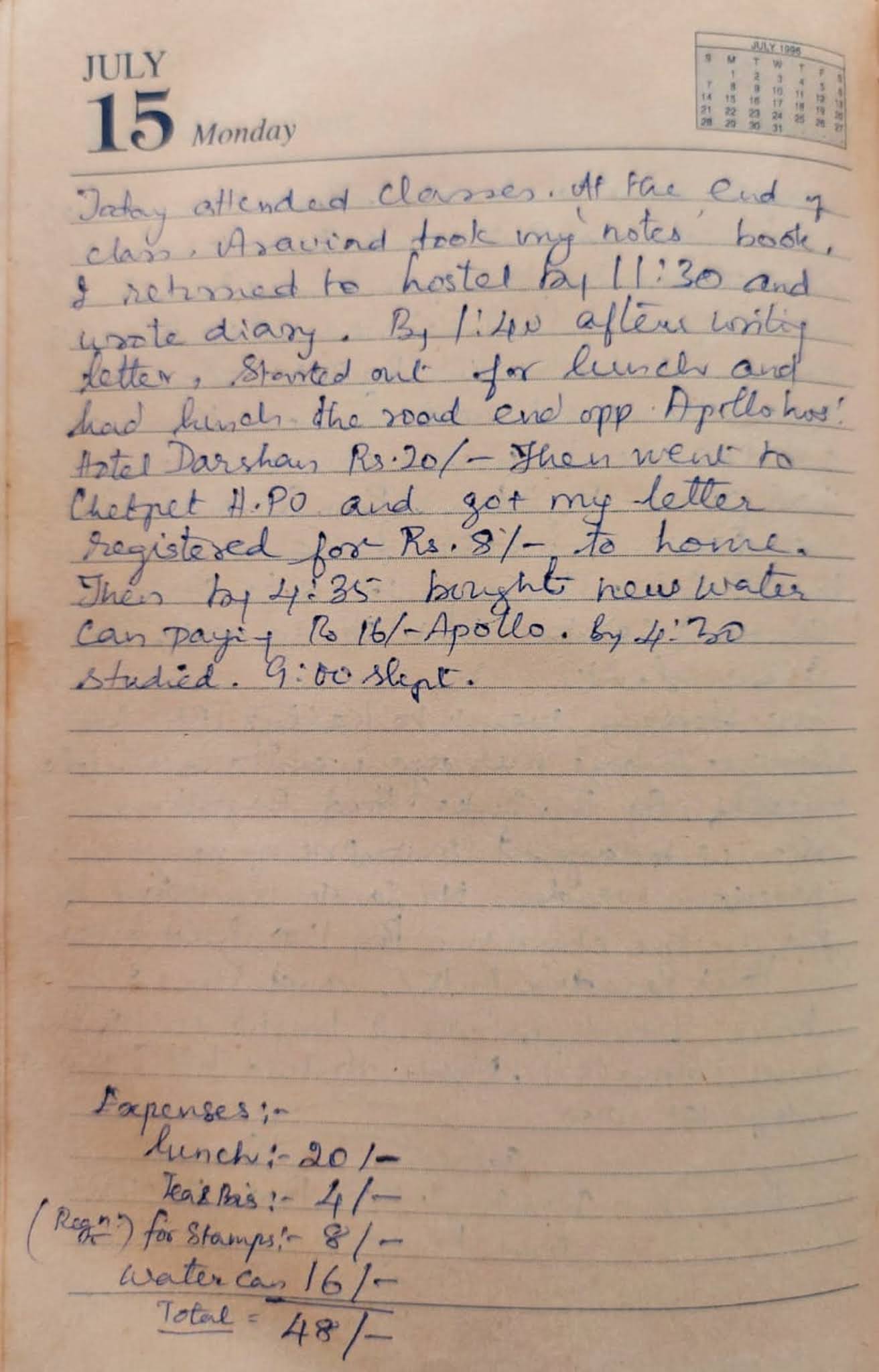
15 July 1996 | ‘Notes’ Book 

On Taking Down ‘Lecture Notes!’ 

#memoriesfromdiaries 💙

Today went to classes.

My friend Aravind took my ‘notes’ book along with him, after our classes got over.

Letter writing was yet another pastime, apart from Diary writing that we cultivated back then – in an age when the internet was not much in vogue.

I had to cycle all the way to the Head Post Office, to get my home-bound letter registered for Rupees 8/-, back in an age and clime when snail mail was the most preferred form of mail!

Quite interestingly, it was exactly on this very same month and year, (04 July 1996) that, Hotmail, founded by Sabeer Bhatia and Jack Smith, offered the first free web-based email service to users from across the world.

Launched quite ‘symbolically’ on 4th July 1996, the Independence Day of the USA, the launch symbolised the ‘freedom’ that Hotmail offered - the ability to access your inbox from literally anywhere in the world!

Something that was a real surprise and a revelation of sorts, back in those days!

Hotmail and its 85 lakh subscribers were sold to Microsoft in December 1997, and the company announced their refurbished email service as Windows Live Mail.

In February 2013, Microsoft officially shut down their Hotmail services, and ‘upgraded’ all its users to its Outlook platform.

Coming back,

Apollo Water Cans were quite popular back then! They were of a different size and mould altogether – those fifteen-litre water dispensers, white in colour, with narrow neck!

Expenses for 15 July 1996!

Lunch – Rs. 20/-

Tea & Biscuits – Rs. 4/-

Regn for Stamps – Rs. 8/-

Water Can – Rs. 16/-

Total expenses for the day – Rs. 48/-

Now, for some cues and clues for my dear students, on how to take down effective Lecture Notes!

Well, as we all know, taking notes helps you to pay attention - more especially to the key sign-post words and key sentences of the lecture.

That way, it’s also a beautiful way of avoiding distractions of any sort, ain’t it?

So now for the nuances of taking lecture notes –

Well, in the whole wide world, and in the world wide web, with an ever-present flow of information, that keeps increasing at such a rapid pace every other day, how on earth could a person possibly get knowledge and understanding in a coherent, graded manner?

The answer is - 

Yes... You've guessed it right!

Only by means of Lectures!

The Cambridge dictionary defines a Lecture as,

a formal talk on a serious subject given to a group of people, especially students.

Indeed, a lecturer prepares for hours and hours before classifying, analysing, evaluating and interpreting the content that they are going to present!

Furthermore, they also grade them in such a neat, balanced coherent order for presentation!

Thats one reason why it takes hours and hours of careful, intense preparation for a lecturer, before they deliver their ‘subject matter’ to their students!

And that's again the reason why the lecture that a lecturer delivers is usually so neatly structured, and graded in itself.

Something that we cannot possibly get anywhere from across the world wide web, which, at the most could give us information only in bits and pieces!

That’s the unique power contained within a good lecture, ain’t it!? 😍

College life is all about gaining information through such series of lectures over a series of semesters!

One reason why, we were taught to always carry a book and a pen in hand, whenever we sit for a lecture, be it on offline or online mode!

Would love to quote one particular example for all of us –

Dr. K. Ganesh, my kindred spirit, colleague and Professor of English, [Retd] stands testimony to this lovely practice. 

In the past two decades that I’ve known him, I’ve never seen him listen to a lecture, without a pen and book in hand!

The person giving the lecture might be junior to him by many years, but still, he will be there taking down notes - Copious notes! With such enthusiasm on him! 

[For a candid shot of one such passionate note-taking by Dr. K. Ganesh, you may want to look up a cute snapshot on this, our past post HERE!]

A principle that I’ve always admired in my kindred spirit!

A principle that I too vouch for! root for! stand for!

If every lecture is a new awakening for the mind, how on earth do we retain the information from a lecture for long?

Walter and Ross, in their book titled, How to Study in College have some beautiful nuggets for us –

Say they –

You can’t possibly hold on to a semester’s worth of information in the working memory of your brain.

Not even close.

What’s more, the things you keep in working memory evaporate, fast.

If you can’t quickly find a place to store them, they’ll be gone in a matter of minutes.

Perhaps forever.

Your primary storage areas will be your long-term memory and your notes!

Yes!

Your Notes...!

This not only helps you to stay focused throughout the lecture, but also helps you gear up with all excitement for the next lecture in the series!

With all humility, let me also confess that,

Back during my student days in College, if at all I was in a class, listening to a lecture, my pen would automatically, by default, hit the notebook, and quite fast-o-fast I would take down all the valuable information that the lecturer gives us.

On an added note, let me also add with some pride that, after I had finished on my college studies, and joined as a lecturer, one fine day, my past Professor (and guide) called me up to ask for my college Note Book, in which I had taken down all his lecture notes with us.

[Well, you see, I had so carefully preserved all my lecture notes during all his classes with us].

I quite faithfully and happily handed it over to my dear Sir. 

He is none other than my friend and guide, Dr. SF! 😍

So yes!

Your lecture notes are indeed such a great way of ‘storing a semester’s worth of information in the working memory of your brain’, ain’t it? 💛

Taken from Walter & Ross’s How to Study in College

Here goes - 👇

You can zero in on the upcoming lecture by marshaling the available information to provide a context for what the speaker will talk about.

Of course, lectures aren’t like textbook chapters; unless they’ve been written down or recorded already, you can’t survey them in advance.

Look Over the Syllabus

Assuming that your instructor is sticking to the syllabus, you should be able to read the list of lecture topics to get a big-picture sense of where this latest lecture will fi t in.

Pay especially close attention to the title and description of the previous lecture, the upcoming lecture, and the one that will follow.

Why is it helpful to prepare for an upcoming lecture by reviewing your notes from the previous lecture?

Review Your Notes from the Previous Lecture

Each lecture will normally build on the concepts from the lectures that came before it. 

Most instructors will assume that you attended, understood, and can remember the previous lecture. 

After all, time will rarely permit a rehash of ideas that have already been fully explained. Although the upcoming lecture will often have some ties to all the lectures that came before it, the bond will usually be strongest with the most recent one.

How do reading assignments relate to the upcoming lecture?

Do the Assigned Reading

Some instructors will assign readings as background for an upcoming lecture.

Others will give you readings designed to follow up on what you’ve just heard and learned in a lecture. 

In either case, surveying these readings can help provide advance organizers that will make it easier to understand and remember an upcoming lecture.

What is the Cornell System?

All of the methodical preparation you’ve done will be wasted if you just wing it when you start to take notes. Instead of taking a chance on a haphazard, seat of-the-pants method of taking notes, you need a proven note-taking system.

The Cornell System, which was developed at Cornell University almost fifty years ago, has been embraced by countless colleges and universities in the United States and throughout the world.

It can be used for taking separate notes, for marking your textbook, and even for annotating electronic texts.

The system is flexible and far-reaching, but its secret is simple:

Wide margins on the outside and the bottom of the text area are the key.

In what sense are notes more valuable than a textbook?

The notes you jot down can become a handwritten textbook.

In fact, in many instances they are more practical, meaningful, and up-to-date than a textbook.

If you keep your notes neat, complete, and well organized, they will serve you splendidly.

What are the principal components of Cornell-style note paper?

Although Cornell-style paper can sometimes be difficult to find at school or office supply stores, you can easily use a pen and ruler to adapt standard loose-leaf paper to the task.

First, draw a vertical line down the left side of each page two-and-one-half inches from the edge of the paper; end the line two inches from the bottom of the sheet.

This creates the cue column.

Next, draw a horizontal line two inches from the bottom of the page.

This is the border for your summary area.

The large space to the right of the cue column and above the summary area is where you write your notes. The illustration here on this post, shows a Cornell note sheet.

What are the cue column and summary area used for?

As you’re taking notes, the cue column should remain empty, as should the summary  area. 

But when the time comes to review and recite what you’ve jotted down, you’ll use the cue column for questions to help clarify meanings, reveal relationships, establish continuity, and strengthen memory.

The summary area will be used to distill a page’s worth of notes down to a sentence or two.

Sentences.  Take key ideas from a lecture or reading and jot them down in your own words. 

Write telegraphically, leaving out articles such as a, an, and the, and abbreviating words you use often.

And here’s wishing you the best on your note-taking for your Lectures! 🤝🏻

Image and Cornell Note Sheet courtesy: How to Study in College, by Walter Pauk & Ross Owens, Wadsworth Cengage Learning. 2011, Tenth Edition.

Now for the Lecture Notes Challenge – 🏆

And this is only for past students: 😍

If you have taken down notes from (any of) your Professor’s Lectures in College, in a sequenced form, (a minimum of 15 lectures from the same lecturer) in your College Note Books, for an entire semester’s duration, you need to just present them to me, and get awarded a cash prize of Rs. 10,000/- right away! 💰🎁

Featured post

Reflections on a PhD Defence | Climate Positionalities and Malayalam Cultural Mediations ❤️

Localising the Climate Crisis Through Kerala’s Flood Imaginaries #PhD-Defence #IITM 29th July 2026 | 4 pm Today, I was happy to be a par...