Thursday, 29 September 2011

Workshop on Research Methodology at GRI: A Report

The UGC-Sponsored two-day Workshop on Research Methodology, conducted by Gandhigram Research Institute - Deemed University, was an eye-opener for all research scholars numbering 160, who had gathered at the Silver Jubilee Hall of GRI, for a mind-boggling Workshop of sorts.

Pro.N.Narayanasamy, Registrar, GRI, inaugurated the Workshop on Research Methodology at 9.45 am. Prof.MA Sudhir spoke extensively on selecting one’s area of research, which requires a lot of reading. He also stressed the importance of taking notes while reading, so that one doesn’t miss out on valuable information.
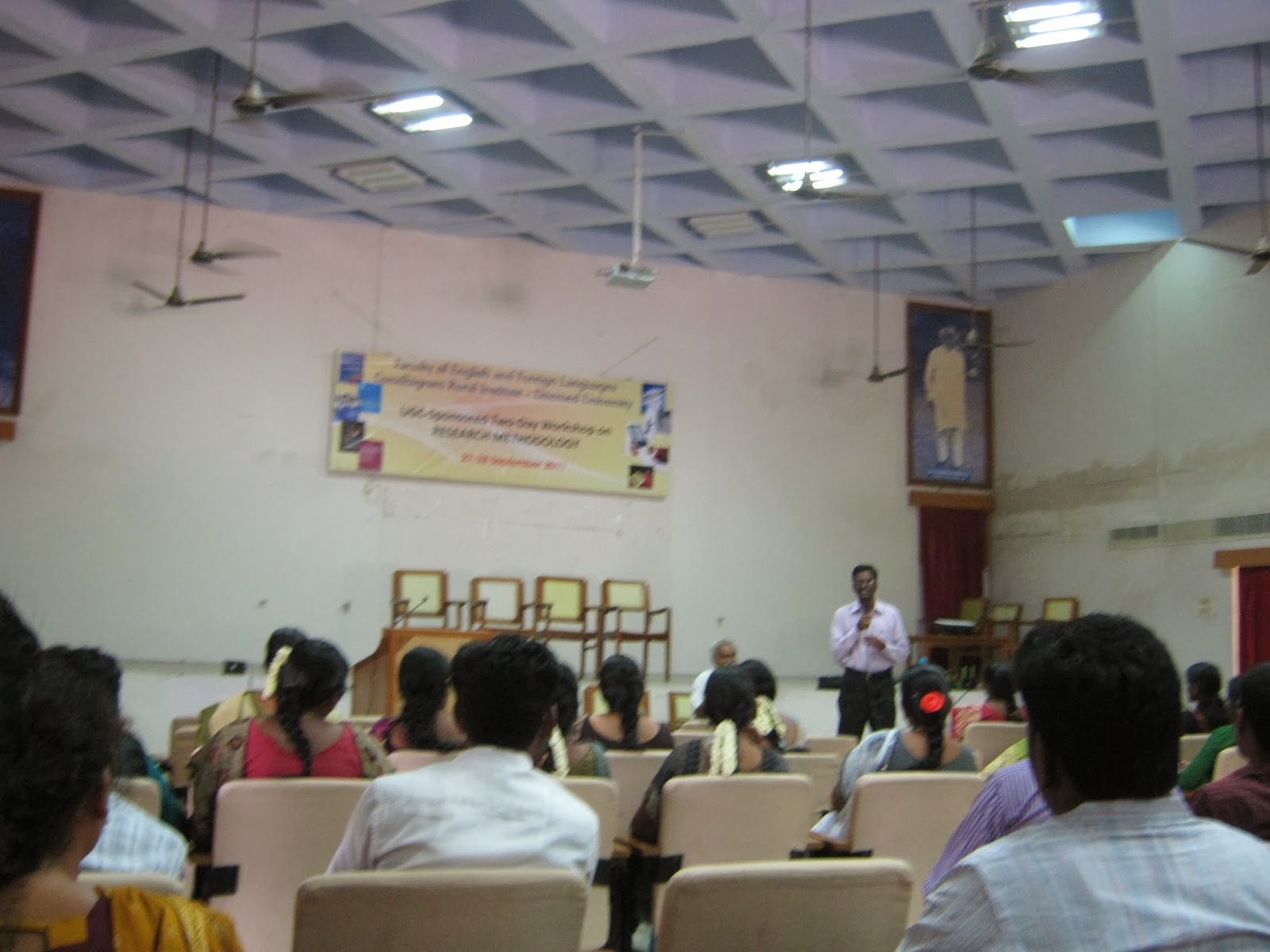
Dr.Joseph Dorairaj, addressing the gathering
He defined Research in the words of C.Francies Rummel, as “An intellectual exercise and problem- solving process” The etymological significance of the term implies “to go about seeking”. Great Research Scholars from Dr.Radhakrishnan, former President of India, to Nobel Laureate Dr.Amartya Sen have come out with astounding research findings, he said. He also elaborated on the two approaches towards Research, namely the 1) Deductive and 2) Inductive. While the former is based on theory, the latter is based on Observation, finding patterns, tentative hypothesis etc., which can be built into a theory. He also spoke on the hour-glass notion of Research.

Elaborating on David Émile Durkheim’s research on suicides, on why people kill themselves, who found out, after having systematically collected data for 20 years, that, there was a relative stability in suicides over 20 years with age variations, seasonal variations etc. and then proceeded to classify suicide into three types, namely, The egoistic, altruistic and the anomic modes of suicide.

Announcement on Assignments..:

Dear Students of Part II English, As part of your Assignment Work with me this Odd Semester, you are expected to get for yourself a copy of Word Power Made Easy by Norman Lewis and work from pg 16 to pg 109, filling up every exercise given therein. Students who have got a copy of English Vocabulary in Use (Upper-intermediate and advanced), are expected to work on units 1 to 60. Last date for submission of your assignments is: Monday, 10 October 2011.

Saturday, 17 September 2011

"The Dream" by Somerset Maugham - Lesson Summary

"The Dream" by Somerset Maugham

Introduction:

One of the most common yet feared dreams is the experience of falling in dreams or dreams of falling. The dream can be as simple as falling out of bed or as extreme as falling from top of a building, ladder, rooftop, mountain, cliff or even out of an airplane without a parachute, to name just a few. Yet, regardless of the height the dreamer is falling from in the dream, the experience is terrifying to the dreamer. As a result, the dreamer generally wakes up hyperventilated, afraid, filled with anxiety, sweating, struggling for each breath he takes, heart pounding in his chest as if it were about to explode. Somerset Maugham narrates one such experience of a dream that he heard from a Russian traveller in transit at Vladivostok, Russia’s largest port city.

Maugham meets a Russian at a Restaurant:

In August 1917, Somerset Maugham had to make a work-related trip from New York to Petrograd. As the trans-Siberian train started at nine in the evening, Maugham dined at the station restaurant. He shared table with a Russian man whose appearance seemed to entertain him. Soon, both got into conversation, and the author felt that the Russian was well-learned and that he was on his way back home after a long stint abroad.

"The Unknown Citizen" - W.H.Auden - Critical Summary

Introduction:
The Unknown Citizen

“The Unknown Citizen” is a poem by W. H. Auden. Auden wrote it in 1939, shortly after moving from England to the United States, and the poem gives evidence of his culture shock when suddenly confronted with American-style chaos and consumerism. It is an ironic poem and the poet intends his satire against a society which kills a person’s individuality.

Significance of the Sub-title:

The sub-title to the poem “To JS/07/M/378/ This Marble Monument Is Erected by the State” alludes to the concept enforced by the government that every human being must be classified by a alpha-numeric tag to distinguish who they are, rather than being able to have their own personal identity. The poet scoffs at humans being given alpha-numeric names when they’re already struggling for their own personal identity in a world clustered with the advancing technology.

His Office Life and Social Life – Analysed:

The Bureau of Statistics has found that "no official complaint" has been made against the unknown citizen. He is also described as a "modern" saint, which means that he always served the "Greater Community." He worked in a factory before the war and he never got fired, as he satisfied his employers always.

Friday, 16 September 2011

The Sporting Spirit - George Orwell - Lesson Summary

Players booing the referee
Introduction:

In the extremely competitive atmosphere in which sports is administered today, every player backed by every nation, would obviously have a strong temptation to take advantage of the gaps in the rule book, bending the rules to his favour, and conveniently interpreting the law to his advantage. Against this backdrop, George Orwell, pleads for the need to understand the importance of demonstrating sportsmanship and set a good example on the sporting field for the others to emulate.

Sports as an Unfailing Cause of ill-will:

In his remarkable essay “The Sporting Spirit”, Orwell grieves over the fact that sport is an unfailing cause of ill-will, and that the visit of the Russian football team Dynamos, has only worsened the Anglo-Soviet relations instead of strengthening it.

Two of the four matches played led to much bad feeling. At the Arsenal match the referee was booed at. At the match in Glasgow, it was a free-for-all right from the start. According to Orwell, football was capable of provoking the vicious passions of patriotism, resulting in fresh animosity on both sides.

"My Grandmother's House" - Kamala Das - Critical Summary

My Grandmother's House (representative)
Introduction:

Kamala Das is one of the three most significant Indian poets writing in English today, the other two being Nissim Ezekiel and Ramanujan. Her poetry is all about herself, about her intensely felt desire for love, for emotional involvement, and her failure to achieve such a relationship. In this poem, “My Grandmother’s House” Kamala Das, recalls her ancestral home and her dead grandmother. This poem takes the form of a confession comparing her present broken state with that of being unconditionally loved by her grandmother.

Themes in the Poetry of Kamala Das:

The poetry of Kamala Das is a search for the essential woman, and hence the woman persona of her poems plays the various roles of unhappy woman, unhappy wife, mistress to lusty men, reluctant nymphomaniac, silent Devdasi and love-lorn Radha. Kamala Das has also been called a poet in the confessional mode. The confessional poets deal with emotional experiences which are generally taboo. There is a ruthless self-analysis and a tone of utter sincerity. As E.V.Ramakrishnan rightly says, “In her poetry, Kamala has always dealt with private humiliations and sufferings which are the stock themes of confessional poetry.”

Reminiscent of the Poet’s Ancestral Home:

The poem is a reminiscence of the poetess’ grandmother and their ancestral home at Malabar in Kerala. Her memory of love she received from her grandmother is associated with the image of her ancestral home, where she had passed some of the happiest days of her life, and where her old grandmother had showered her love and affection. With the death of her grandmother the house withdrew into silence. When her grandmother died, even the house seemed to share her grief, which is poignantly expressed in the phrase “the House withdrew”. The house soon became desolate and snakes crawled among books. Her blood became cold like the moon because there was none to love her the way she wanted.


Wednesday, 7 September 2011

because of her love of books...

Jane in Chapter 5, page no.87, initiates conversation with a stranger merely because of curiosity and not because of loneliness or being gregarious by nature. This can be concluded from the lines preceding the conversation: “I stood lonely enough: but to that feeling of isolation I was accustomed: it did not oppress me much.”

Jane seems to love books and reading as it seems to be the only reason for her to start a conversation with a stranger in a sea of strangers. She herself finds it surprising that she started a conversation as can be inferred from these lines: “I hardly know where I found the hardihood thus to open a conversation with a stranger. The step was contrary to my nature or habits”. She only read childish and frivolous kinds of books and could not comprehend serious tests. She seems to like magic with her reference to fairies and genii as something she liked to read about.

In the entire length of the conversation it can be seen that Jane keeps questioning about different things, from the tablet she found to the stranger’s personal life. She is very inquisitive by nature, and also very curious. Jane is neither diplomatic nor does she have enough tact while questioning the stranger, “Are you an orphan?”

Jane wishes to know all about her new environment and the people who are there. She is a child with the childish tendency of opening her mouth before thinking through what she wants to say. She is honest. (“I cannot pronounce her name as you do”; “But Miss.Temple is the best – isn’t she?”)

Featured post

Why is India Resisting the American Spelling Takeover! 💜

Why is India Still ‘Organising’ Instead of ‘Organizing’? From Macaulay to MS Word | The Evolution of Indian English #newspaperinlearning #re...