A Riveting Rendezvous with
Dr. Hepzhibah Israel
Interviewing Dr. Hepzhibah
Israel | University of Edinburgh
I MA Students | 31st July
2024
I’ve never been
interviewed by six people. This is the first time in my life. So why do you want
to interview me. I’m not even teaching you. Why do you want to interview me?
To travel with your world,
replied Shobhana, a reply that impressed Dr. Hepzhibah greatly!
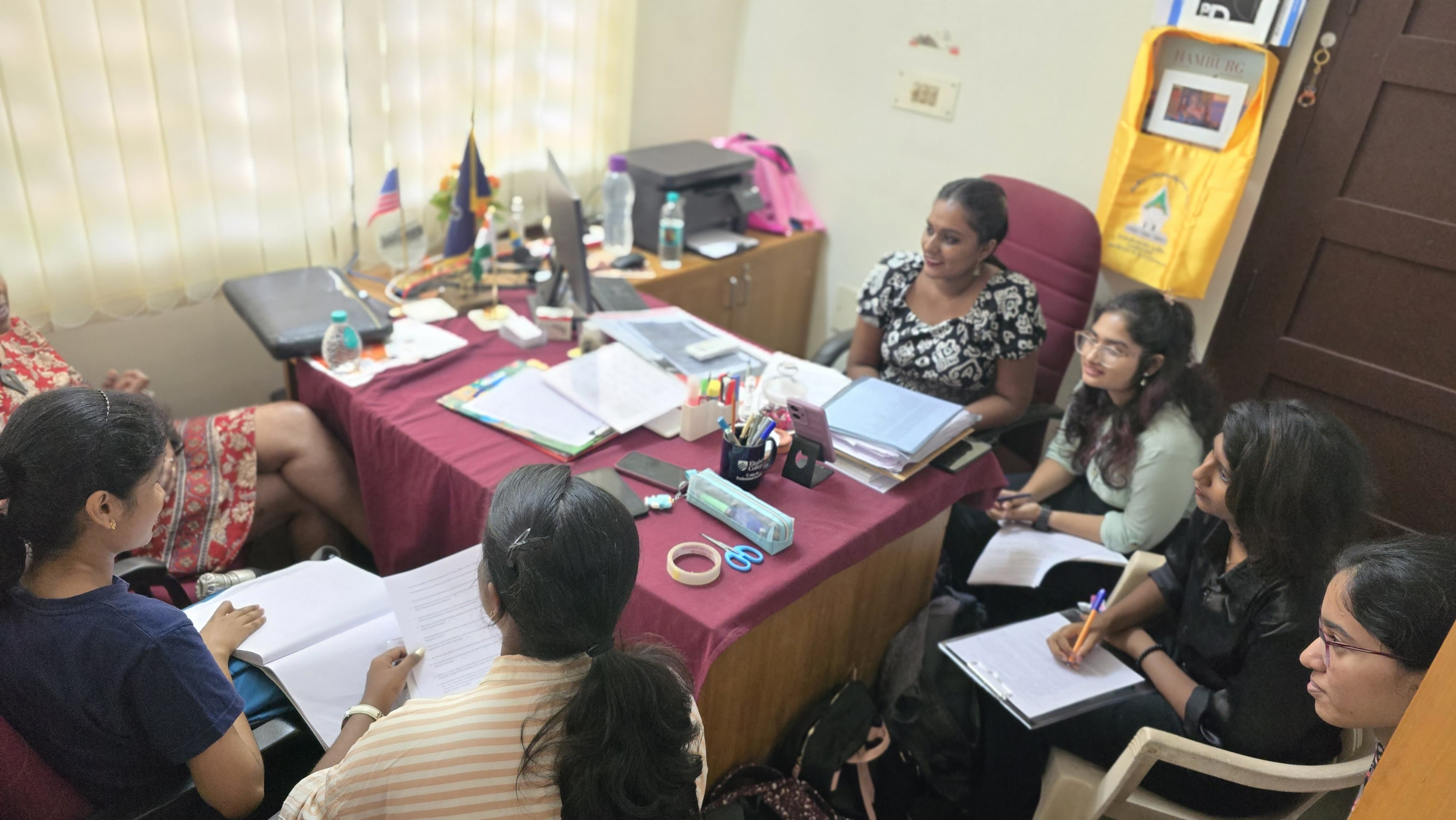
Well, indeed, it was a
very highly engaging, mind-blowing interview by our I MA English students –
Nikita, Shobana, Pooja, Ranjitha, Divya and a student from MA Pol. Science,
from 12 noon to 1 pm today in the Office of the Dean of International
Programmes.
Stay glued from here-on,
to enjoy the various facets of this riveting and spirited interview with Dr.
Hepzhibah Israel –
Just excerpts for us all -

‘You are interested in travelling
with me. That’s a good reason for an interview’.
Nikita added,
‘Well, I love meeting with
people, learn from people and get inspired from their achievements’.
Students: Starting on a
casual note… How do you find the weather in Chennai…
Dr. Hephzibah: Well, it’s
hot and sweaty. I just returned from Thekkady which was quite cool.
What inspired you to visit
Chennai, and what are your expectations about this trip?
I had two reasons for
coming to Chennai. One was personal. One was to teach in MCC. I wanted to see
how the response of MA students in MCC was to translation.
Do you have any favourite
experiences or moments in your trip so far?
That’s a very broad
question. Just to narrow it down, within MCC, it’s been quite good to interact
with students, who ask really interesting questions. Yesterday especially we
had a very interesting Panel Discussion for four hours on Translation Studies.
Actually the session yesterday
was for three hours. But then, we ended up interacting for four hours, and
people were asking such interesting, thought-provoking questions.
What made you take to
English Literature? How was your life at Miranda House? And your career as a
Professor with Delhi University?
I was always with a book
in my hand all through my childhood and teenage years. And I was always doing
well at school and my highest marks were always in English. So it’s a Catch 22
situation.
When you do it well,
you always want to do it more! I was always passionate about it. I wanted to
write! And my dream was to become a novelist. I haven’t done that yet.
But I did like the idea of
writing and literature and what role it plays. And I knew what I didn’t want to
become. I didn’t want to become a doctor, engineer, business management person
in an MNC, cos that I knew was not for me.
The only other thing I’d
have wanted to become was to be a geographer, because I’d have loved going
to Antarctica, or to one of these exotic places, studying land forms and stuff,
and my father had a role to play, saying, ‘That’s a ridiculous idea’.
I just went ahead with
English – when you’re young you’re not sure what to do. When you like something
so much you just go with the flow of it. So that’s one of the things I did.
About Miranda House – I’d
say it really had a very important role to play – even now that has a key role in my life.
It is a women’s college, and
at that point, when I was there, it had the most dynamic English department, in
the whole of Delhi University, much more
than St. Stephen’s or Lady Shriram College, which are the other competitors to
Miranda House.
In fact I was first disappointed
that I didn’t get into St. Stephen’s, and then I was very relieved that I didn’t
get into it, because it was politically very conservative.
Whereas all the women who
were teaching me in Miranda House tended to be Feminists, Marxists, and
ideologically they shaped the way I thought about literature, and so they shaped the way I thought about literature as a part
of wider cultural politics.
So it’s not just saying,
I like this novel because it’s
so beautiful and it made me cry, or,
‘This poem is so beautiful’.
That’s what I would have
said at school before I went to university, whereas the way they made me think
about issues to do with gender, with feminism, patriarchy, issues to do with class,
especially class in the UK with respect to British Novels, Caste, (especially
Caste in India), nationalism colonialism, postcolonialism - all of those ideas I
found really exciting.
Quite a few of them tended
to be Marxists-feminists and therefore their teaching helped me grow
intellectually. And so a lot of what I do now, the way I read etc, sometimes people
prescribe texts in their MA, and even PhD in Edinburgh, and I say happily that,
‘I’d read that as an Undergrad student in India’, and that was in the early
90s.
Cos my teachers were really
up-to-date with all the theories and the criticism that was being published. They
really had a fundamental role to play in shaping my career and future as an
academic and as a researcher.
Do you think young
literary scholars look at literature in a far more different way compared to scholars
of your generation? Why?
Then, I need to know how
you look at literature?
Students: We look at
literature as a reflection of ourselves, as a slice of our lives, the texts
were never just texts, they were gateways to ideas and ideologies, I think
literature itself plays a very major role in shaping your ideology and who you
are as a person.
In my case literature it’s
more than just a text! When you read Chaucer, sometimes Sylvia Plath you can actually
feel – who are you as a human – what does it mean to be a human –
Literature made me
understand that imagination and reality are not binaries. Reality itself is not
real. It’s constructed. There’s a need for us to bridge the gap between
imagination and reality.
Dr. Hepzhibah: I
think it’s not very useful to think about generational gap in a broad sense. I’d
rather answer on my behalf.
Most of what you said would
echo with what I think about literature then and now!
The only thing I’d differ
is the idea of ‘Literature being a reflection of reality’.
If we really think critically
about that, literature doesn’t reflect reality, but reconstructs reality for a
political purpose. It could be for a political purpose.
There’s a politics behind
writing that poetry. You could kill yourself. But when you choose to write
about your thoughts to suffering, it’s not just reflecting that reality, but
trying to shape that reality.
That part is important for
me. How does literature derive from reality? How it reconstructs reality for
people. In the context of people who are oppressed, literature has been used to
suppress people – you cook for the man, or thoughts of sexual desire,
repression, these are constructs that literature promotes.
So literatures are
ideological battlefields, where different writers are trying to shape reality in
different ways.
In their texts they try to
imagine a different future. The relationship between what is happening in the text,
and what is happening outside!
Students: How does a
translated piece of work shape societal ideas? Or how does a translated version
contribute to shaping societal ideas?
Translations shape
realities, and even cultures.
Obviously the source text or
the original text would have shaped reality in the source language and in the source
culture.
But when it is translated,
the translator then has a role to play in reshaping the text to a new culture. So
you could have a feminist translation of a patriarchal text – that changes the
text in such a way that it challenges certain patriarchal norms in the target
language or target culture.
But it’s better if you
read articles. Because there’s a lot in Translation Studies. If you’re interested,
you can look up journals on JSTOR titled, ‘translation studies’.
There’s a lot on cultural
translations or politics of translation or ‘translation and politics’, and you will
have hundreds of articles that come up.
Students: How do you
ensure that the authenticity of a text is preserved in translation?
Within translation
studies, the idea of authenticity has been challenged. So there is nothing like
an essence or an authentic meaning. Because all texts are interpreted by readers.
And a translator is like another reader. So every translation is a re-interpretation.
It’s not an exact equivalent of the source text.
Students: What inspired
you to be the creator of creator through your research and teaching? Which work
nurtured that literary spark?
My mother was a teacher. And
all my life the one thing I didn’t want to be was a teacher. I hate the idea of
being a teacher. During my MA too I was very scared of facing people, and I was
very shy of walking into a room full of students, who all stared at me. The
thought of it was very scary.
However, just after my MA,
one of the English teachers in my school, fell badly ill, and couldn’t teach
for a few months, and the principal knew that I’d finished my MA, and so she
asked me to come and teach.
You can’t say ‘No’ to a
Principal, and so I said, ‘Yes’.
But I spent the next one
week being completely terrified at the idea of going to class. I couldn’t sleep.
Then on the day I was about to teach, I went to school, to tell the Principal
that I cant’ do this!
In those days there were
no mobile phones. So I took a bus and went and told her, that I don’t want to
teach.
But she refused my
explanations, and said, ‘Of course, you are teaching’, and she took me straight
to class.
I had prepared for the
class to teach a poem. I still remember, it was a 11th standard class. I don’t know
what happened, but something clicked when I started speaking. I introduced
myself.
I realised that, in the first
five or ten minutes, I thought o myself that, I know so much more than they do!
They’re just 11th Standard, and I had known so much about Blake than they knew,
and I didn’t even have to prepare, because I had just finished my MA. And that
gave me confidence to speak in class.
Just the knowledge that I had
knowledge gave me the confidence to speak. And I taught, and I found that the entire
class was silent, and they listened to me. That gives you a kick. It’s a bit
like being on stage, (if you’re interested in standing on stage). So every
teacher is actually a performer of a certain kind.
So you walk into the
classroom, and you perform on that day. You entertain your students. You teach
them. You do all kinds of things to keep them engrossed. If you don’t do that,
and if you’ve lost their interest in the first five to ten minutes, or in that
first one hour, you’ve lost your audience.
How do you capture the
imagination of your young audience? That was very intriguing for me. I found
that I could do it. I didn’t know I could do it, until I did it. Which was something
that my mother had said.
You won’t enjoy it until
you try it. The same tactics we use with food.
I tried and I found that I
actually enjoyed teaching it. So the next day I actually enjoyed going forward
to school. I ended up teaching there for three to four months. And I realised
that, I could actually do it.
Then I went on to teach at
University. For me teaching adults is something I like doing. I’m not very good
with very young people. You need different sets of talents for that. I can’t go
and talk about politics and ideology to young children. But I want to talk
about feminist politics, and so I need young people of about 16 and above to
teach. That’s how I ended up in University teaching.
Sometimes the damage is
done at school, and the University is too late to correct certain assumptions.
First year undergraduate
teaching is one of the most exciting actually, since the student is fresh out
of school, rigid and very formal, and can’t ask questions, very strict environment
where you’re boxed in.
Then you come into this
new world, where everything is new and you shape them, and you challenge
assumptions, and that person is forced to think about why they assume certain
things, and then you keep challenging those students, and you build ways of
thinking in students.
So I think for me, critical
thinking is very important in young people. Because if you have the tools for
critical thinking, you can apply them to anything – not just literature! You can
apply to historical texts, political texts, religious texts, you can apply it
to various other contexts as well.
So it doesn’t have to be
just literary texts that you are critical with.
I’m sure you would realise
that you are critical now, when you watch the news, when you watch a film. It
becomes a part of your training and you can’t get it out of your bloodstream.
And that’s good. Don’t be embarrassed! Don’t be defensive about it. I’m sure
your family will tell you that you are being critical.
But one of the things you
probably enjoy [and I certainly do], is the enjoyment of critical analysis.
What’s actually
entertaining is the critical engagement! Why does the text work in this way,
and what is the message, and how is it being conveyed! And how is it being
received. So carry on by using the tools in other contexts as well.
Students: What’s your take
on literary festivals, book clubs that promote literary content and literary engagement?
The question is about, who
is organizing it, who is funding it, etc.
I guess you are aware of the Shell company environmental
debate – they will put money into environmental issues, and say that they
promote environmental research. They also give literary prizes for
eco-friendly, novels and novels on literatures that challenge the Anthropocene.
They present themselves as if they are the saviours of the world. But in practice
they’re destroying literature.
But they’re actually
getting the money out of oppressing someone. Someone’s health, someone’s illiteracy.
Students: How do you see Digital
Humanities and technology transform the field of literary studies.
At the moment, AI and
digital tools are really challenging translation studies and translators in a
big way much more than literary studies. There’s a worldwide acceptance that
literatures are so creative that machines cant quite copy that. It’s still a
consensus all over that humans are still more creative.
As for Translation, there’s
more and more reliance on machines, and there will be a time in the world when
human translations are no more necessary.
We know the pressure of
global English over Indian languages.
Machines pretend that
there’s no language politics. More and more people need to speak about this,
and need to be aware which languages people speak where.
When do you speak Tamil.
Who do we speak to in Tamil? I’m sure you’ve experienced this. They’ll get
offended when we talk in Tamil for them. But I know English, and I’m not going
to be pushed down by you. It’s a class conflict here. And actually, the more AI
takes over the translation world, the more negative the effects will be in the future.
I’m interested in Digital
humanities. AI technology is vey useful. I travelled in China. I don’t know a
single word in Chinese. But the only way I found my way back was because of Google
translations.
A lot of IT people are gung
ho about machine translations. They need to come to your MA classes and
study something about ideology and politics.
They depend upon human intellect!
Where’s originality in that case?
It also makes me feel
that, there’s operation of binary everywhere. The moment there’s creation there’s
destruction.
Students: Can you tell us
about your journey into translation studies?
I did my BA, MA and MPhil
in English.
MPhil in Delhi University is
different.
It enabled me to have a
relationship with Tamil in the classroom. For me growing up in Delhi, Tamil was
a domestic language. I was aware that most people around me were Hindi. One out
of 20 were Tamil in Delhi.
And we spoke in English
and Hindi. So studying Literature was only English.
Harish Trivedi was
interested in translation. Those were the reasons I got interested in that.
That brought the three
together.
Students: What’s so unique
about your Translation?
Well, it’s hard to say. What’s
interesting for me was mainly a commitment to certain ideological issues. Particularly
a certain text. What kind of text. I wouldn’t claim that my translation is
unique.
But I’d say that every
translator has a particular perspective to approach a text! I’d be an Indian
woman, a Tamil speaker, all of these factors, growing up in Delhi, so the idea
of dislocation, displacement, and negotiating what it means to be Tamil in Delhi,
plays a unique part in my translation.
All translations would
bring what is unique to their translation process.
Students: When you translate
a text, how to you resolve the author-translator conflict?
Well, that’s a million-dollar
question.
Yes, there’s something compromised
at some point.
Lawrence Venuti defines
translation as an act of violence!
It is akin to committing
an act of ethnocentric violence by uprooting the text from the language and
culture that gave it life! It is the forcible replacement of the linguistic and
cultural difference of the foreign text with a text that will be intelligible
to the target-language culture! He says that, translations are acts of violence.
So you can’t find this
utopia! You can just say, if this is more feminist, or this is more conscious
of Dalit politics than another. So every translation will change the source
text!
Students: Your research
spans English literary studies, what are the significant challenges you’ve
explored!
I started looking into the
history of translation of Bible into Tamil. I was interested in the debates
around translation. I wasn’t interested in ‘which word was there in Tamil or
not, as an equivalent. My interest was on looking at how perceptions or debates
on language, debates on translation, debates on identity shaped the way the
Bible was translated.
And how the translated
Bible shaped the way of Tamil literary culture or politics for at least the
Protestant community. And, in that context, I was looking at the Bible as a
literary or a cultural text.
My concern was not
theological! It was not to look at the Bible as a religious text! It was to
look at the Bible as a literary text that was playing a part in the literary
scenario in Tamil and I released that it had changed.
So, in the 18th century, there
were particular challenges or debates, which changes in the 19th century, which
changed again in the 20th century, when Protestant Tamils and Catholics started
translating the Bible for themselves, rather than relying on missionaries. So
that kind of relationship with language and literature was central to my PhD
project.
I’ve also translated
stories. Katha in Delhi, that publish Prize Stories. They’ve got a whole series
of books written by academics on translation.
Get the library to order
these books, so you can apply to the Indian context much more rather than
thinking of translation in the abstract. They’ve several anthologies on ‘translating
caste’ and ‘translating gender’. They’ve a whole series of books written by
academics from various universities across India, also reflecting on the
process of translation.
Students: Imagination is a
world in itself to unravel the hidden. Could you please share your experiences
and insights.
There’s a different way of
thinking about imagination than the prescriptive classic 19th
century fiction. Imaginary worlds are always linked to reality in some way. That
link is interesting. So what’s fantastical cannot be understood without taking
into account what is real.
Most recently I had the
opportunity to write poetry for the Edinburgh art gallery. In that poetry I was
trying to imagine a world without borders.
So imagination was central
to that writing project. In a world where borders were policed all the time. So
can we imagine a world without borders, where we need no police?
So that’s something that I
imagined in my own writing.
Students: What role does
translation play in facilitating cross-cultural understanding?
It plays a role, but it’s a
double-edged sword. Texts were used to subjugate people.
One last burning question –
Students: In what way do
Postcolonial studies intersect with Translation Studies in your research?
Well, you need to read my
book on that. All your questions will be answered there.
What are the intrinsic
aspects to creative insights through your research?
I’d call it central to
that – a commitment to research. A commitment to research properly. Research in
a proper way - not just two articles.
Research fully, in a
committed way. Do the hard work. I’ve been told that, in the last 10 or 15
years, many academics give money for their articles to be published. So this is
a new problem that’s come up. Cos promotions are linked to the articles.
20 articles are required to
be promoted from lecturer to senior lecturer. So they give money and get the
articles.
As a researcher, I’d put
all my money to research and not to such unethical publishing. Do it to the
best of one’s knowledge. Start early. Redraft your article multiple times. It’s
the commitment to writing well.
To write well!
Write not just a literary
text but an academic text! It attracts people to your writing.
The creativity angle comes
in when you write better. Give yourself time!
Students: How do you rate your
experience with us, interviewing you today, ma’am?
It was wonderful. Some questions
were very insightful, some show class. Some from a very different direction. Some
very challenging. So thank you for your questions.
Students: Thank you so
much ma’am.

.png)