Sunday, 25 July 2010

Lectures by Eminent Academicians - Saturday, 24 July

The first in a series of UGC preparatory lectures, started with Dr.Seshasayee, Head, Department of English, A.M.Jain College, delivering an effective and motivating lecture on Language, Grammar, and Structural Linguistics to our students from 10 am to 12.45 noon, on Saturday, 24 July 2010. 


Excerpts from Professor's lecture:
"A car driver does not need to know about the various nuts and bolts of the car. He just needs to know how how to drive a car! On the other hand, a car mechanic has to have a good working knowledge about everything relating to the functioning of the car! The same is the case with the linguist!" he said.

"There's a kind of mental / psychological block, when we utter the word "linguistics". But it is not as tough as it is made out to be!", he said.  

He outlined the aims and objectives of Traditional grammarians, for whom the grammar book takes the position similar to that of a Holy Book. You've got to obey it, without questioning it. Then he spoke on the Latinate fallacy, which argued against William Lylye's proposition that all grammar rules are Latin-based. The Latin Fallacy, which believed that what applies in Latin must also apply in English, was abandoned as the prescriptive approach to grammar came under challenge from Linguistics scholars, when the science of linguistics came to the fore in the late 19th century, who claimed that English could not be satisfactorily described or explained in terms of the rules governing Latin. a prescriptive grammar is one that lays down the rules for English language usage, while a descriptive grammar synthesises rules for English usage from the language that people actually use. A prescriptive grammarian believes that certain forms used are correct and that others, even though they may be used by native speakers, are incorrect.

Then in the 19th century came Robert Lowth, the author of one of the most influential textbooks of English grammar. Lowth's method included "correctness" - to teach us what's right and what's wrong, thus criticising "false syntax"; his examples of false syntax were taken from Shakespeare, Milton, Swift, Pope, etc.

Then appeared Lindley Murray, often called "the father of English grammar", who based his grammar on Lylie, but didn't say that the roots are Latin. Instead he adopted it as logical rules which we call "logical fallacy". Following Murray, came along Otto Jespersen, who along with Paul Passy, he was the founder of the International Phonetic Association, and concentratred more on morphology and syntax.

Traditional grammarians refuse to accept the fact that language keeps changing. But the fact is, there's no point in asking today's student to write like a Shakespeare, or a Milton, or even that of a 19th century writer. It is difficult to adopt the writing style of the past. Language must constantly be in a state of flux. But the Traditional grammarians based their study on writing. They totally ignored the spoken part. They believed that writing is primary and speech is only secondary. Hence, Traditional Grammar is normative and prescriptive. You can't question why it's prescribed. That is why, it is unscientific.

Thus Traditional Grammar was replaced with Modern Grammar, which is descriptive. Modern grammar doesn't tell you which is right or which is wrong. In other words, it prescribes the language as it is being used by the native speakers. So here we find the shift from the grammarian to the native speaker.

Prescriptive grammar has a collected corpus. It does not say what is right or what is wrong. It just says whether it is correct or incorrect. On the other hand, Modern grammar tells us whether a particular usage is acceptable or not acceptable. Because, what is unacceptable today may become acceptable at a later period of time.

Consider the sentence:

"I didn't do nothing."

[In Traditional grammar, this is not correct, as they go by the logical rule - two negatives make a positive] but the other way round, to emphasize that I did nothing, I say, "I didn't do nothing"

Modern grammar says that it is unacceptable because native educated speakers do not use it. They depend on 'Social Acceptance' as the sole criterion.

That is, "I seed you" is not incorrect. On the other hand, it's unacceptable.

Georgina, thanking Dr.Seshasayee
Linguists see language as a part of human behaviour. Though there are more than 5000 languages, there are some commonalities among them. A linguist thus studies language as a human aspect, and try to formulate general theories based on that - General Linguistics. GL is not language-specific, followed by a variety of linguistics, like micro-linguistics, in which language is studied for the sake of itself, along with the elements of syntax and phonology. It contrasts with macro-linguistics, which includes meanings, and especially with sociolinguistics, which studies how language and meaning function within human social systems.

Then he spoke about the two ways in which language can be studied - the synchronic and the diachronic, and also elaborated on the common language theories, concerning language. He then outlined the basic characteristics of language, and then proceeded to expound the concepts of Fedinand de Saussure (the father of 20th century Linguistics) - la langue, le langue, la parole, etc.

He then spoke about Received Standard, Regional Standard, and Modified Standard, and also elaborated on dialect, idiolect etc. He then talked on the basic concepts of Structural Linguistics, and the three broad aspects of language - Phonological level, grammatical level, and the semantic level. He also outlined the difference between phonetics and phonology, and also gave a morphological rendering of a few sentences as illustrations.

To sum up, - the lecture, not only helped in giving the students a refreshing view on the subject, but also helped in dispelling certain notions about the subject, which were preventing the ordinary student from venturing into the field boldly. The fresh perspective into Language, Grammar and Linguistics was indeed an intellectual treat to the student of literature. Thank you sir. You made our day..!

Our sincere thanks are due to our beloved Professor Dr.Stephen Jebanesan, Professor of English, and Warden, Selaiyur Hall, for giving us the needed infrastructure as well as the much required motivation to keep the lectures going. Thanks are also due to all the members of Staff of the English dept, and especially, Prof.Wesley Santharaj, for his invaluable help, Prof.Dinesh, for his support and guidance, Prof.Jayanthi, for her presence and motivation, Prof.Jubi, Dept of Journalism, for covering the occasion, Prof.Rayson, for his presence and moral support, and Anand, student from SFS, Selaiyur Hall, for videographing the whole event for us. Thank you...! Thanks and kudos - a million - to our self-motivated students who make the best use of the once-in-a-lifetime - opportunites that come their way. It's indeed you - who keep us going..! Thank you...!

Friday, 23 July 2010

I MA Students scoring music..:

III BA English Lit Students..:

II BA English Lit Students performing a play..:

Prof.David, "our Chocolate Professor," giving a lovli Hindi number..:

Students of English Lit @ the Freshers' Party..:

Prashant, III BA giving a soulful number...:

Freshers' in the English Dept..:

Shloka and Ankita (I MA) preparing to give a special number

Freshers' Party started with a delicious and sumptuous lunch, hosted on behalf of the freshers. Rita (II MA) gave the opening prayer, followed by a variety of performances.

Cultivating a Lifetime Reading Habit..:

This could change your life
Set times: You should have a few set times during every day when you’ll read for at least 5-10 minutes.

Always carry a book: Wherever you go, take a book with you.

Make a list: Keep a list of all the great books you want to read. You can keep this in your journal, in a pocket notebook, on your personal home page

Find a quiet place: Find a place in your home where you can sit in a comfortable chair (don’t lay down unless you’re going to sleep) and curl up with a good book without interruptions. There should be no television or computer near the chair to minimize distractions, and no music or noisy family members/roommates. If you don’t have a place like this, create one

Reduce television/Internet: If you really want to read more, try cutting back on TV or Internet consumption. This may be difficult for many people. Still, every minute you reduce of Internet/TV, you could use for reading

Keep a log: Similar to the reading list, this log should have not only the title and author of the books you read, but the dates you start and finish them if possible.

Go to used book shops: it is very fun to browse through the new books people have donated. Make your trip to a used book store a regular thing.

Have a library day: Even cheaper than a used book shop is a library, of course. Make it a weekly trip.

Read fun and compelling books: that really grip you and keep you going. Even if they aren’t literary masterpieces, they make you want to read — and that’s the goal here. After you have cultivated the reading habit, you can move on to more difficult stuff, but for now, go for the fun, gripping stuff.

Make it pleasurable: Make your reading time your favorite time of day. Have some good tea or coffee while you read, or another kind of treat. Get into a comfortable chair with a good blanket. Read during sunrise or sunset, or at the beach.

Blog it: One of the best ways to form a habit is to put it on your blog. If you don’t have one, create one. It’s free. Have your family go there and give you book suggestions and comment on the ones you’re reading

Set a high goal: Tell yourself that you want to read 50 books this year (or some other number like that). Then set about trying to accomplish it. Just be sure you’re still enjoying the reading though — don’t make it a rushed chore

Have a reading hour or reading day: If you turn off the TV or Internet in the evening, you could have a set hour (perhaps just after dinner) when you and maybe all the members of your family read each night. Or you could do a reading day, when you (and again, your other family members if you can get them to join you) read for practically the whole day.

Thanks to: Leo Babauta

ARE YOU A MEMBER...?

"When I got [my] library card, that was when my life began," says Rita Mae Brown, prolific American writer and social activist. "Your Library is your Portrait," says Holbrook Jackson. "Books are the ever burning lamps of accumulated wisdom," says George William Curtis. Indeed, this is the best time to check out some of the good libraries in the City, and a compendium of the same, numbering around 115, is available HERE.

Thursday, 22 July 2010

FRESHERS' PARTY..:

Dear Students of I BA/I MA English Lit.,

Join us for the Freshers' Party, hosted by your seniors on Friday, 23 July 2010. This, we hope, would be a freshers' party with a difference. Do come and be a part of the show.

Regards and all best wishes,
Rufus

Monday, 19 July 2010

UGC-NET Preparatory Lectures..:

Dear Students of I MA/II MA English, We are planning on a series of lectures as part of your UGC-NET exam preparation, starting this Saturday. Speakers include eminent scholars drawn from all over the country. This Saturday, 24 July 2010, we are having two lectures - the first one, from 10 - 12:30, and the second lecture will be from 2 to 4 pm on the same day. All of you are invited...! Be there! Regards, Rufus

Wednesday, 23 June 2010

MA Admissions - Reg

Dear Students,
The list of students admitted to the MA English Course at MCC, has been displayed in our College Website. 
Regards,
Rufus

Wednesday, 16 June 2010

Tuesday, 15 June 2010

Admissions 2010-11 - An Appraisal...:

Admissions for the year 2010-11 for all the Under-graduate courses have seen a phenomenal rise over the previous years, and is almost over. While BA English and BCom classes closed receipt and sale of applications as early as June 03, 2010, many other departments also followed suit by the end of the week.

The guidelines for UG Admissions are very open and straightforward. The Department Admission Committee recommends 80% of the sanctioned strength of students, while the rest is filled in by the Principal.

Merit has been the primary criterion for the admissions this year. Departments follow strictly the norms and regulations while making their recommendations. With a view to enriching the traditional cosmopolitan character of the College, the Departments take into consideration candidates from other states as well as other countries.

Classes begin on June 16 for the II/III UG Classes, and II PG Classes, while orientation for the freshers will be on, at the Anderson Hall at 8.15 am, the same day.

Wish you a rewarding and fruitful new academic year ahead.

Regards and all best wishes,
Rufus

Monday, 14 June 2010

Welcome Back...!


Dear Students, Welcome to yet another eventful year at our own Madras Christian College. "Desire is the starting point of all achievement, not a hope, not a wish, but a keen pulsating desire which transcends everything," said Napoleon Hill. Indeed, desire is the key to motivation, but it's determination and commitment to an unrelenting pursuit of your goal - a commitment to excellence - that will enable you to attain the success you seek. Your College is growing by leaps and bounds not only academically but also infrastructure wise, in both letter and in spirit. Under the aegis of a new, energetic and dynamic leadership, let's together march ahead in making our college the numero uno! Indeed, our own web log too has bounced back with double energy after a brief hiatus. I earnestly hope to make this academic web log a meaningful exercise in communication to my dear students. With warm regards and all best wishes, Rufus

Sunday, 13 June 2010

Welcome Back...!

Dear Students,
Welcome to yet another eventful year at our own Madras Christian College. "Desire is the starting point of all achievement, not a hope, not a wish, but a keen pulsating desire which transcends everything," said Napoleon Hill. Indeed, desire is the key to motivation, but it's determination and commitment to an unrelenting pursuit of your goal - a commitment to excellence - that will enable you to attain the success you seek.

Your College is growing by leaps and bounds not only academically but also infrastructure wise, in both letter and in spirit. Under the aegis of a new, energetic and dynamic leadership, let's together march ahead in making our college the numero uno!

Indeed, our own web log too has bounced back with double energy after a brief hiatus. I earnestly hope to make this academic web log a meaningful exercise in communicating with my dear students.

With warm regards and all best wishes,
Rufus

Wednesday, 21 April 2010

Retiring Professors on the Dais...:

Three emiment Professors from the Dept of English, seated from right to left - Prof.Cherian, (seated first from right) Prof.Victor, Prof.Nirmal, and the other retiring Professors at the felicitation function hosted in their honour.

Dr.Nirmal calls it a day, @ MCC..:

Dr.Nirmal Selvamony, being greeted by the Principal, at the felicitation function for retiring Professors.

FOUR DECADES IN MCC CAMPUS...!

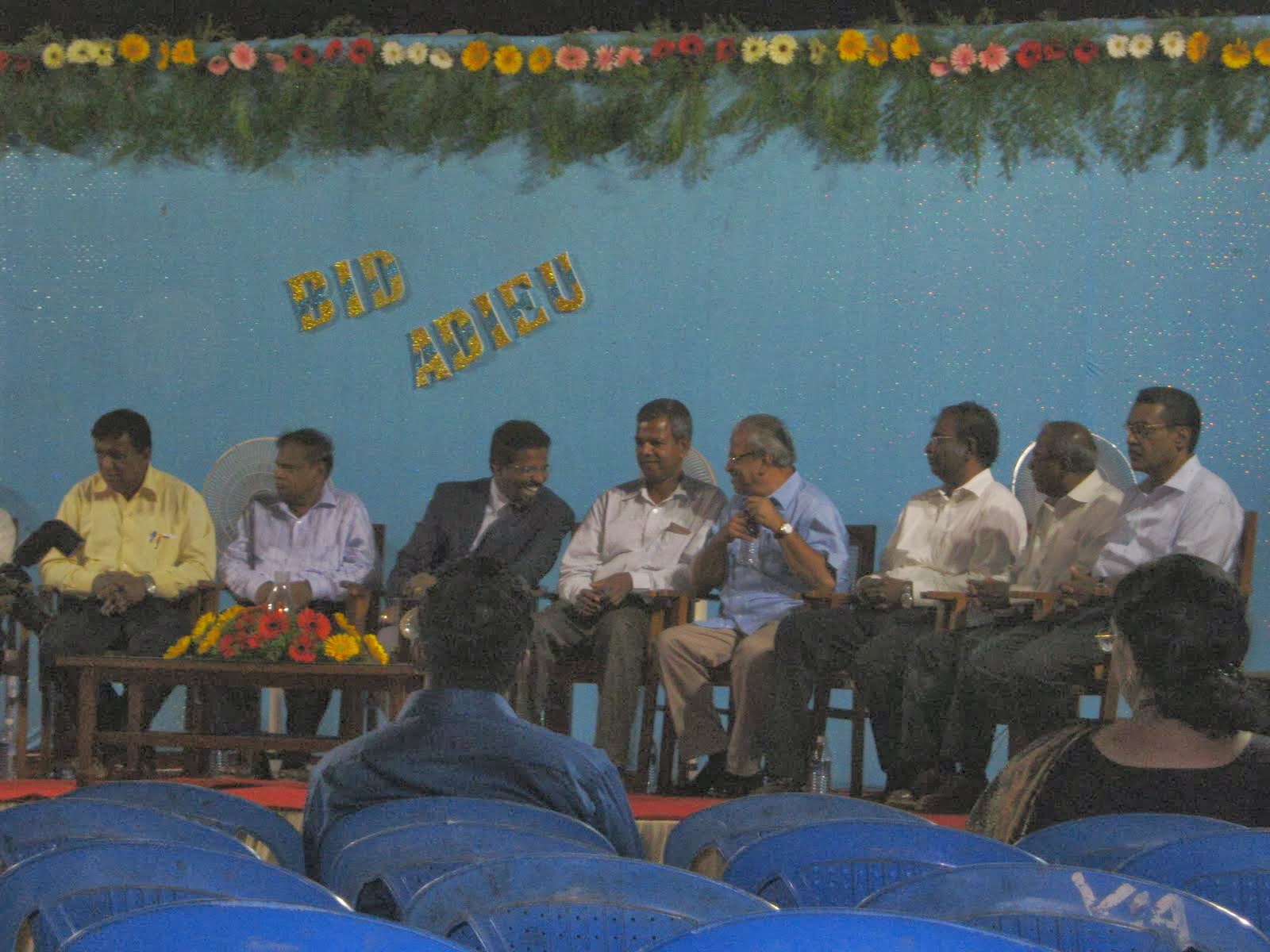
The College bid adieu to a host of luminaries, at a function hosted to felicitate the retiring Professors. In Pic: Prof.Victor Frederick, Dept of English, along with Dr.Ganesh, the Principal, Prof.David, Dr.Stephen, Dr.Lakshminarayanan, & Dr.Gabriel.

Thursday, 11 March 2010

Mimesis - 2010 - A Review

The Annual Inter-Collegiate Literary Festival - Mimesis 2010, conducted by The English Association, MCC, took off to a flying start on 09 March 2010.
The grand attraction of Mimesis 2010, was the Drama Competition. A Theatre Workshop was held and it was headed by Mr. V. Balakrishnan of Theatre Nisha fame.
A variety of Literary and Creative competitions like Quiz, ShipWreck, Be the Playwright, Drama competition (Mime, Musical drama, Monoacting...), Face Painting, Scene Sketching, Freeze Zone etc were conducted.
The two-day programme had a grand finale on 10 March. The event saw enthusiastic participation of many City Colleges and also from our own student volunteers, who along with the President, the HoD, and the other Staff members, made it a grand success.

Saturday, 23 January 2010

“Roman Fever” – Edith Wharton – A Critical Appreciation


Edith Wharton was born near Washington Square to wealthy and distinguished parents rooted in colonial times. She was educated privately at home and abroad acquiring an early command of foreign languages and an easy familiarity with English and continental society. Her first writings were poems published anonymously in 1880. At 23, she married Edward Wharton of Boston. They lived, at first, in New York city, then successively in New Port, Rhode Island and Lennox, Massachusetts, with frequent visits to Europe. In 1907 she settled permanently in France.

Her ethical sense, her poetic sensibility and compression were evident in her first collection of stories – The Greater Inclination (1899). Her other works include – The Valley of Decision (1902), The Descent of man (1904), The House of Mirth (1905), Ethan Frome (1911), The Fruit of the Free (1915) and The Tales of Men and Ghosts (1910). The Tales of Men and Ghosts contains some of her best stories of the supernatural. During the war years she gave much of her energy to the organisation of relief activities. Fighting France (1915) and The Main (1918) are war novels. After the war Edith Wharton returned to New York. The Age of Innocence (1920), her greatest novel, was awarded the Pulitzer Prize and has remained a landmark.

Edith Wharton’s stories were centered upon the changing society of New York city during her own lifetime. She viewed this genteel, formalised society with a woman’s eye; and being primarily a satirist, she was interested in the dynamics of the society itself.

The setting of the short story “Roman Fever” is important, simply because it symbolises the emotional state of the two principal characters – Mrs. Alida Slade and Mrs. Grace Ansley. The setting revives memories for “two American ladies of ripe but well-cared for middle age.” They have come back to Rome for a holiday in the company of their younger daughters.

Sunday, 1 November 2009

BELIEVE IN YOURSELF..! Excellent Tips for Writing a great Semester Exam:

Dear Students,

The following tips, it is ardently hoped, would help you face your exams with the right attitude of mind and in the proper perspective.

Before the Examination:

1. Get a normal night’s sleep before the examination date.
2. Reach the Exam Centre early and relax or discuss with close friends.
3. BE SELF-RELIANT: Check if you have taken your Hall Ticket, your College ID Card etc along with the required stationery needed for the exam. Do not borrow anything like pens, pencils, eraser etc from anybody in the Examination hall.
4. Check again the time and place of the Examination Centre.
5. On the examination day, leave home early so that you will don’t get caught up in traffic jams / hardships / tight-corners etc., as n
o student is permitted inside the examination centre 30 minutes after the commencement of the exam.
6. Have a light breakfast too, as energy is essential for good thinking.
7.DO NOT LEAVE VALUABLES like mobile phone, jewellery, cash etc outside the EXAMINATION VENUE. It might not be safe at all.

During the Examination:

1. Read the question paper and the instructions thoroughly. Mark the questions which you find you can answer. Ask the invigilator for clarifications, if any.
2. Make a rough time scheme and decide how much time you should allot to each question.
3. Leave 15 minutes at the end to review the answers and make corrections, as needed.
4. Before you start on any particular question, make sure you understand it/interpret it correctly.
5. Answer the easiest and shortest question first.
Answers should be brief and conforming to what is asked in the question.
6. If you get stuck up, proceed to the next question and come back at the end if there is time.
Leave a margin of 3 cm at the left side of the answer sheet, if there is no printed margin.
7. Mark the question numbers clearly in the left margin.
8. Clearly understand the difference between the usages "Define", “Distinguish”, “Compare”, “Describe”, “Illustrate”, etc.
9.
ORGANISE YOUR ANSWER SHEET: write legibly; use reasonably large size letters; don’t cram; space the lines. NUMBER ALL YOUR PAGES.
10. Do not write your name or any symbols that reveal your identity, anywhere in the answer sheet.
Morning Session starts at 9.30 am.
Afternoon Session starts at 2 pm.

Finally, be honest, and do your best..! God will take care of the rest..!
Here's wishing you happy writing! All the very best..!

Featured post

Upside-Down and Charmingly Unique | Meet the Velvet-fronted Nuthatch 💚

The Headfirst Acrobat | Meet the Velvet-fronted Nuthatch #intothewildwithrufus #birding The Nuthatch is one bird that’s fascinated me skyh...