Showing posts with label Travellogues. Show all posts

Monday, 26 May 2025

Meet the largest mongoose in Asia ๐Ÿ’š

The Stripe-Necked Mongoose

In Forests, Literature and Mythology

#intothewildwithrufus

We chanced upon these Stripe-Necked Mongooses in Nagarhole Tiger Reserve, Karnataka.

The Stripe-necked mongoose is the largest mongoose in Asia. They are native to southern India (primarily the Western Ghats and some parts of the Eastern Ghats) and Sri Lanka.

It always has a black stripe, thinly bordered with white, from ear to shoulder on both sides of the neck, and hence the name ‘Stripe-necked’!

The Mongoose is primarily terrestrial ie., ground-dwelling creatures, and spend a lot of their time foraging on the ground. Moreover, they are diurnal i.e., they are active during the day and generally solitary. They also tend to avoid human habitation.

They use their keen sense of smell and long claws to locate and dig out prey from holes in the ground or under debris.

Be it beetles, millipedes, ants, crickets, termites, grasshoppers, Rodents (mice, rats), small reptiles (lizards, small snakes), amphibians (frogs), ground birds and their eggs, they have them all.

In Indian mythology, Kubera, king of the Yakshas, is the guardian of treasures. His pet mongoose spits out precious gems.

In literature, mongooses are often depicted as brave and resourceful.  A notable example is Rudyard Kipling’s “Rikki-Tikki-Tavi”, where a mongoose named Rikki-Tikki bravely battles cobras to protect a family.

“The Loyal Mongoose,” a Panchatantra story, highlights the importance of careful thought before action.

A couple leaves their infant child with their pet mongoose for a while. Upon their return, they see the mongoose with blood on its mouth and immediately conclude it has harmed their baby. 

Without pausing to consider the situation, they attack and kill the mongoose. They soon discover their baby is safe and the blood on the mongoose is from a snake the mongoose had killed to protect the child. The story emphasizes the need to think carefully before acting and avoid making assumptions based on limited information. 

Best Seen At: Nagarhole NP, Karnataka; Aanamalai WLS, Tamil Nadu

Locally Common Social Unit: Solitary or pairs

Citations

Pattanaik, Devdutt. Indian Mythology: Tales, Symbols, and Rituals from the Heart of the Subcontinent. Vermont: Inner Traditions, 2003

Menon, Vivek. Indian Mammals: A Field Guide. Gurgaon: Hachette Books, 2014. 

Tuesday, 8 April 2025

The Great Home of the Soul - The Open Road! ❤️❤️❤️

What makes Japanese Travel Writing Unique?

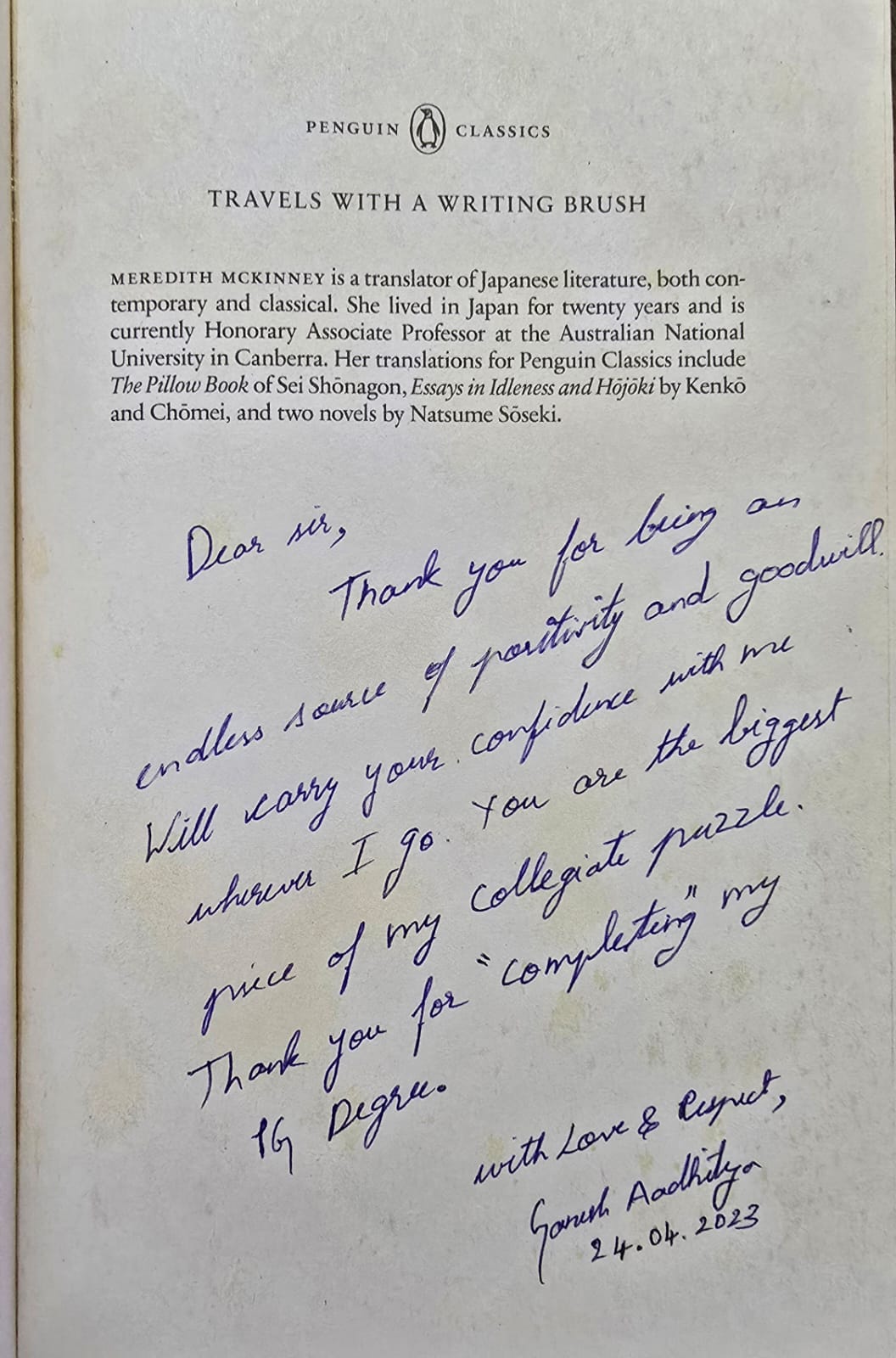
Travels with a Writing Brush

Meredith McKinney | Reflections

#lovelyreads

Epigraph comes first you see! ๐Ÿ˜Š

This book was given to me by one of our loveliest students, in April 2023!

And it has taken me a full two years to read this book! ๐Ÿ˜Š And at last here it is!

Here we go!

Well, first and foremost - to begin this lovely blogpost, I’ve got a series of seven rhetorical questions!

Where on earth do you find travel writing inspiring and impacting an entire nation’s imagination?

Where on earth do you find a literature of travel, documented as ‘Poetic Renderings’ or ‘Poetic Highlights’?

Where on earth do you find an inherent connection between travel and poetry embedded dep within a nation’s literary tradition?

Where on earth do you find places mentioned in poetry becoming significant literary landmarks for future travellers?

Where on earth do you find a unique literary tradition where the journey was not just a physical movement but also a source of profound poetic and emotional experience?

Where on earth do you find a nation’s literature and culture expounded through the specific lens of travel writing?

Where on earth do the evocative travel poems capture the aura and the essence of a place or experience?

The clue lies in the famous sobriquet –

The Land of the Rising Sun! ๐Ÿ˜Š

Woven so intricately in this lovely book titled, Travels with a Writing Brush by Meredith McKinney on the Japanese tryst with the twin sisters of poetry and travel!

Meredith Mckinney, by the way, is a translator of Japanese literature, both contemporary and classical. She lived in Japan for twenty years and is currently Honorary  Associate Professor at the Australian National University in Canberra.

Secondly, in a way, this post is also a continuation of our past post on Japanese Culture, by Pico Iyer, one of the greatest travel writers of all time!

Pico Iyer calls Japan - the home of ‘collected inwardness’!

As Proust once observed, “a change in the weather is sufficient to recreate the world, and ourselves.” The phrase ‘collected inwardness’ here could connote a person who is calm, self-controlled, and introspective! Travel teaches you this ‘collected inwardness’ says Iyer. You may want to read that past post HERE on our blog.

Meredith in this amazing book here, extends the metaphor a bit further and says that, this ‘collected inwardness’ is a unique feature not only of travel, but also of ‘literature of travel’.

As Meredith notes, in her book (by contrasting the Japanese impulse with the Western impulse to documenting their travels) -

Travel gave fresh impetus to the writer the ‘illusory option’ of flight from their wearied present.

As such, the traveller doubled up as a writer and an adventurer seeking the exotic or the wild, as an exemplar of the exotic, a connoisseur of fascinating landscapes, and an observer of strange habits, rituals and customs.

To the Western travel writer then, a successful travelogue carries with it, a great sense of curiosity and a sharp sense of humour – which were both part of the travel writer’s narrative strategies.

However, their eastern counterpart in Japan begs to disagree, differ and defer on this notion of travel!

To the Japanese travel writer, and reader, for many centuries it was above all the poems that were the point.

Travel writings were either ‘poetic renderings’ or ‘poetic highlights’. 

This has important consequences for the literature of travel that may make it at first somewhat disorienting for the Western reader. Where we might expect a more or less continuous narrative of the journey, what we often find is a series of short, disconnected scenes or episodes, sometimes quite briefly sketched, that culminate in a poem, bridged perhaps by a vague linking expression such as ‘On I went, and then …’ that vertiginously elides what can be a substantial amount of intervening time and space.

The effect is a little like a series of glowing points on an otherwise dark map, a kind of montage of intense poetic experiences rather than a realistic description of the journey.

So what makes this book unique?

This book by McKinney titled, Travels with a Writing Brush: Classical Japanese Travel Writing from the Manyoshu to Basho is an anthology that stretches across a thousand years of Japanese travel writing. It contains an assortment of songs, diaries, tales, and poetry, offering a unique glimpse into how travel inspired the Japanese imagination throughout history.

McKinney’s profound observations on the Japanese and their travel sensibilities are phenomenal in their import through each of the pages of the book are quite endearing and alluring to the travel buff!

She foregrounds the waka sensibility that governs the prose of most literary travel writing until the Edo period! Where the poetic effect is reinforced by the prose itself!

She adds,

In classical Japanese literature, one definition of good poetry is poetry that touches the heart. Celebration and delight, emotions that we may look for in poetry, play a relatively minor role, as does the purely imagistic description that we in the West associate with haiku.

Longing and absence, rather than fulfilment and pleasure, are at the heart of Japan’s classical love poetry (one of the great poetic categories), and it was only natural that these became the dominant themes also in travel literature, in which the landscape itself evokes the aware of the lonely traveller savouring his longing for home and absent loved ones.

The anonymous author of A Gift for the Capital, a quintessential medieval travel chronicle, sums up the experience of the literary traveller in the following description –

And yes, do pay attention to the poetic cadence to the prose, as you read… ๐Ÿ˜Š

There were times when I slept alone, blanketed in the wind off the high peaks; times when I woke to waves pounding the rocky shore, sleeves soaked from the wandering traveller’s sorrowing sleep. Times also when I chanced to hear in the grass by my pillow the small cry of insects weakening in the cold, and knew that autumn was at its end; or looking up from yet another bed in some fisherman’s rough hut, knew from the sky that the moon was rising now above a flood tide.

Wandering thus, drawn on along the road, I crossed the Shirakawa Barrier and, past the twentieth day, came to the banks of a broad river. This was none other than the Abukuma River.

I had heard tell of this remote place back in the Capital, and now standing beside it I felt the full force of how immensely far my journey had brought me. The ferryman drew up his boat, I and the other travellers hurried aboard, and as I gazed out over the wide water I saw that from the layered mountain range beyond smoke was rising.

I asked the boatmen about it, and they told me that it had begun in the same year the Kamakura government had fallen, and continued ever since. Strange indeed.

Disembarking and going on my way, I saw by the wayside a grave mound. It was evidently the doing of passersby, with a number of poems attached to nearby trees.

Someone explained to me that it was the grave of the long ago Chinese Prince Dong Ping, who had died here yearning for his distant home, and it was no doubt his longing that made the plants that grew upon his grave mound all lean westward toward China.

Moved by this tale, I was reminded of the similar story of the green grasses that grew on Wang Zhaojun’s grave. It seemed to me that any traveller who met his end beneath a foreign sky would surely long for the night smoke of his funeral pyre / to drift toward home, and I sighed at the folly of our worldly attachments. It moved me, too, to wonder if the dense line of pines that grew about the grave mound were what they call unai-matsu, the pines planted to mark a grave, and the thought put me in mind of certain old tales.

Home – what is it

 that still our hearts

 even when we have died

 and turned to dream

 remember it with love?

The greatest pleasure a literary traveller could experience was the pleasure of arriving in person at a place hallowed in poetry, notes McKinney.

Many other places visited by the travellers in these pages originally gained their poetic fame in similar ways; it was not the characteristics of the place itself so much as the presence of its name in literature (or sometimes in history) that lent it special power. The term for such place names, and by extension for the places that bore those names, was utamakura (poem-pillow), and their central role in travel literature was one of its defining features, she notes! 

This is not to suggest, of course, that the travellers in these pages were not men and women with their own stories, writing in varying ways from their own lived experience.

Rather, the waka sensibility and its great literary tradition gave expressive form and depth to the articulation of individual experience, and often also to that experience itself, says McKinney.

In such ways, both the land itself and the experience of those who travelled through it were overlaid with a complex palimpsest of the literary that integrated the two in much the same way that landscape and feeling might merge in poetry.

There’s one such poem by Sami Mansei from the early eighth century.

Mansei took the tonsure in 721, and is known by his Buddhist name. He was part of ลŒtomo no Tabito’s poetic circle. This poem is one of the most frequently quoted poems in classical poetry and plays a key role in later travel poetry, although it was better known in a later variant form. It is a rare example of a Manyลshลซ poem that expresses a specifically Buddhist sensibility.

To what shall I compare

 this world?

 It is like a boat at daybreak

 rowing away and gone

 leaving no trace

Sample this, on the Bay of Shiogama –

Dawn’s paling moon

 and with it fishing boats

 rowing out across the bay

 of Shiogama

recede toward nothing

whereupon his companion says -

What point in looking

 at the salt-soaked shells you bring

 from Shiogama Bay

 since I was not there with you

 to see it?

And the reply –

What point indeed

 in the salty shells

 given this bitterness

 though it was all for you

 I gathered them at Shiogama?

Well, one added feature of this book is the philological fidelity that McKinney tries to adhere to, throughout the book.

Something akin to Achebe’s glossing in his novels, Meredith McKinney does an extensive glossing of seemingly native, obscure or untranslatable terms, like the waka, the renga, the tanka, the hokku and the like!

Sample this –

Journal of the Kyushu Road adheres strictly to the norms of the literary travel journal, in which the prose descriptions are essentially incidental to the poetry composed along the way.

As a leading poet of his day, Yลซsai is made welcome along the way much as Sลgi and other renga poets were before him, and his journal reveals the central place that renga still held in the upper echelons of society.

The traditional tanka was still considered the paramount poetic form, but Yลซsai’s journal also records numerous hokku that he composed for the renga sessions that he was invariably invited to lead, and he does not hide the fact that he found this role onerous at times.

He was a highly skilled poet but not a great one, and his poetry generally follows the taste of the day with much playful punning, often on place names (which loses much of its force in translation). His occasional serious tanka on time-honoured themes such as transiency and longing seem more poetic exercises than deeply felt, and the real energy is in his lighter poetry,

observes McKinney. She then discusses the transition from renga to haikai by the famous Matsuo Basho in the 17th century.

Thirdly, a special word about the epigraph to the book [from D. H. Lawrence], that’s gonna thrill the travel buff –

The great home of the soul is the open road. ๐Ÿ˜Š

Fourthly, the translator’s preface, in which Meredith admits that, Classical  Japanese poetry is notoriously resistant to translation – especially the rhythm, a delight in punning word play, the crucial role of allusion, pivot words and the syntactic folding together of meaning, concision, ambiguity, linguistic nuance and more  besides: all these are virtually impossible to reproduce.

However, she also assures the reader that, she has tried her best to ‘honour the literary qualities of the writing, while simultaneously aiming as far as possible to remain faithful to the linguistic level of the text’ from Manyoshu to Basho! Her panoramic sweep of Japanese Travel writing that ranges well over a thousand years of their literary output, is simply outstanding!

Moreover, she observes that,

Although Japanese underwent considerable changes over the course of the thousand years covered here, its literary written language remained essentially remarkably stable.

Finally, this book was gifted to me by one of our best students ever – Ganesh Aadhitya, exactly two years ago. Hence, this post is also dedicated to you, dear Ganesh!

I should admit that, it took me some time to really start reading the book, and I could sense that, each page was really leading me deeper into the soul of Japanese Travel writing!

Thank you dear Ganesh. ๐Ÿ˜Š

I would like to end this post with a suggestion for the avid travel buff! You can think of doing your higher research and / or present papers on themes that connect with Japanese travel writing just for you to switch gears to higher, ethereal and epiphanic planes of awareness and modes of realisation! ๐Ÿ˜Š

PS: You may also want to read out past five-part series on Travelogues and Travel Writing in Literature HERE on our blog.

Friday, 1 March 2024

'Hum Aapke Hain Koun..! has become the paradigm or the very epitome of a family movie!' ❤️

International Conference @ DMC College | Goa

#goamusings #thedaytoday

1st March 2024

Early in the morning today, I went for a stroll down the streets of Mapusa, Goa, and I was quite fascinated by all things Goan!

Their architecture especially is something that requires a vivid detailed description in a separate post altogether!

This Portuguese architectural legacy beautifully blends the Mughal, the European and the Indian into an amalgam that gives Goan architecture its own unique aura of sorts!

On either side of the roads – one could see roadside shops selling eggs, milk and coconuts in makeshift tables spread out for the purpose!

And these temporary shops disappear within two hours into the morning, when traffic reaches its peak, and the sun gets into ‘intense’ mode! ๐Ÿ˜Š

DMC College is situated in a lovely hill that overlooks the Mapusa region of Goa.

We all had our breakfast in College. So happy to see two of our students from Chennai had made it to this Conference. Gautham who is presenting his paper, said that he had come all the way from Chennai to Goa, to present his first paper. So proud of you Gautham and Ezhil!

Sharp at 10 am, the Conference started in the Conference Hall. The invited guests lit the lamp, and this was followed by the Key Note Address by Dr. Vivek Sachdeva, Professor & Dean, University School of Humanities and Social Sciences, GGSIP University, New Delhi.

The Mobile Book Van @ the Conference Venue

His talk was on the topic, ‘New Cinema Form and Shifting Ideologies’.

Confining the scope of his talk to Hindi Cinema, Professor Vivek spoke about the impact of OTT and the new avenues for film distribution, that have changed the way films are made today, and on how we understand the OTT platform as a ‘new space’.

This ‘new space’ must be seen in relation to globalization, liberalization, digital revolution, and the post-pandemic scenario, etc, and for this this I'll fall back on narrative theory, he said.

Excerpts from his talk -

By new spaces, I mean, OTT has opened up new platforms – today, Turkish, Iranian, Korean films and a lot of South Indian films are made available online, based on subscriptions.

Moreover, they are simultaneously dubbed into multiple languages as well.

Some Hindi films were released on Amazon Prime even before they could be released on screen.

They've created a neo-cultural space for cinema through the OTT Platform.

This new space is an alternative space!

However, this alternative space is also controlled by consumerist ideology.

It's not a space of enunciation or alternative ideology but only a space for alternative consumption!

It has changed the relationship of viewers with cinema.

The old cinema was based on class-based stratification where those who cannot afford the luxury seats, were often seated in the front rows, or on the ground!

Imaginary communities watched the same movie together.

The use of Hindustani language also became a tool of resistance against British Raj.

It contributed towards fostering and imagining the nation.

Immediately after independence, depictions in Indian cinema included, themes of reforming rich brats or hardened criminals, and the challenges before India as a young nation, and the responsibility of young Indians towards society.

The poor were a regular constituent of the cinemas of the 1950s.

In contrast, the nature of cinema changed after the introduction of multiplexes. It increased the cost of living, and the poor were excluded from these cinema halls.

Films like Hum Aapke Hain Koun..! (1994) offered a spectrum of affluence. The folk songs and traditional rituals and Diwali celebrations have influenced society to such an extent that society has become bollywoodised! In short, Hum Aapke Hain Koun..! has become the paradigm or the very epitome of a family movie!

New cinema today is made with the newly emerging New Middle class, with the beginning of liberalization in India.

The new middle class with better pay package gave a fillip to consumerism.

These spaces were ‘spaces of consumption’ were food, high-priced popcorn and cinema were consumed at the same place!

Privatization of internet services with ‘broader’ bandwidth gave boost to video content on internet.

The first OTT was BigFlix launched by Reliance Entertainment in 2008.

The policies of liberalization allowed Amazon [2016] and Netflix [2017] to set shop in the Indian market, as a result of free economy.

Movies began to be watched in laptops, and became a highly personalized experience which has eventually affected the form, and the narrative experience as well!

A new genre, the Web series - a serialized form of narrative emerged because of the OTT Platforms.

TV adaptations of serialized visual Narratives.

However when it comes to OTT, the content part is tutored.

TV serials and TV series are different in their essence and they are based on the structure of narratives.

Web series like Mirzapur are based on crimes in remote parts of India. The Delhi police in fact appreciated the makers, because it was so close in the storyline to the Delhi police records.

[But we must also remember it is just a narrative of Delhi police record.] ๐Ÿ˜Š

The tone and tenor of representation changes in web series.

Mirzapur – the TV series highlights the nexus between money power and political power in society.

It tells the pressures of middle-class families, happily married women, their hidden sexualities etc.

This way focalisation assumes significance here.

Crime is no longer contained to the metropolis. Mumbai is not only a city of opportunities now but also a city of crime.

It differs from Italian new realism as well. It makes the films deceptively realistic, since they're made of lesser-known casts and crew as well. It lacks the dramatic acting and sounds which are associated with Bollywood.

These pseudo-realistic movies produced a reified image of rural India that's originally not there.

Away from the family, it gives them an individualised perspective to experience a story away from the gaze.

One drawback of these crime thriller series is that, they fail to give a socio-economic perspective to the crime, which used to be part of the new cinema of the 1950s.

Newly imagined gender roles are also shown, which blurs our perspective towards good and evil.

OTT has given space for alternative Narratives that have not found a space on big screen. Eg. Deepa Mehta!

OTTs hence are like online parlours with different packages.

They have emerged as an alternative space with new kinds of Narratives, but they have also become capitalistic!

OTTs have hence resulted in affecting the other forms and modes of cinema produced in the country.

In the context of ideology and habitus, the question that I would like to leave with you today is – 

Do you think art can transcend these metrics?

Signed off Dr. Vivek Sachdeva!

Then Dr. Geetha Bakilapadavu spoke on ‘Film and Ideology’.

Dr. Geetha is with BITS Pilani, Goa Campus.

Dr. Krishna Manavalli, Professor & Chairperson, Dept of English, University of Mysore, spoke next on ‘Christie Calling: Adaptations of Agatha Christie in Hindi Cinema’.

She began her talk with an interesting anecdote!

The queen of crime fiction – Agatha Christie - after a failed marriage and a traumatic divorce, or rather two years after her divorce, while visiting friends on an expedition in Iraq - she chanced upon Max Mallowan, an archaeologist who was 14 years her junior.

She found him quite engaging. But Max was sceptical, and so he asked her -

I don’t think you’d find life with me interesting. Won’t you be disturbed by the fact that so much of my work has to do with corpses?

She reassured him: "I adore corpses and stiffs."

With that began an exhilarating romance, and they lived happily ever after. ๐Ÿ˜Š

The genre of whodunit films.. hasn't received much justice, said Dr. Krishna.

Where's the reader in the translation?

Where's the viewer in the adaptation?

asked Dr. Krishna, before signing off on her Plenary Session!

On the whole, it was a very engaging morning session of Plenary Talks!

In the afternoon, while going for our lunch, all of a sudden, I saw a familiar voice beckoning me from quite nearby!

It was Dr. Susan Deborah! ๐Ÿ˜Š

It’s been ages since we had last met in Goa, some six years ago, and so it was so delightful to meet up with Susan. We missed meeting up with Rayson though! [Rayson, btw, is Professor with BITS Pilani, Goa Campus.]

She had arrived just in time to chair the afternoon’s session.

With the Speakers, Paper Presenters and the Organisers

I was so happy that we could talk over our lunch together.

It also reminded me of our vibrant Assam sojourn that had happened exactly 12 years ago, where we had presented our papers in the Conference in which Professor Gayatri Spivak was the Key-Note Speaker! ๐Ÿ˜Š

It was such a joy for all three of us back then, to spend three days in the intellectual company of Professor Spivak in Sibsagar College, Assam.

PS: You may want to read more about our memorable Assam Sojourn, and our rendezvous with Professor Spivak, on our past post HERE.

Thursday, 29 February 2024

'If the basis of all education is knowledge wielded by love then society can be transformed' | How A Single Comment Can Augment Your Perspectives for the Better! ❤️

So What is Literature 2.0? | Goa Musings

#thursdaymusings

#anecdotalevidence

#blogcomments

29th February 2024

This morning, at 4.45 am, our train chugged into Thivim Railway Station. Prof. Subhash from DMC College, Goa, was there at the station, to receive me warmly.

Then, on our lovely car drive to our hotel, I learnt a lot of local specifics about North & South Goa, about Konkani’s five alphabets [and hence five scripts] - Devanagari, Roman, Kannada, Malayalam and Perso-Arabic scripts that are currently used to write the Konkani language, about the famous tourist attractions, about how, for every two kilometres the language varies when it comes to Goa and how community plus geography determine the dialectical  variant of a particular region, etc etc!

But that’s meet for another post!

Today, just a few minutes ago, at 9.45 pm, we drove back from our lively dinner time at Jacob’s Creek, where our conversations over literature, culture and society went on and on for hours!

As I got back to my room, the first thing that I had resolved was to write a post on a lovely comment that I had received on our academic blog yesterday.

Well, for avid bloggers out there, this post is meant to motivate you to share your precious thoughts, of all hues - because you may not know how much it is valuable and useful to someone who is desperate to get inspiration from that particular post of yours! 


This comment was for a post [that I’d written exactly nine years ago, in February 2015] on this, our blogging site!

It was a critical take on Bertrand Russell’s “Education and Discipline”.

Back then, there were hardly any good critical summaries available for this wonderful essay by Bertrand Russell, and hence I took some quality time off to write and post a wholesome and simplified critical summary on this highly philosophical treatise!

And it felt so happy to to see a lot of encouraging comments for that post! Just posting a few here!

Today, I had received another such comment for this post, which said,

Russell’s earlier work, ‘On Education’, is also significant.

Well, this lovely comment, is the spur and the motivation for this post!

In the era of Digital Humanities, to rephrase a typical New Historicist parlance, these comments could also be called anecdotal evidence of the highest order!

This takes us to the concept of Literature 2.0!

In this era where the text assumes an entirely different avatar in the digital platform, it becomes all the more imperative on our part to know more about Literature 2.0!

What exactly is Literature 2.0 then?

Well, Literature 2.0 is basically about websites that host literary works – a poem, prose or play, on their platform, and also abundantly make use of user-generated content for their readers aka end users.

In this respect, Literature 2.0 helps in enhancing user interactivity and collaboration.

And this could also be called a kinda New Historicist reading since, it is also characterised by a ‘parallel reading’ of the text alongside its socio-cultural and socio-historical conditions, which form the co-text to the text, thus enhancing and amplifying the meaning of the text!

The ‘Textuality’ of the historical specifics hence become equally important in the production and the interpretation of the text! In other words, the historical specifics of a work of art, say a text, gets embedded into the text!

This reading and interpreting of the ‘Text’ in the context of the co-text includes both the literary and the non-literary as well, which make it ‘anecdotal!’ [Anecdotal Evidence].

In short, it is these anecdotal materials that prove valuable for the New Historicist to lay bare their truth claim that, meaning production is dependent on this so-called ‘fragmented stuff’ [reader responses of any sort, be it in social media, on You Tube, on blog posts, etc), that facilitate the shaping of an event or a story into ‘formalized facts!’

To sum it up, the anecdote or the anecdotal evidence helps in refashioning the historical reality as it really ought to have been!

Again, that’s simply because of the fact that, anecdotal evidence helps us to take into account the felt experience of the other as well!

So what is the book that the person has mentioned in the comment and why does it assume a lot of significance to enhance the original post?

Well, it’s Russell’s book ‘On Education’, in which Russell says that,

If the basis of all education is knowledge wielded by love then society can be transformed.

How true he proves!

It’s not knowledge alone that the child needs, but knowledge that’s wielded by love, that the child needs, and that can transform society for the better!

The comment, then, is an excellent exemplar to Literature 2.0!

Featured post

Reflections on a PhD Defence | Climate Positionalities and Malayalam Cultural Mediations ❤️

Localising the Climate Crisis Through Kerala’s Flood Imaginaries #PhD-Defence #IITM 29th July 2026 | 4 pm Today, I was happy to be a par...