Saturday, 15 March 2025

A Great Honour for our Alumnus Dr. Rao ❤️

A Great Honour for our Alumnus | Dr. Narasinga Rao

The “Grandfather of Undergraduate Research in Oklahoma”

University of Central Oklahama

Dr. Narasinga Rao is fondly known as the “Grandfather of Undergraduate Research in Oklahoma”. Dr. Rao also had the privilege of studying under Nobel Laureates, Dr. Herbert Hauptman and Sir John Eccles.

When he visited us in MCC, [on 25th & 27th May 2024 in MCC], he had given us a subtle cue and a clue – that an Endowed India Scholar Program was being planned in his honour by the University of Oklahama quite shortly.

And last week he mailed us the good news that, it had happened! 

The University of Central Oklahama had instituted the Endowed India Scholar Program to his honour! And how!!

About the Dr. S. Narasinga Rao Endowed India Scholar Program

The University of Central Oklahoma Foundation has established the Dr. S. Narasinga Rao Endowed India Scholar Program, a groundbreaking initiative aimed at fostering academic collaboration and cultural exchange between India and the United States.

This program honors the esteemed contributions of Dr. S. Narasinga Rao, emeritus dean of research and professor of physics and engineering, who has played a pivotal role in enhancing education and research at UCO.

The endowed program will facilitate visits from distinguished scholars, professors, and artists from India to UCO, enriching the campus community through lectures, performances, internships, and collaborative research. It aims to create a vibrant platform for knowledge sharing and support the study of Indian culture, philosophy, and humanities within a global educational context.

According to a press release from University of Central Oklahama -

Dr. Rao’s visionary leadership has already left an indelible mark on UCO, including the introduction of Sanskrit and Ethno-Musicology courses. His foresight in securing external funding has established important programs that elevate the university’s position in academics and research.

The India Scholar Program represents another step forward in UCO’s commitment to international scholarship.

“Education has become global, and everyone needs to interact and understand each other,” Dr. Rao said. “This program will enhance collaborative projects and discussions that allow students to learn from one another, building a strong support network across countries.”

The program will offer paid research internships to qualified graduate students from India, allowing them to gain valuable experience while contributing to UCO’s research endeavors. Dr. Rao and faculty advisors from Indian institutions will direct the selection process, ensuring that the program upholds academic excellence and relevance.

Dr. Rao’s contributions to undergraduate research have been recognized by the Oklahoma State Regents for Higher Education, and in 2024, UCO marked the 25th anniversary of Oklahoma Research Day, an event founded by Dr. Rao in 1999. This year also celebrates the 50th anniversary of the India Association of Oklahoma, further highlighting Dr. Rao’s lasting influence in the state.

UCO invites local communities and organizations to celebrate the launch of the Dr. S. Narasinga Rao Endowed India Scholar Program and its ongoing commitment to enriching the educational landscape through international collaboration.

For more information about the program and how to get involved, please contact the UCO Foundation at foundation@uco.edu.

About Dr. S. Narasinga Rao

Dr. S. Narasinga Rao, fondly known as the “Grandfather of Undergraduate Research in Oklahoma”, is a proud alumnus of Madras Christian College. Dr. Rao also has the privilege of studying under Nobel Laureates, Dr. Herbert Hauptman and Sir John Eccles. He is Professor Emeritus, Department of Physics and Engineering, University of Central Oklahoma.

He was back in his alma mater Madras Christian College on 25th and 27th May 2025 to relive and relish his good old days in MCC. Reminiscing on those memorable days of yore, he said that –

Narayanan, IAS, Former Economic Adviser to the Prime Minister, who was responsible for implementation of economic policies of several Ministries, was my student in MCC. He then became his colleague. There was another Narayan in the same batch. He became the Ambassador to Switzerland for six years. When I went to a conference in Hyderabad two years ago, I met him there.

MM. Rajendran, [Former Chief Secretary of Tamil Nadu, and Governor of Orissa] was my Demonstrator in MCC. He was one year senior to me. K. Ragunath, [who served as the Foreign Secretary of India, and Indian High Commissioner to Bangladesh as well as Ambassador to Russia, Nigeria and the Philippines], and K. Raman were brothers. They both studied here.

BPR Vittal, IAS, Former Chief Secretary, Government of Andhra Pradesh, and Secretary, Finance and Planning, government of Andhra Pradesh, from 1972 to 1982, and had a brief stint at the International Monetary Fund as fiscal adviser to the governments of Sudan and Malawi, was my friend,

he observed.

Born in Krishnagiri, Tamil Nadu in 1938, Dr. Rao did his BSc in Physics in Madras Christian College, Tambaram from 1955 – 58. He then served as a Demonstrator in Physics, in MCC, for three years. After completing his MSc in Physics with MCC in 1962, Dr. Rao, went on to become a Lecturer in Physics, in MCC from 1962-67. After having done his MSc in Physics in McMaster University, Canada, 1969, he then completed his PhD in State University of New York, Buffalo, NY, in the year 1973.

From 1973 – 83, he served as Senior Research Scientist with Oklahoma Medical Research Foundation. He then went on to become a Professor of Physics and Engineering with University of Central Oklahoma, from 1983-2009.

From 1990 – 2009, he was Dean of Joe C Jackson College of Graduate Studies and Research. From 2009 till date, he is Emeritus Professor and Graduate Dean, with the University of Central Oklahoma.

PS: You may want to read our past post on the Rendezvous with Dr. Rao, HERE. 

Friday, 14 March 2025

"Two women (in visual or print media) must be having a conversation with each other. But… their conversation must not be about a man"

Have you heard of this Bechdel Test?

Disrupting the status quo | Alison Bechdel

Well, I’m currently reading the book titled, Alison Bechdel: Conversations edited by Rachel R. Martin.

In her engaging introduction to the book, Rachel says –

If you have spent a long time resisting the status quo—whether it’s in art, society, or the political world—what happens when the status quo at last gives way?

A universe of possibility opens up.

Alison Bechdel stands in that universe of possibility. 

Thanks to the surprising success of her graphic memoirs, the Tony Award–winning musical adaptation of her graphic memoir Fun Home, and the honor of her being named a MacArthur Fellow, the status quo has been disrupted…

she notes.

So what makes Alison Bechdel special?

For many of us who work with Theory, Alison’s Test assumes a lot of significance. On the likes of a Simone de Beauvoir or a Laura Mulvey or a Judith Butler!

She’s quite popular for the Bechdel Test, named in her honour!

Wherein, two women (in visual or print media) must be having a conversation with each other. But… their conversation must not be about a man.

This test was created by Alison aka Alison Bechdel - graphic artist in 1985.

The purpose of this test is to assess whether a film or other piece of media adequately portrays women as characters with agency and relationships beyond their interactions with men.

This book introduced me to a few of the nuances behind the Test!

Here goes -

The “The Rule” strip from Alison Bechdel’s comic “Dykes to Watch Out For” (1986) introduced what is now known as the Bechdel Test, a simple test for gender bias in media.

This test is used to evaluate representation of women in films and all creative forms of media since then.

Quoting from an interesting conversation between Gross and Alison from off the book -

Gross: Alison, listeners will be really angry with me if I don’t ask you about the Bechdel test. And why don’t you describe what it is?

Bechdel: [Laughter] All right, well, I feel a little bit sheepish about the whole thing because it’s not like I invented this test or said this is the Bechdel Test.

It somehow has gotten attributed to me over the years. Many, many years, ago back in 1985, I wrote an episode of my comic strip where two women are talking to each other about—they want to go see a movie. 

And one woman says, you know, I’ll only go to a movie if it satisfies three criteria. I have to confess that I stole this whole thing from a friend of mine at the time because I didn’t have an idea for my strip—my friend, Liz Wallace. And Liz said, okay, I’ll only see a movie if it has at least two women in it, who talk to each other about something besides a man.

And that left very, very few movies in 1985. The only movie my friend could go see was Alien because two women talked to each other about the monster. [laughter]

But somehow, young, feminist film students found this old cartoon and sort of resurrected it in the internet era. And now it’s this weird thing. Like, people actually use it to analyze films to see whether or not they pass that test.

Gross: So . . .

Bechdel: And still, very few—surprisingly few films actually pass it, although more and more do.

Blogger’s Note: As Alison has observed, very few films have actually passed the test. Can you name them?

PS: You may also want to read our past post on a similar thread on the Smurfette Principle HERE.

Four Memorable Paper Presentations at In Tandem Today | A Report ❤️

In Tandem Symposium | Today

Friday, 14th March 2025 | A Report

Topic: Peace Studies

It was a memorable Symposium at In Tandem today, thanks to Dr. Preeti Srinivasan, Head, Dept of English, Queen Mary’s College (Autonomous), Chennai who made it possible for us.

All the four paper presenters were eloquent and had the grace and the felicity of expression on them, even as they helped us all tune to the various nuances of peace.

Ms. Harshina spoke on the importance of humanising the transgender experience which she felt, would result in promoting peace, by dismantling harmful stereotypes and prejudices, leading to a more inclusive and equitable society where everyone feels safe and valued. 

By fostering understanding and empathy, we can create a more peaceful and harmonious society where differences are celebrated rather than feared or marginalized, leading to the living of an authentic life, she averred, while analysing Lee Mokebe’s poetry.

Ms. Paulin Blessy spoke next, on ‘Human Family’ by Maya Angelou, wherein she emphasised on the necessity and importance of compassion in promoting peace. 

This, she feels, can happen only when we celebrate every culture for their uniqueness, embracing their differences. The fact that there is a repetition of the line, We are more alike my friends seeks to emphasise and reiterate this fact over and over again.

Ms. Bhooja offered a very interesting concept on celebrating linguistic peace. Putting forth her views that, the three-language formula could be a kind of smokescreen for imposition of Hindi, she said that, there is every possibility that regional languages, and the regional archives that carry indigenous / regional wisdom might be slowly phased out, if the three-language formula is foregrounded! 

Even the former Vice-President Shri Venkaiah Naidu has been a strong votary for celebrating one’s mother tongue! She also augmented her views with Maslow’s hierarchy of needs.

Ms. Annie spoke on the importance of maintaining ‘family peace’. Highlighting the pressing issue of how post-partum depression has been subtly relegated to the sidelines, she said that, mothers face a lot of anxiety and baby blues, which results in the erosion of family peace. For the family to retain and sustain its family peace, it’s highly important that, the mother is given a lot of empathy, care and attention.

Ms. Shobhana Prakash from I MA English, augmented their thoughts with her excellent observations.

Supporting Annie’s views, this blogger, quoted Sigmund Freud’s lines on the importance of mother’s welfare for the family. He says that -

“I have found that people who know that they are preferred or favored by their mothers give evidence in their lives of a peculiar self-reliance and an unshakeable optimism which often bring actual success to their possessors.”

The quote suggests that a strong, positive bonding with one’s mother coupled with the sound mental health of the mother can foster self-confidence and optimism in the children and thereby in the family.

Dr. Preethi gave a few enriching insights as well, and she suggested that, the paper presenters can further explore on the subject by looking up the concepts of positive and negative peace.

The session began sharp at 6.05 pm and ended sharp at 7.05 pm.

Ms. Annie did a very outstanding MC for the session. 

Congratulations Bhooja, Annie, Paulin and Harshina. You guys made the evening a very memorable and rewarding one for all of us.  

A British surgeon’s documentation of the flora in 17th Century Madras | Today's 'The Hindu'


Congratulations Dr. Gnanasekaran, Department of Botany, Madras Christian College.

We are so proud of you.

Thursday, 13 March 2025

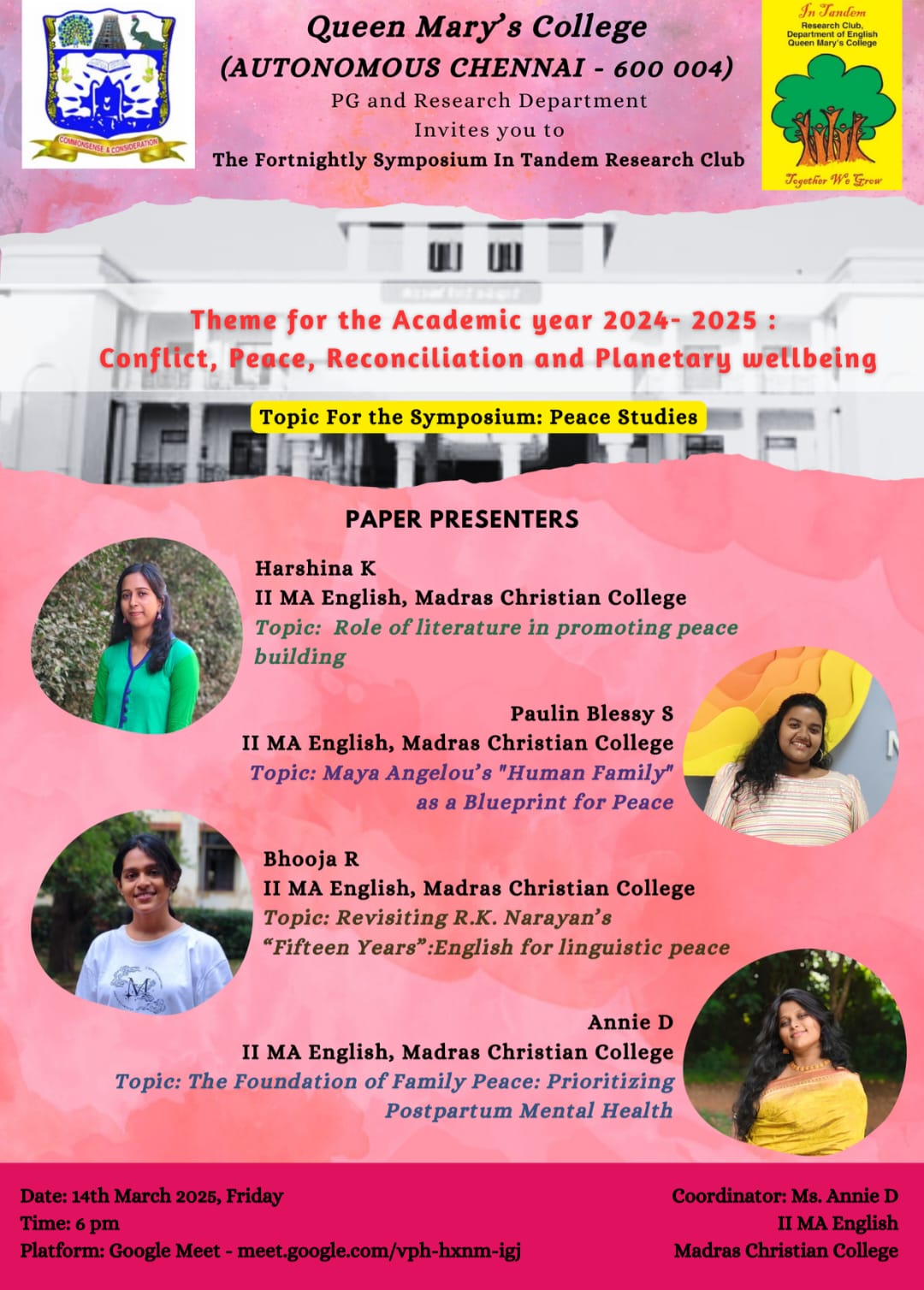
Cordially Inviting You...


The Fortnightly Symposium of

In Tandem Research Club

Invites you for presentations on

Peaces Studies

6 pm, Friday, 14th March 2025

Harshina K

II MA English, MCC

Paulin Blessy S

II MA English, MCC

Bhooja, R

II MA English, MCC

Annie D

II MA English, MCC

Google Meet Link: https://meet.google.com/vph-hxnm-igj

Saturday, 8 March 2025

Cordially Inviting You... ❤️ | FDP


FACULTY OF SCIENCE AND HUMANITIES FACULTY OF SCIENCE AND HUMANITIES   

SRM INSTITUTE OF SCIENCE AND TECHNOLOGY

Kattankulathur, Chennai

P.G. and Research Department of English

Organises a

“Global Connections, Local Realities: Tribal Studies in Multicultural World”

From 17 March to 23 March 2025

6:30 pm to 07:30 pm

Registration Link: https://forms.gle/sN3fGTrDzGBa4soy7

PROGRAM SCHEDULE

17   MAR - 23   MAR 2025

Registration Fees

Faculty Members: Rs- 200/

Last Date for Registration 15th March 2025

Account Details

Name of the Bank: City Union Bank

Name: SRM INSTITUTE OF SCIENCE & TECHNOLOGY

Account Number: 500101012865859

IFSC: CIUB0000117

The upcoming “Global Connections, Local Realities: Tribal Studies in a Multicultural World,” organized by the P.G. and Research Department of English, SRM Institute of Science and Technology, is structured as a transformative Online Seven-Day Faculty Development Program (FDP) from 17th March to 23th March 2025 (6:30 PM – 7:30 PM IST).

Rooted in the principles of glocalization, this initiative offers English educators a collaborative platform to engage with innovative pedagogical practices and explore the intersections of tribal studies, literature, and cultural narratives in a globalized world.

The program is designed to facilitate meaningful knowledge exchange among faculty members, addressing both global and local perspectives on literature, indigenous narratives, and contemporary research methodologies.

With a strong focus on digital teaching adaptations, it equips educators with essential tools for effective online instruction, ensuring an enriched virtual learning experience.

By fostering academic discourse on the evolving landscape of tribal studies, this FDP encourages faculty members to integrate diverse cultural frameworks into their teaching strategies.

Participants can expect an intellectually stimulating experience, gaining deeper insights into the multidimensional aspects of tribal literature, ecological narratives, mythmaking, and transmedial narratology.

Through this program, educators will not only enhance their understanding of contemporary literary landscapes but also develop innovative teaching approaches that resonate with students in the digital age.

Contact

Dr. Arunprabu C. S. - 8248259234 Dr. Arunprabu C. S. - 8248259234

Dr. Shalini Infanta L. - 9994320477 Dr. Shalini Infanta L. - 9994320477


"I see more meaning in words" | Celebrating an Illustrious Alumna of MCC on International Women's Day Today ❤️

On Our Illustrious Alumna Vidya Venkat

How she found her Unique Voice and Agency through her Writing

#InternationalWomen'sDay

Vidya Venkat | 2003 @ MCC


On the occasion of Women’s Day today, me thought of writing about one of our illustrious alumnae – Dr. Vidya Venkat, and how her writing helped her find her unique voice – and achieving greater academic heights in life.

Well, yesterday I had invited Dr. Vidya Venkat to interact with our students on the topic, ‘What is the Purpose of Writing?’

You may want to read on that, on our past blogpost.

Even as she was addressing her juniors, I was sitting there, listening to Vidya – when memories came flooding about Vidya as a vibrant student – how she’s evolved over the years, from being a vibrant I BA English Literature student in my class, to achieving such great heights – thanks to her passion for writing – writing with such dedication, commitment, consistency and a sense of purpose.

So well, me thought, this blogpost could highlight Vidya’s passion for writing - right from her UG days – which would be a great inspiration and motivation for all her juniors today – on the occasion of International Women’s Day today.

Vidya is a spontaneous poet. Even back then, almost 22 years ago - she used to write those soulful, spontaneous poems on her phone, and send it to us - her Professors - via the 160 character-text messages (SMS) of those days, when smartphones were almost unheard of!

When she wrote one such poem, and had it sent to me, (during her first year of her BA English Programme), I was so impressed with the spontaneity of her lines, that I replied to her by SMS (on my Nokia 1100), 😊 saying,

Lovelyyy, Vidyanjali.

Very soon, she had also started a blog on the world wide web, and christened it, ‘Vidyanjali’.

Front Cover of the Book
Poems of all hues and feature articles of myriad colours started adorning her blog.

Then when she was in her final year of her BA English Programme, she published her first book of poetry, with Writers Workshop, Calcutta.


In her introduction to her book, she writes –

Imagine you are standing under the night sky, its rippling black silk spreading above endlessly and the stars shining like diamonds studded in them. Would you, not even for a moment, be filled with wonder when you look up?

It is human nature to look up at certain things and be fascinated. And a poet often expresses his/ her fascination with life. As long as life offers such things as are fascinating, poets will be born (sometimes even the absence of fascination can be a resource of poetry).

Poets will talk about the world, their aspirations, their dreams, their successes and /or disappointments. Many a time questions are asked in poetry without answering them. But the questions matter to humanity at large.

The truth is that every human soul can find an echo of its own voice in poetry. It may be written by faceless people, living anonymous existences.

But their words, pouring out of their souls, will live and their chords will vibrate till life itself vibrates and provides ample proof of its existence.

I have penned the fifty poems presented in this small collection over the last two-and-a-half years, making an attempt to measure life in words and keeping in mind the generalisation mentioned in the previous paragraph (my life is everyone’s life).

In a small world, with a small life, experiences can also be so small, so similar, that they might even go unnoticed. Our diurnal existence provides us with ample material for poetry. Every poem here is therefore essentially a moment, captured and held in words.

We all live and dream and find and lose and wait and hope for things, but whatever life offers us, we must leave behind something, so I have decided to leave behind a voice...

15 December 2005

VIDYA VENKAT

The Introduction in fact, sets the tone and the tenor for the highly engaging fifty poems that follow.

The uniqueness of Vidya’s poetry is that, she allows her poems to have an ‘aboutness’ or a ‘purposiveness’ to them! In short, her poems speak for themselves – to each their aura.

Moreover, I’m so happy to note that, she talks and walks - true to her convictions and her credo – akin to the talk yesterday with our students – the convictions that she has for herself –

By bringing a certain perspective to literature that was missing earlier.

And I quote –

Mahasweta Devi gave voice to the Adivasis who were oppressed / silenced. Similarly, you find a purpose beyond your own emotional / psychological needs. A writer hence, must actively engage with the world,

said Vidya yesterday, while addressing her juniors.

True to her credo, giving a representative poem that she had published 20 years ago in her first collection of poetry.

A Poor Farmer’s Prayer

O! Itinerant dwellers of the sky
Shower your mercy upon us.
Our thirst is unquenched and throats are dry
O! Lend us a new life..
My fields are lying barren as sand,
The food we get doesn’t fill our hand
Then how will it soothe that painful groan
Of the stomach? And I'm not alone.

My children are being starved to death
My crops have failed, I've a debt;

Tell me what can I do but pray?
Hope to live or die one day…
The ministers had made us promises huge

Of making better our weary lives
In famines or calamitous deluge
Yet unfulfilled are they, don't know why...
We trust in you and your eternal powers
Who give us fruits and lovely flowers
Who bless our fields with bounty of green;
But such ruthlessness had never been!
Why ! Great Gods of the sky
Have you punished us so?
You I worshipped in fervour high
And sacrificed my goats
O! Do tell what mistakes are mine
And ever shall I repent
Forgive our faults, O! deity divine
And rains of happiness send…

This empathetic voice, narrated from a poor farmer’s perspective, seeks to foreground one of her chief credos to writing poetry – poetry with a purpose!

Yet another poem on the Dangers of Globalisation, titled, ‘Beware: Globalisation has come’, has an ‘Orwell-ian sense of urgency’ to its texture.

Interestingly, the poem is highly prophetic as well, as it foregrounds a bleak future, where ‘the world is no longer wonderful’, as ‘information’ overload starts getting the better of us, and over our sweet lives!

Here goes the poem –

Beware: Globalisation has come! (2005)

This world is no longer wonderful:
It doesn't take imagination to know
What America is like for an Indian;
The TV shows us all..
It doesn't take intuition to know
When mother remembered me because
I have a cell phone now...
It doesn't take industry to know
When what was done because
The computer does it all.
It doesn't take intelligence to know
What is what because
The internet has it all..
It doesn't take knowledge to live
Our lives, only information' matters,
And this world has it all..
You cannot start at a point here
And be rest assured you'd reach there again
You might risk toppling over the edges
For this world is no longer round…

In yet another poem, she talks about, how words give more meaning to her life – the hallmark of a true-blue literary being!

Here goes the poem for us –

I see more meaning in words (2005)

I see more meaning in words
Revealed like a ray of light, to the blind
Groping and searching about restlessly…

Where do you come from? And why
Only to me that privilege to see
What the others don't?
It comes and jolts and leaves me
Desperate, asking for more,
This whole business of poetry
Is not that easy as it may seem.
To set out decided on a sunny morn
And return with harvest by the eve
Is the dreamer's unfulfilled dream
But poetry is no silly dream, dreamt
By fair ladies on plush bowers
The man on the horseback never comes.

It is we who must go in search and wander
Amidst dark forests, suffer pain and then
Know what the others haven't known…

And the best among them all – with a Donne-ish and Freud-ian streak to the lines –

It’s titled, ‘Foreplay’

Foreplay (2005)

Create the mood.
Then, sustain the heat of the moment
By keeping the eyes fixed in a steady gaze.
Don't move! But be there and simply let
Sweet sensations fill you up
And erect the hair on your body.
Let nerves get nervous.
Let thought approach you ever so slowly
That it tortures with increasing want.
Let fingers move about restlessly
Looking for words.
Let the foreplay arouse your feelings enough
So that the poem reaches a wonderful climax
And only leaves you asking for more...

The above poems are part of her first publication (2005), and well, there has been no turning back for Vidya, since then!

She started off as a freelance writer and researcher in 2005, and during the early career days did script-writing, voice-overs and research work for documentary films for Doordarshan, India's public service broadcaster. She then worked for The Hindu group of publications for 7 years.

Her writing has been her key USP that has helped her fetch a fully-funded MA Programme with SOAS. In 2011, she won the Felix scholarship - a full scholarship awarded to six academically gifted and meritorious students from India to pursue her MA at the School of Oriental and African Studies, University of London.

Then she proceeded to complete her doctoral degree in Anthropology from SOAS, University of London, again, on a full scholarship (SOAS Research Studentship).

She is currently a research fellow on the European Research Council-funded Global Research Network on Parliaments and People. She also holds a Research Associate affiliation with the Department of Anthropology and Sociology at SOAS.

One key takeaway from Vidya’s academic life is her consistency.

For the past twenty years, she has been consistently putting her pen to paper for some purposive writing or the other.

She’s now got her own website where you can find her entire oeuvre at https://vidya-venkat.com/category/academic/

On the occasion of International Women’s Day today, let’s together celebrate the power of writing – especially of our women - the skill, the agility and the ability of our women writers wield their magic wand – the power of their words - to use their words to express unique perspectives, challenge societal norms, illuminate complex experiences, and influence social change through their narratives, often highlighting issues related to gender, identity, and societal injustices.

Bespeaks to the potent voice, agency and power that women can wield through the art of writing!

More power to you, Vidya. We are so proud of you!

Fast-forward to 20 years later, she continues to write such soulful poetry!

Even this January 2025 - she has woven a wonderful poem titled, ‘Pottery Lesson’.

Dedicated to all the lovely women students out there – who find more meaning in words – expressing their own, unique and phenomenal voices through their inimitable, phenomenal voices – through blogging, vlogging, speaking, dancing, writing – in their own sweet style!

More power to you dear all!

You make our lives better and our joys complete!

Friday, 7 March 2025

‘What is the purpose of writing?’ | Alumna Talk Today | in Campus ❤️

Dr. Vidya Venkat | Alumna Talk

@ MCC | Today | 7th March 2025

It was such a joy to have with us today, Dr. Vidya Venkat (2003 – 2006, BA English, MCC), to address the I MA English and II BA English Classes.


Dr. Vidya’s talk today was based on an article she had written for The Hindu on 2nd March 2018.

The article is titled, “Mahasweta Devi is not dead” - Though the writer is no more in the corporeal sense, her words, her thoughts, and the lives of those she touched infused subaltern writing with a tangible value and will ensure she continues to live on in our midst, observes Vidya.


Excerpts from her talk today -

Literature can be very liberating as a discipline. So today I wish to talk to you about ‘What is the purpose of writing?’ or ‘What does it take to be a writer?’

Einstein says that, “Logic will get you from A to B. Imagination will take you everywhere”.

There are many myths on what it takes to be a writer.

Firstly, the myth that, I had to read all these legendary, canonical works to be a writer. My classmates Arjun, Sara Abraham and myself we used to have reading lists for ourselves. It was such a humongous work, and quite intimidating as well. This myth shouldn’t impede me.

Secondly, the myth that, writing should use difficult words filled with jargon. However, it’s not so. The purpose of writing is to be understood. If you set out to intimidate the reader, you are not going to achieve what Orwell or Khaled Hosseini achieved. Your job is to reach a person you don’t know.

There’s also another mode of writing – done by Virginia Woolf among others of her ilk. It’s what I call, self-indulgent writing! They write about the mental process that they were experiencing, which I feel, is okay to an extent, but it doesn’t contribute in any way to society.

That’s why I love Mahasweta Devi. Because I personally feel that, the most important task a writer wishes to accomplish is – to engage with the world.

To be a writer who makes a mark! To be a writer who wants to be remembered!

She brought a certain perspective to literature that was missing earlier.

She gave voice to the Adivasis who were oppressed / silenced.

Water, Land and Forest were the three issues that she was engaged with.

The purpose of writing is all about interiority.

So you find a purpose beyond your own emotional / psychological needs.

A writer hence, must actively engage with the world. Listening is an important skill for the writer.

Mahasweta Devi was an active listener. Her literature had a purpose to it. I read Bell Jar, but I wasn’t convinced enough. But Mahasweta Devi opened my mind to something beyond me.

She was able to step outside of herself – observed the humanity around her – gave voice to the voices that were suppressed.

In the Mahabharata, Draupadi cried out “Krishna, save me” when Dushasana tried to disrobe her. However, Mahasweta’s Draupati begs to differ. This is the message that she gives to every oppressed woman in this world, through her powerful characters. ‘You don’t need anybody to save you. You’re powerful yourself’.

She has mobilised such powerful characters.

Take Anne Frank for example. She started writing in her diary on June 14, 1942, her 13th birthday. She continued writing in it for two years while hiding with her family in Amsterdam. She was able to impact the whole world through her writing, because she had something to say.

So as a writer, you have to figure out what you have to say!

Svetlana Alexievich is one such writer, who wrote Voices from Chernobyl, a book about the Chernobyl disaster. She witnessed a disaster and recorded it for posterity. She won the Nobel Prize in Literature in 2015 for her work.

Denise Levertov was a founding member of the anti-war collective RESIST, along with other prominent activists. She also participated in the Writers and Artists Protest against the Vietnam War.

Levertov was a poet, essayist, and activist who opposed American involvement in the Vietnam War. Her poetry often combined personal and political themes, and she sought to motivate others to be aware of social and political issues. She also spoke out against nuclear weaponry and the Persian Gulf War.

Arundhati Roy talks about how communism is failing in Kerala and casteism is on the rise!

Similarly, even today, Orwell is relevant because his works continue to highlight the dangers of authoritarianism, government surveillance, and the manipulation of language and information!

In summing up - to write, you need to have a pen, a paper and a sense of purpose,

she signed off.

The Talk was held in the II BA English Classroom, QSC Building, and it was well-attended by students of I MA and II BA English Classes.


[Vasanth, II BA English, gave a memento to his senior Vidya, while Terese Maria, I MA English, honoured our guest of the day with the traditional shawl. Andrea, II BA English was the official photographer for the event]

About Dr. Vidya Venkat

Vidya Venkat is a writer and musician based out of Chennai. She has a PhD in Social Anthropology from SOAS University of London and has worked as a journalist and communications consultant in India since 2005. When not engaged in worldly pursuits, you can find her afloat in her private Universe penning poems and songs.

She completed her doctoral degree in Anthropology from SOAS, University of London on a full scholarship (SOAS Research Studentship). She is a research fellow on the European Research Council-funded Global Research Network on Parliaments and People. She also holds a Research Associate affiliation with the Department of Anthropology and Sociology at SOAS.

Her interests broadly lie in the areas of development, environment, human rights, politics and international affairs. Her writings have appeared in leading English language publications in India and abroad, including The Hindu, Frontline, The Statesman, Biblio-A Review of Books, Pambazuka, Outlook, Open, etc.

In 2011, she won the prestigious Felix scholarship - a full scholarship awarded to six academically gifted and meritorious students from India to pursue an advanced degree at the School of Oriental and African Studies, University of London.

Sunday, 2 March 2025

"Be a big person, be large-hearted, think big" ❤️

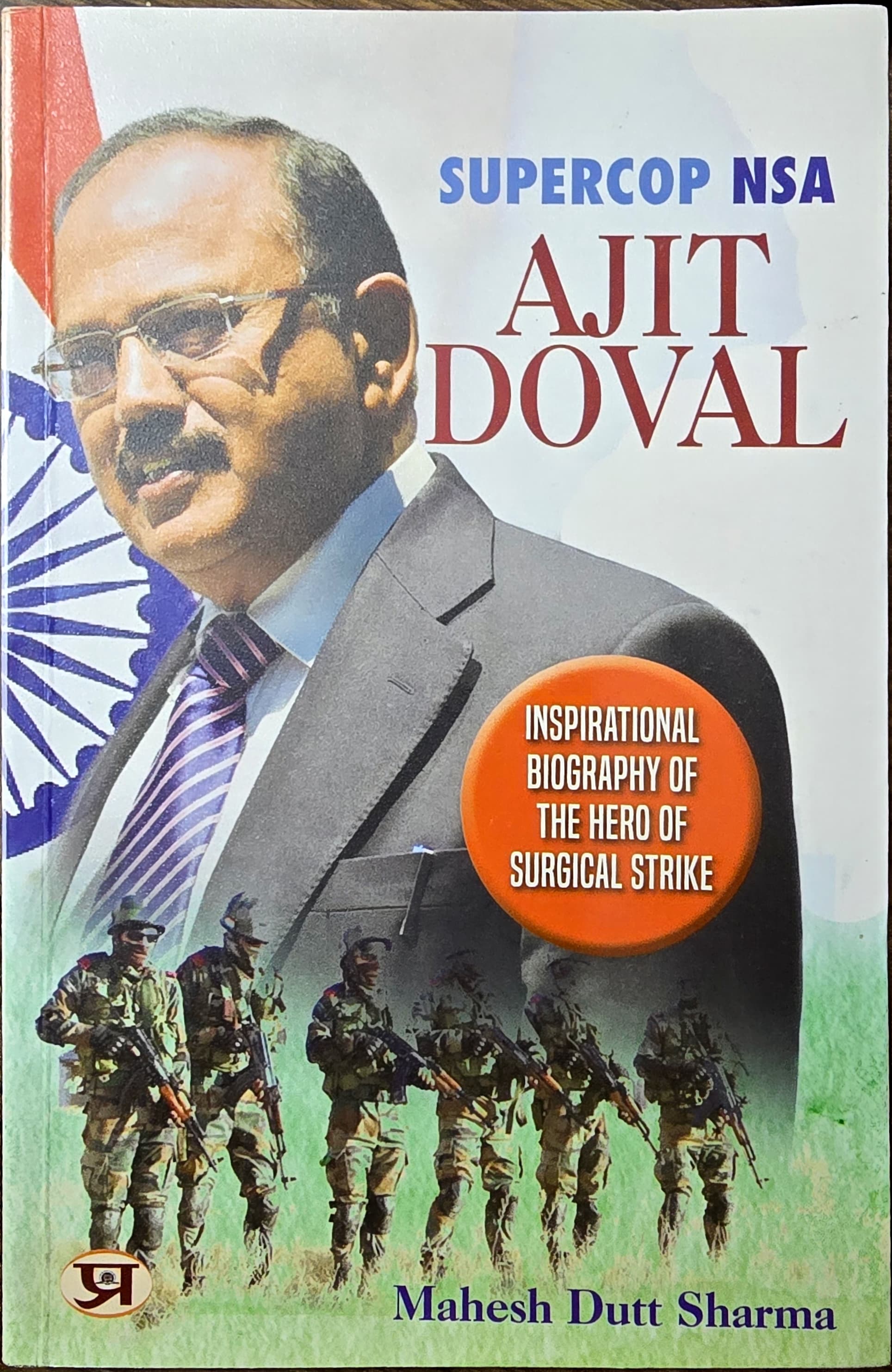
Supercop NSA AJIT DOVAL

The Inspirational Biography of the hero of Surgical Strike

By Mahesh Dutt Sharma

Vignettes Gleaned from the Book

Personally, I cherish it when - for a change - students come up to their Professors and say, ‘Sir, you should really read this book. It’s so inspiring’.

And here I would like to acknowledge a few of such lovely student-recommends that I had got from my vibrant students.

The first student-recommended book that I received was from Dhanavaishnavi, MA English, and it’s titled, Hunger by Knut Hamsun.

Yet another student-recommend that I received this year, was from Lakshmi Ramaswamy, II MA English, and it’s titled, Demian, by Hermann Hesse.

Jerusha from II MA Philosophy had recommended one such book. It’s titled, Lost in Thought: The Hidden Pleasures of an Intellectual Life by Zena Hitz. (Mr. Sabari, III BBA is reading it now). 😊

And this particular book, titled, Supercop NSA: Ajit Doval. It’s by Mahesh Dutt Sharma. This book I received from Anagha, I MA English, a month ago.

Well, this inspirational biography on Ajit Doval is quite engaging and inspiring for many reasons.

Ajit Doval – is one of the most respected officers of the Indian Police Service. Having joined the IPS in 1968 in the Kerala Cadre, he retired in January 2005 as the director of Intelligence Bureau.

He is popularly known as the James Bond of India, and ‘Operations Man’, and has the distinction of being the first police officer to be awarded the Kirti Chakra, the second-highest peace-time award in India, after the Param Vir Chakra.

His adventurous stint as ‘Supercop’ is something highly laudable, and the stuff that thrillers are made of.

After a particular incident in 2014, he was appointed as National Security Adviser of India. In 2014, ISIS terrorists took 46 Indian nurses captive in Iraq. To rescue them, India undertook an intelligence mission, under which Ajit personally went to Iraq, to understand the ground reality. He interacted with the ISIS terrorists, took them into his confidence, and successfully brought all the nurses back home safely.

As an undercover operative, he spent seven years in Pakistan, gathering information on intelligence and terrorist activities.

Since the author Mahesh Dutt Sharma also happens to be a journalist, he does an inspiring interview with Ajit Doval, in Chapters 19 & 20 of the book.

Two such replies that he gave to a few questions intrigued and inspired me much. Reproducing it here below.

Question: You said that you do not use a cellphone, do not use a computer for communication, but have many profiles on social media, on Twitter. What do you have to say about this? Several ideas are promoted on these for a by calling them your views.

Ajit Doval: I do not have any social media account not did I have any account till now. All of them are either my well-wishers or are fake accounts. But I would like to tell the audience that whatever you see on Ajit Doval’s Facebook or Twitter accounts, don’t get confused by it. It don’t have any such account. Maybe when I stop working for the government, then maybe I would create an account. But I don’t have an account right now.

Question: India is a country of youth. What would you like to say to the youth about how to take their future forward, how to make India more secure?

Ajit Doval: I think our youth are so well-informed and so motivated that I don't need to tell them much in terms of information. They browse and know everything about where the opportunities are.

But I want to tell them something about their attitudes, which can make their lives more worthwhile. We all have an identity. The smaller the identity, the smaller the person.

Expand your identity. I have an identity; I am Ajit Doval. If I live as Ajit Doval, what I eat or what my hobbies are-that is all there is to it. But if I live for my family, then my identity gets bigger. When I live for my village, it gets even bigger; people know that I belong to a particular village.

Some people identify themselves by caste and people say that he belongs to a particular caste. You are growing, but you are not getting a big identity.

Connect your identity with your country. You will become part of a very big family. Today my identity is that of an Indian, I have no ethnic, linguistic or regional identity. Being an Indian is my identity.

That's why I feel that I am as big as India. Every Indian should feel the same way. That's the way.

You see that something wrong is happening in your country. If someone is tearing the railway seat or someone is creating a mess, then you feel bad. You feel that someone is defiling your country if they speak against it. I don't have much time, otherwise, I could have told you about many incidents.

Once, Vivekananda was going to America from Japan by ship. He saw that an Indian, who had bought the ship ticket but had not bought a meal ticket, was being given some snacks instead of a full meal. He started cursing the Japanese saying that it was discrimination etc. Maybe he probably did not even understand the language and that caused the dispute.

A Japanese got up and said, "Here is your food Until the ship reaches its destination, I will not eat, rather I will give my food to you. But if you utter a single word against Japan, I will throw you out of the ship."

He could give up his food but could not hear a single negative, objectionable or offensive word against his country. It is a feeling. Develop such a feeling. Be a big person, be large-hearted, think big. Rise above trivialities, Don’t pursue small benefits, or small facilities. Think Big. When you grow up, the whole of humanity becomes yours, like Buddha or Gandhiji. Your identity becomes bigger than just that of a human being.

Our Vedas give us a greater identity than that of being just human; SO, I am connected to everything that has life. Some people become so great that they think that the formless Brahma has given them everything.

Whether there is life in it or not, it is part of me and I am part of it. This is Aham Brahmasmi or Shivoham. This is how you become great.

Materialism, modern values make you a smaller person. In the eyes of your children, your wife, you keep shrinking. Even your parents, relatives, your society and country do not matter to you. You just think that only you matter.

So, change your attitude. Be proud to be an Indian, live for India. When you do this, you will be very happy, even if you die doing it, you will still be proud. Death will come anyway, but you will be proud of it. So, live your life well and die in a way that will be remembered, signs off Ajit Doval.

A book that I highly recommend for today’s youngsters, to get that much-needed inspiration that would lead to compelling action – action that would advance the nation - in their own sweet ways.

Featured post

Four Urgent Interventions to Reimagine Indian Academia ❤️

Why Having Great Faculty on the Rolls is the Real Asset of World-Class Universities Hindustan Times 18 November 2026 #newspaperinlearning I...