Sunday, 22 June 2025

"What the Best College Students Do" ❤️❤️❤️

What the Best College Students Do

#reflections

Thoughts on the Eve of a New Academic Year

22nd June 2025

Tomorrow heralds a new beginning for freshers who are just transitioning from School life to College life. For all ye freshers stepping into College life, we warmly welcome you to the rewards of a blessed College life.

Tomorrow, Monday, 23rd June 2025, at 8.15 am, kindly be seated in the Anderson Hall, for the UG Orientation for all Freshers (Aided Stream). And for all ye students of the Self-financed Stream, please assemble in the Anderson Hall by 1.15 pm tomorrow.

Our Principal & Secretary Dr. Paul Wilson will be orienting you towards life in College, and he will also be introducing the various officials of the College, starting from the Bursar, the Vice-Principals, the Deans, the Associate Deans, The Heads of Departments, the Controller of Examinations and the various Unit Heads as well.

Coming back –

What makes College life impactful?

Well, College life is a transformative time, and hence making the most of it involves a blend of academic focus, personal growth, and social engagement.

For this, let me put down a few salient points on what your College Professors expect from you!

Or rather what I would expect from my student in their College life. 😊

Firstly, Professors expect students to be regular and punctual to class. Professors have an eye on students who miss classes on a regular basis. Yes! they take it very personally, and even as a mark of disrespect when the student continuously absents themselves to their class, or comes late to their class, without informing them in advance.

Secondly, Professors admire students who complete their course work / assignments by deadline, without ‘requesting’ for any extension. This is one of the most important aspects that a professor expects from their students. Every extension of the deadline speaks to the failure on the part of the student in wisely managing their time!

Thirdly, Professors expect students to participate in class activities with enthusiasm, by taking notes of lectures, encouraging their fellow students, asking thought-provoking questions, etc.

Fourthly, Professors expect their students to make the best use of their time in College. This could be by participation in class discussions, group discussions, panel discussions, competitions, extra-curricular activities, etc in a consistent manner, and also by making best use of the Campus resources available to the student. 

Fifthly, classroom conduct is something that makes the student earn brownie points from the Professor. While the teacher is lecturing, they would expect the student to avoid distractions like excessive talking, using phones, or studying for other classes during lectures.

Sixthly, Professors admire students who are able to manage their time effectively - make use of their spare time by doing internships/part-time jobs, blogging, vlogging, reading, or preparing for their future, in a consistent and planned manner on a daily basis, and also by attending career fairs, workshops, and mock interviews to brace themselves for their future. 

Finally, professors expect students to meet them with prior appointments during office hours. While meeting with your Professor in-person, or talking to your professor over phone, list out in a sheet of paper, the points that you wish to talk to them for clarification/discussion, etc. Professors are valuable mentors who have the gift of guiding you in the right path. 

You can ask them specific questions, discuss concepts you don’t understand, seek clarification on assignments, or ask them suggestions on planning for your career ahead of you.

Since your Professor will have a host of other commitments and responsibilities to attend to on a given day, always meet your professors with a neatly drafted agenda, so that you don’t end up wasting your time or the time of your Professor’s, in the process.

Ken Bain a highly acclaimed educator, author, and expert in teaching and learning, and currently the President of the Best Teachers Institute in the USA, in his famous book titled, What the Best College Students Do, gives real-life experiences to augment his findings.

The book argues that simply chasing high grades (surface learning) often doesn’t lead to genuine understanding or lasting knowledge.

Instead, it emphasizes “deep learning,” which involves understanding concepts, making connections across disciplines, asking important questions, and seeking meaning and application for what is learned.

The most successful students are driven by curiosity, interest, and a passion for learning says Ken. Moreover, they are intrinsically motivated to explore and understand, he avers.

He then narrates the story of Sherry Kafka –

Sherry Kafka came from a small town in the Arkansas Ozarks. Her family didn’t have much money, and they moved around a lot trying to make ends meet. She went to sixteen schools in twelve years.

When Sherry was in the eighth grade, she wanted to be a writer. To become a writer, she realized that she needed to learn more, and that meant eventually going to college.

Because her family was poor, she knew it wouldn’t be easy, and thus she began to fish around for some means to pay for her higher education. In her senior year of high school, she entered and won a national writing contest that promised to pay all expenses for her first year in college.

That fall she arrived on campus, full of excitement about her new adventure in this faraway city, and was presented with a list of mandatory courses.

Before she left home, however, she had promised herself that every semester, she would take at least one course “just for me,” something she would enjoy.

When she looked at the list of requirements, she spotted a happy coincidence, a course that looked interesting but also fulfilled a fine arts requirement.

It was a course in the Drama Department called “Integration of Abilities.”

The title itself spoke to a childhood memory. When she was a little girl, her father had told her that the most successful people, “the most interesting” people, the people “who got the most out of life,” were the “people who were the best integrated.”

He had told her that she should make a connection between every course she took and find ways that they overlapped.

“When I studied,” she concluded, “I should think about what happened in biology and how that applied to English, or music.” She decided to enroll. It would change her life.

Over that first meeting and in the days to come, her professor, Paul Baker, invited Sherry and the other students to participate in a new kind of learning.

“To some,” he said, “growth is almost all” just improving your memory.

To others, “it lies in learning how gadgets work—how to put motors together, how to attach pipes, mix formulas, solve problems.”

The purpose of that type of growth, he said, “is never to develop a new method but to become extremely adept at the old ones.”

To a third group, growth means you develop “cults” and “systems” in which you can estimate “how far below your own standards other people have fallen.”

You “join, dictate, slap backs, smoke cigars in backrooms, belong to important committees, become a pseudo artist, musician, actor, prophet, preacher, politician. You drop names and surround yourself with position.”

To only a few, Baker concluded, “growth is the discovery of the dynamic power of the mind.”

It is discovering yourself, and who you are, and how you can use yourself. That’s all you have.

Baker emphasized that in all of human history, no one has ever had your set of body chemistries and life experiences.

No one has ever had a brain exactly like yours. You are one of a kind. You can look at problems from an angle no one else can see. But you must find out who you are and how you work if you expect to unleash the powers of your own mind.

As Sherry Kafka sat in that revolving chair, now listening intently, her professor invited her into that highest level of growth.

“Everybody is unique,” he kept saying, and you have much to contribute to the world.

“Each of you has your own philosophy, your own viewpoint, your own physical tensions and background,” he emphasized.

“You come from a certain soil, a certain family with or without religious background. You were born in a certain house to a certain family at a certain time. Nobody else in the world has done so.”

You can, Baker argued, create in ways that no one else can.

The book goes on to narrate the lives of students who went to college and emerged from that experience as dynamic and innovative men and women who changed the world in which they lived. The book talks about how their college experiences, particularly their interactions with professors, change their patterns of thinking.

Fundamentally, we want to promote deep, passionate, joyous, and creative learning, says Ken.

Grades are important, but anyone who concentrates just on making straight A’s will probably not become a deep learner. Anyone who concentrates on deep learning, however, can make high marks.

In a series of studies, Nolen asked students, “What makes you proud?”

Some said things like, “I feel most successful when I score higher than other students and I show people I’m smart.”

She called these people “ego-oriented,” and they correspond to our strategic learners.

Others responded that they felt most successful when they got a new idea, when something they learned made them want to find out more. She called these people “task-oriented.”

We’ve called them “deep learners.”

Nolen also uncovered another type of student. She called these people “work-avoidance” types.

We’ve seen them before as surface learners. They told her they felt most successful when they could “get out of some work,” when all the “work was easy” or when they “didn’t have to work too hard.”

In part, Ken observes that, success thus comes simply from taking control over your own education, from realizing that you are in charge.

Opportunities to learn matter, and without them, no one can succeed, but given the chance, our subjects had to find their motivation for working, says Ken.

With the right opportunities in front of you, and the best college that you have enrolled yourself in, here’s wishing you deep, passionate, joyous, and creative learning in your College life.

And through each of your memorable days as part of your brief sojourn in college, may you develop a holistic personality, across all key dimensions, nurturing the “whole person” equipping yourself each day, towards becoming a well-rounded, adaptable, and emotionally intelligent individual ready to navigate the complexities of life.

Best wishes for you!

Saturday, 21 June 2025

MCC among the TOP TEN in INDIA - Yet Again! ❤️❤️❤️ | On Digitalisation & Knowledge Economy ❤️

MCC among the TOP TEN in INDIA

FIRST in South IndiaYet again! 

The Day Today | #reflections

21st June 2025

Today we had the IT Committee Meeting from 10.30 am onwards in the Council Room. Mr. Satish Rajkumar, Head of Digitalisation and IT @ Volvo Energy in Bengaluru was the invited speaker.

Mr. Sathish shared some enriching ideas on digitalisation, and the benefits of implementing a digital transformation through office automation that would thereby result in organizational transformation.

Our Principal Dr. Wilson reiterated on the importance of Digitalisation and knowledge economy as invaluable assets for the future. Ensure that you monetise your knowledge in creative ways, he added.

Well, unlike agrarian or industrial economies, knowledge economy is an economic system which foregrounds knowledge, information, and intellectual capital as the most valuable assets!

This in turn, gives added emphasis on value creation through human capital viz., skills, expertise, creativity, intellectual property like patents, copyrights, etc.

The meeting ended at 1.40 pm.

Today, we got the exciting news that MCC has improved its position in the TOP TEN in India, in the latest India Today 2025 College Rankings.

Last year MCC was placed TOP SEVENTH in India, and this year we have moved one notch higher – placed TOP SIXTH in India.

We have been placed in the FIRST SPOT in South India, and FIRST in Chennai as well.

PS: You may want to read more on our past rankings in the TOP TEN (July 2021) on our past post HERE

Short-Term Intensive Online Coaching by MCC’s IASC ❤️

TNPSC Group IV – 2025

📚 Short-Term Intensive Online Coaching by MCC’s IASC

🗓️ 23rd June to 9th July 2025

🕑 2 PM to 5 PM | 45 Hours | Fee: ₹2000

🔹 Focused Preparation

🔹 Mock Tests

🔹 Mentor Support

🔹 TNPSC-aligned syllabus

👨‍🏫 MCC faculty-led. Open to all aspirants.

🛑 Registration closes 23 June 2025.

👇 Tap below to register & pay

📌 Register: https://forms.gle/oLAxiwvr38ZW5cUm6

💳 Pay Fee: https://u.payu.in/PAYUMN/XJazahjH8Ams

Friday, 20 June 2025

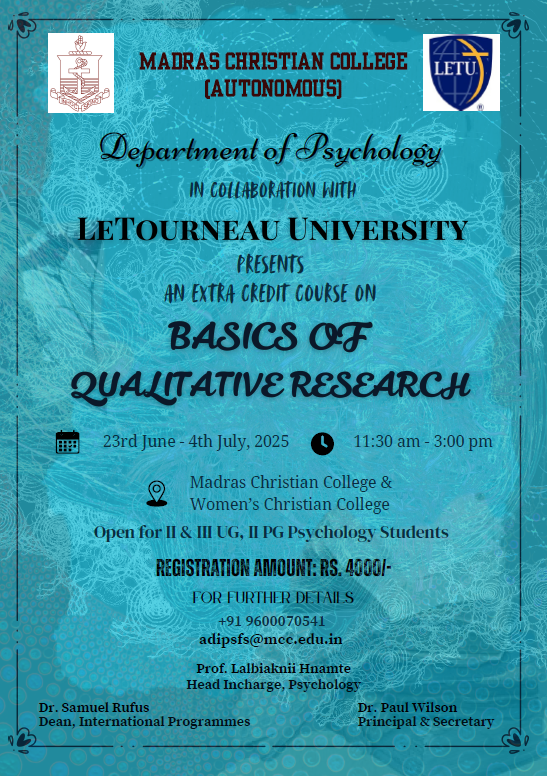
A One-Credit Course on BASICS OF QUALITATIVE RESEARCH - Reg.


20th June 2025

LeTourneau University, Longview, TX 75602, United States

in association with

The Department of Psychology

Madras Christian College (Autonomous) Chennai – 600 059  & 

&

The Department of Psychology

Women’s Christian College (Autonomous) Chennai – 600 006.                                               

Offers

A One-Credit Course on

BASICS OF QUALITATIVE RESEARCH 

Eligibility: Apart from students of Psychology, anyone interested in Studying the nuances of Qualitative Research

Resource Person: Dr. Vicki Sheafer, Dean of the School of Psychology & Counseling & Chair of Undergraduate Programs in Psychology & Counseling, LeTourneau University, Longview, Texas, USA 

Duration of the Course: 23rd June 2025 to 4th July 2025 [Ten days] 

Course Venue

23rd June 2025 to 27th June 2025 - Women’s Christian College Campus 

30th June 2025 to 4th July 2025 - Madras Christian College Campus 

On successful completion of the Course, participants will be given a Course Completion Certificate.

Students desirous of participating in the Course, may pay the Registration fee using the link below, by selecting the following option – “LeTourneau Extra Credit Course” on or before 7 pm, 22nd June 2025.

https://wcconline.wcc.edu.in/WCC_IOB_PG_MVC/WccPay/WEpayment

For more details, please contact –

Dr. Millicent Serena, Associate Dean of International Programmes, (SFS) at 9600070541

or

Dr. Lalbiaknii Hnamte, Head, Department of Psychology, MCC, at 9626189504

Best wishes,

Office of International Programmes

MCC

Thursday, 19 June 2025

India Records its strongest Presence in the QS World University Rankings 2026 ❤️

The TUK-TUK-TUK Bird in MCC | Today 

19th June 2025

#reflections

Felt so happy to read India’s strong presence in the QS World Rankings, cited in today’s Times of India.

India hits record high with 54 institutions in QS university rankings, says the article. 

IIT-Delhi Tops India At 123, IIT-Madras Breaks Into Global Top 200

India has recorded its strongest presence yet in the QS World University Rankings 2026, with 54 institutions making it to the list — a significant jump from 46 in 2025 and 45 in 2024. 

This 390% increase from just 11 ranked varsities in 2014 makes India the fastest growing higher education system among G20 countries and the fourth most represented nation in rankings, behind only the US, UK, and China.

Leading the Indian pack is the Indian Institute of Technology Delhi, which climbed to a joint 123rd position (alongside Georgia Institute of Technology, US) — its best-ever showing. In 2025 and 2024, the institute stood at 150 and 197, respectively.

This steady rise is backed by strong scores in Employer Reputation (50th globally), Citations per Faculty (8th), and Academic Reputation (142nd), highlighting its growing global stature. 

While IIT-Bombay slipped to 129th this year from its all-time best rank of 118 in 2025, it remains in the global top 130 and continues to score highly on Employer Reputation, ranking 39th in that indicator.

IIT-Madras, meanwhile, recorded one of the most dramatic improvements in 2026 — leaping 47 places to reach the 180th spot. This is the first time it has entered the global top 200, marking its best-ever performance in the QS rankings.

Other top-performing Indian institutions include IIT-Kharagpur (215), IISc Bangalore (219), and IIT-Kanpur (222).

Among non-IITs, Delhi University (328) and Anna University (465) featured in the top 500 for India.

The inclusion of eight new Indian universities in the 2026 edition — more than any other country — signals a broader institutional momentum. However, India’s rise has been uneven.

Despite improvements in research strength and academic reputation, challenges remain in areas critical to internationalisation.

The International Students Ratio remains a key concern, with 78% of Indian universities seeing a decline in this indicator.

No Indian institution ranks in the global top 500 for attracting international students, which affects the diversity and global exposure on campuses.

Similarly, the Faculty-Student Ratio presents a structural bottleneck.

OP Jindal Global University is the only Indian university in the global top 350 for this metric. While the country works towards its ambitious target of achieving a 50% Gross Enrolment Ratio by 2035, concerns persist around the capacity to recruit quality faculty at scale.

Moreover, as against 12 Indian universities in top 500 in 2025, there’s one less in the latest rankings,

says the article in today’s ToI.

Coming back -

Today a lot of parallel FDPs and Workshops were in progress in our College. Thanks to our visionary Principal Dr. Paul Wilson for organizing such empowering Programmes for the benefit of the larger MCC Community.

The HoDs and Deans had their special Leadership Training Programme for the second consecutive day today.

Today, after the Programme got over at 5.15 pm, I started clicking a few lovely bird and deer pics in campus.

When… to my sweetest surprise, I got a darshan of the Coppersmith Barbet – three rather – sitting pretty on one of the towering trees.

The Coppersmith barbet gets its name from its unique “tuk... tuk... tuk...” call – that strongly resembles a coppersmith hammering metal, and hence its name! 😊

What’s more?  When the Barbet makes these “tuk tuks” the bird’s beak remains shut during each “tuk”. Because of this unique ventriloquist sensibility in the Coppersmith Barbet, it is often difficult to pinpoint its exact location, say bird enthusiasts.

The Original Shot!

Added, its very presence offers a visual treat to the avid bird watcher!

Its striking plumage that’s predominantly green, allows it to blend remarkably well with foliage. Added, it has a vivid crimson forehead and throat, and vibrant yellow cheeks with a yellow eye-ring.

Giving us all a few more lovely Nature Clicks taken today. 😊

The Asian Open-Bill

Spotted Deer in Campus Today
Spot the Three Tuk-Tuk-Tuk Birds!

The Common Moorhen

Wednesday, 18 June 2025

"To be dedicated is to give oneself to something completely" ❤️

The Day Today | Reflections

18th June 2025

#reflections

Firstly, today, we were so happy to welcome the two students who had arrived earlier this week, to spend their Semester Abroad in MCC.

Our Principal along with the Dean of International Programmes, the Associate Deans of International Programmes (Aided & SFS), Dr. Robert, Dr. Marilyn and Dr. Prince cordially welcomed them today.

Secondly, today, I was so happy to get two lovely books from my kindred spirit, on J. Krishnamurti. When he came all the way to our Office to hand them over to me, he was so excited, saying, ‘Sir, I know you’ll love these two books. It’s by your favourite JK’. 😊

I was also touched by his noble gesture yesterday, in recommending Ms. Lekhaa’s books to their local lending library. He then shared with me the happy news that the library had got her books on their stacks.

This, I feel is the greatest encouragement we can give for such budding writers. I also shared the joy with her.

Ms. Lekhaa’s books can be purchased HERE on Amazon.

Added, so happy to note that, Ms. Lekhaa has been selected to do her Fall Semester Abroad with LeTourneau University, Texas.

Thirdly, at 3.30 pm today, I was delighted to be part of the Viva Voce Examination of Ms. S. Keerthana, IIT Madras, who has done a highly commendable thesis under the supervision of her vibrant guide Dr. Divya, Professor, IIT Madras.

As one of the External Examiners for her thesis, I was so happy to see the panoramic sweep in her thesis titled, “Changing Shores, Shifting Horizons: Mapping the Ontology of Female Subjectivity in Post-1960’s Tamil Women Narratives”.

The researcher has done a very insightful and extensive study by contextualising and conceptualising theoretical paradigms in the works of the selected authors, ably bringing out their activist tendencies, and how the writers define or rather re-define feminism as a polyvalent site marked by freedom, rebellion and subversion.

I had also suggested to the researcher to consider publishing her thesis as a book.

I particularly loved the quote by Simon Gikandi that the researcher used as a kind of touchstone to their writing –

‘To write is to claim a text of one’s own; textuality is an instrument of territorial possession … narrative is crucial to our discovery of selfhood’.

How true!

Just started reading J. Krishnamurti’s book on Teaching: The Greatest Profession.

Here, a questioner asks him –

One of our professors says that what you are telling us is quite impractical. He challenges you to bring up six boys and six girls on a salary of 120 rupees. What is your answer to this criticism?

J. K replies –

If I had only a salary of 120 rupees, I would not attempt to raise six boys and six girls; that is the first thing. Secondly, if I were a professor, it would be a dedication and not a job. Do you see the difference?

Teaching at any level is not a profession, it is not a mere job; it is an act of dedication. Do you understand the meaning of that word dedication?

To be dedicated is to give oneself to something completely, without asking anything in return, to be like a monk, like a hermit, like the greatest teachers and scientists – not like those who pass a few examinations and call themselves professors. I am talking of those who have dedicated themselves to teaching, not for money, but because it is their vocation, it is their love.

If there are such teachers, they will find that boys and girls can be taught most practically all the things I am talking about,

says J. Krishnamurti. 

Now, finally, for today’s Clicks from Nature’s Plenty for all of us!

The Grey Pelican or Spot-billed Pelican of Chennai's Wetlands
The Spotted Owlet in Campus

Tuesday, 17 June 2025

The Dawn Chorus of the Birds | City vs Forest Birds | A Study in Contrast 💚

The Song of the Woodlands | Where is Creativity?

#reflections | Part II

17th June 2025

Quite early into the morning today, at around five am, I was walking my way towards my bistro for my cuppa 😊 all the while listening to the lovely songs of the birds from the trees that lined up the streets on either sides.

Listening to the songs of these birds was indeed so pleasant to the ears – and makes us appreciate the inherent musicality in their songs! However, the noise and clamour of the city literally drowned the birds’ cute vocalizations.

Then I thought of contrasting it with the songs of the birds that I was listening to, deep in the forest, almost around the same time, quite early in the morning, just around a month ago!

The contrast in the dawn chorus was so striking!

Call it the “Lombard effect,” wherein urban birds tend to sing louder to overcome the background noise and clatter of the city.

Catchpole and Slater in their exciting book on the subject titled, Bird Song: Biological Themes and Variations, observe that –

Birds with territories in noisy parts of the city sang more loudly than those elsewhere. Under normal circumstances they might therefore not be singing at full volume. This raising of the amplitude of vocalisations in noisy conditions is known as the Lombard effect. (101)

In sharp contrast, the acoustic environment of the forest is so arresting! Rather mesmerizing and therapeutic to the soul!

Call it the Acoustic Adaptation Hypothesis, wherein the acoustic signals (like calls, songs, or other vocalizations) produced by animals are tuned to maximize their transmission efficiency!

It is said that, urban birds might alter the structure of their songs, by having shorter songs or fewer pauses, for better audibility and reception!

On the contrary, forest birds often exhibit more complex and varied song structures, as they are not under any sort of pressure to alter the structure of their songs!

In this regard, I would like to quote from one of my favourite poems.

Indeed, one of the best poems that has laid a claim to my heart, is Tagore’s “The Tame Bird was in a Cage”.

An awesome poem with such mystical undertones.

There is a tame bird who lives in a cage. It represents a state of being that is so accustomed to comfort and security, possibly at the expense of true freedom.

Tagore juxtaposes this bird with the free, wild bird, flying freely in the sky, singing of the “forest,” “the open sky”, and the boundless expanse of the sky! It embodies absolute freedom, independence, and a connection to the vastness of nature.

Now, the wild bird flies near the cage and calls out to the tame bird. It asks the tame bird to come out into the open sky, inviting it to share its freedom.

However, the tame bird, that seems quite ‘contended with its comfort’, in turn, invites the wild bird into its cage, offering it the “grains of food” given by its master - symbols of comfort and security.

Despite their apparent affection or desire for connection, there seems to be an unbridgeable divide between them. The “love” between them, as the poem states, “is a sigh in the void.”

Although both try to talk it out, their words and worlds are highly incompatible!

The free bird cries, “O my love, let us fly to the woods.”

The cage bird whispers, “Come hither, let us both live in the cage.”

Says the free bird, “Among bars, where is there room to spread one’s wings?”

“Alas,” cries the caged bird, “I should not know where to sit perched in the sky.”

The free bird cries, “My darling, sing the songs of the woodlands.”

The cage bird sings, “Sit by my side, I'll teach you the speech of the learned.”

The forest bird cries, “No, ah no! songs can never be taught.”

The cage bird says, “Alas for me, I know not the songs of the woodlands.”

In essence, Tagore beautifully foregrounds the stark contrast between the free bird - representing true freedom, and attaining one’s true aspirations and ideals in life, and the tame bird in the cage - representing material attachments, worldly comforts, and being constrained by the conformities of life.

In this regard, it would be apt to quote from Freud’s Civilisation and its Discontents, to see the compelling connection between the two texts.

To Freud, like with Tagore, civilization, while necessary for human survival and cooperation is achieved by repressing and sublimating one’s primal instincts, which leads to a constant and sustained feeling of “discontent” or “unease” in the individual.

Although Tagore’s approach is more mystical and philosophical, and Freud’s take is psychoanalytic, both writers seek to foreground a ubiquitous human dilemma: the great conflict within an individual – the realities of being constrained by conformities, and the ideal of living a life of unfettered freedom!

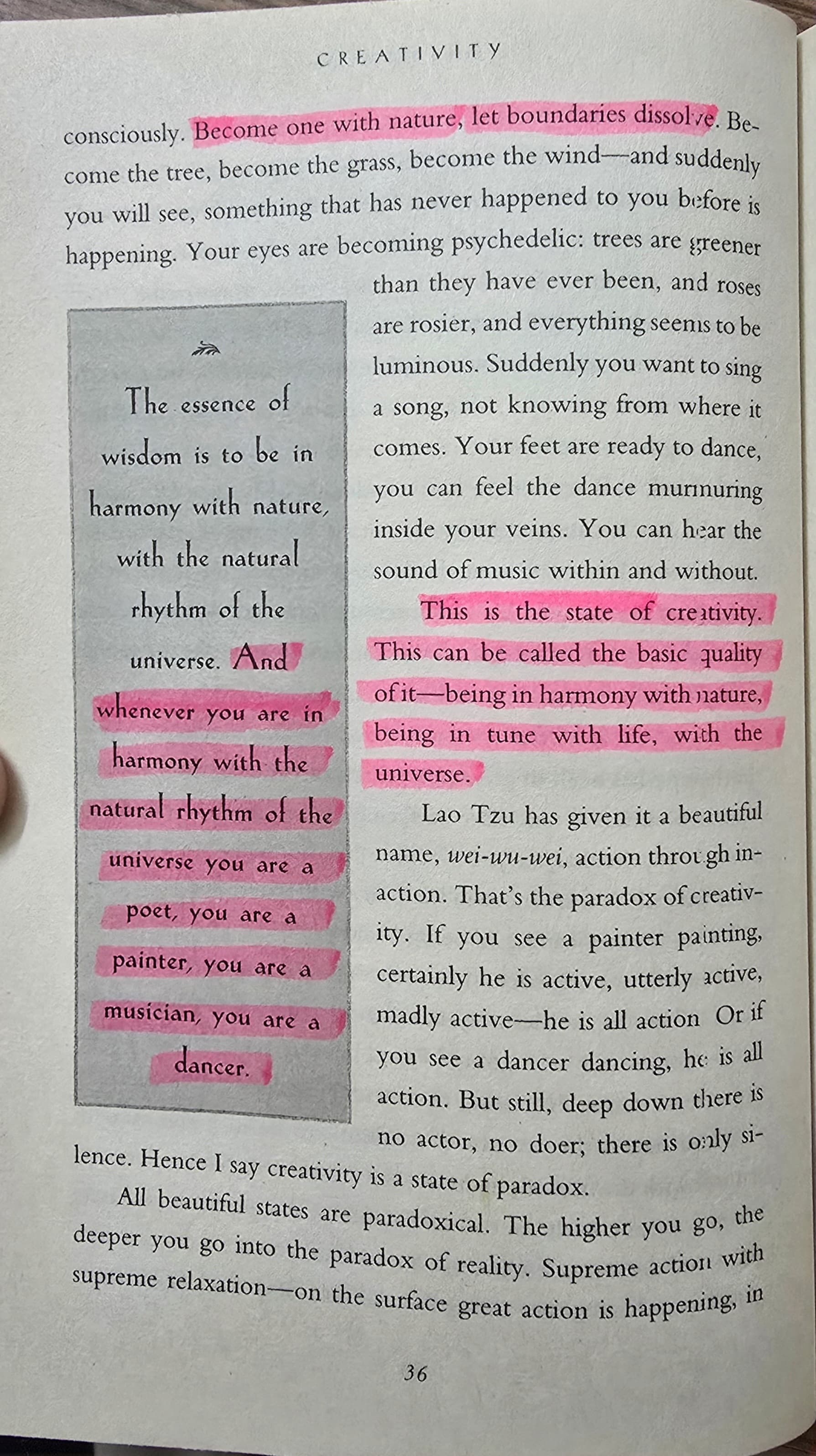
And this state of unfettered freedom is the state of creativity, which can be achieved only when one is in harmony with nature, says Osho.

Now, over to the video - 


Featured post

Upside-Down and Charmingly Unique | Meet the Velvet-fronted Nuthatch 💚

The Headfirst Acrobat | Meet the Velvet-fronted Nuthatch #intothewildwithrufus #birding The Nuthatch is one bird that’s fascinated me skyh...