Wednesday, 12 October 2011

“A Definition of a Gentleman” – Cardinal Newman - Critical Summary

Introduction:

John Henry Newman’s The Idea of a University is an attempt to define a liberal arts education.  In this book, he argues that the primary purpose of a university is to develop the mind, and not merely to dispense information.  He was strongly in favour of a ‘liberal education' which he contrasted with commercial or professional education. According to him, a student, after his studies at the University, must be able to cultivate a lifestyle according to what he or she has grasped and practised from the university way of living. The present essay, “A Definition of a Gentleman” is an excerpt from The Idea of a University, a series of lectures given in Ireland in the year 1852.
Who's a Gentleman?


One who never inflicts Pain:

Newman defines the gentleman as one who never inflicts pain. This, according to him, is the most refined as the most accurate definition of a gentleman. Outlining the qualities of a gentleman, Newman says that, a gentleman doesn't assert his nature, but instead makes others who are around him feel comfortable and at ease. He also helps others by making it easier for them to succeed.

Gentleman – Compared to an Easy Chair or a Good Fire:

A true gentleman is like an easy chair or a good fire that helps people to be warm and cozy. An easy chair does nothing really; it just provides a wonderful place to relax and make people feel at ease and at comfort. Moreover, we don't have to do anything to enjoy the easy chair; it is always there, always welcoming, and always comfortable. Similarly, the gentleman is not always in front of you, but still he is there... waiting with open arms to comfort you, helps make your life easier, and to support you when you need it most. The gentleman is also compared to a good fire, which helps dispel cold and fatigue. The gentleman in like manner, is a secure solace during times of sadness and weariness, and is a warm reassurance of solace during times of trouble.

Tuesday, 11 October 2011

"The Art of Living" – Samuel Smiles

by Samuel Smiles
Introduction:

Samuel Smiles is still well known today as a writer and moralist. His works have always reflected the spirit of his age. This essay, “The Art of Living” is an excerpt from Chapter XVI of his book Thrift (1875).Arguing for the importance of the seeing eye and the feeling heart which are an ingredient of good taste, the essay also celebrates the eminent household qualifications like Prudence, Punctuality and Perseverance, which eventually result in peace, comfort and domestic prosperity.

The Art of Living in Actual Life:

The Art of Living is the art of turning the means of living to the best account – in short, it is the art of making the best of everything. It is the art of extracting from life its highest enjoyment, and, thereby reaching its highest results.

Like poetry and painting, the art of living comes chiefly by nature; but everyone can cultivate and develop it. It can be encouraged and developed by parents and teachers, and perfected by self-culture. Without intelligence, it cannot exist.

Monday, 10 October 2011

I Year Part II English - Lesson Summaries - Reg

Dear Students of I Year Part II English, 
Your lesson summaries for Semester I, will be uploaded in a phased manner starting tomorrow. 
The last date for submission of your Assignments is Wednesday, 12 October 2011. You may hand in your assignments to me personally on any working day between 12.30 and 2 pm in the English Department Staff Room.
Regards and all best wishes, 
Rufus
Course Teacher

Saturday, 8 October 2011

II Year Part II English - Lesson Summaries Link - Reg

Dear Students,
Notes for your II Year III Semester Part II English have been uploaded in an easy format HERE.
You can download or print them by clicking on the respective buttons found on top of the document.
Regards and all best wishes, 
Rufus

Friday, 7 October 2011

I BSc Zoo (Reg) - II CIA Test - Reg

Dear Students of I BSc Zoology (Reg),  
For your II CIA Test with me on Monday, 10 October 2011, you will be tested from the following:  
Poetry
A Very Indian Poem in English
Woman Work  
Prose
My Visions for India  
A Definition of a Gentleman  
The Case for Short Words  
My Stupid Suicide Plan
The Art of Living
Drama
A Doll's House

The test will be conducted in Room No: A 101, which is quite adjacent to the Campus Post Office.
For any clarifications, kindly contact me at rufusonline@gmail.com  
Regards and all best wishes,  
Rufus

Thursday, 29 September 2011

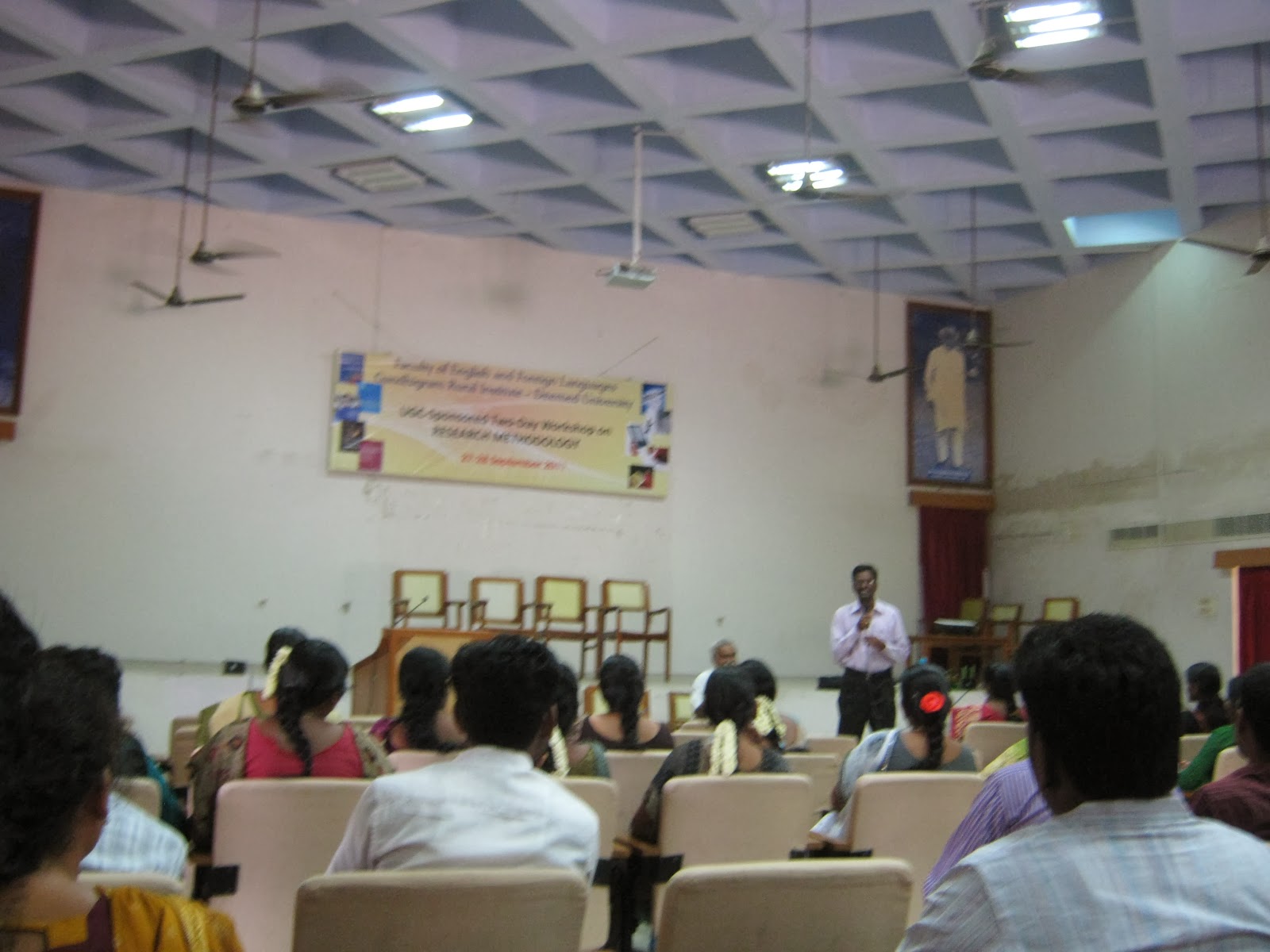
Workshop on Research Methodology at GRI: A Report

The UGC-Sponsored two-day Workshop on Research Methodology, conducted by Gandhigram Research Institute - Deemed University, was an eye-opener for all research scholars numbering 160, who had gathered at the Silver Jubilee Hall of GRI, for a mind-boggling Workshop of sorts.

Pro.N.Narayanasamy, Registrar, GRI, inaugurated the Workshop on Research Methodology at 9.45 am. Prof.MA Sudhir spoke extensively on selecting one’s area of research, which requires a lot of reading. He also stressed the importance of taking notes while reading, so that one doesn’t miss out on valuable information.

Dr.Joseph Dorairaj, addressing the gathering
He defined Research in the words of C.Francies Rummel, as “An intellectual exercise and problem- solving process” The etymological significance of the term implies “to go about seeking”. Great Research Scholars from Dr.Radhakrishnan, former President of India, to Nobel Laureate Dr.Amartya Sen have come out with astounding research findings, he said. He also elaborated on the two approaches towards Research, namely the 1) Deductive and 2) Inductive. While the former is based on theory, the latter is based on Observation, finding patterns, tentative hypothesis etc., which can be built into a theory. He also spoke on the hour-glass notion of Research.

Elaborating on David Émile Durkheim’s research on suicides, on why people kill themselves, who found out, after having systematically collected data for 20 years, that, there was a relative stability in suicides over 20 years with age variations, seasonal variations etc. and then proceeded to classify suicide into three types, namely, The egoistic, altruistic and the anomic modes of suicide.

Announcement on Assignments..:

Dear Students of Part II English, As part of your Assignment Work with me this Odd Semester, you are expected to get for yourself a copy of Word Power Made Easy by Norman Lewis and work from pg 16 to pg 109, filling up every exercise given therein. Students who have got a copy of English Vocabulary in Use (Upper-intermediate and advanced), are expected to work on units 1 to 60. Last date for submission of your assignments is: Monday, 10 October 2011.

Saturday, 17 September 2011

"The Dream" by Somerset Maugham - Lesson Summary

"The Dream" by Somerset Maugham

Introduction:

One of the most common yet feared dreams is the experience of falling in dreams or dreams of falling. The dream can be as simple as falling out of bed or as extreme as falling from top of a building, ladder, rooftop, mountain, cliff or even out of an airplane without a parachute, to name just a few. Yet, regardless of the height the dreamer is falling from in the dream, the experience is terrifying to the dreamer. As a result, the dreamer generally wakes up hyperventilated, afraid, filled with anxiety, sweating, struggling for each breath he takes, heart pounding in his chest as if it were about to explode. Somerset Maugham narrates one such experience of a dream that he heard from a Russian traveller in transit at Vladivostok, Russia’s largest port city.

Maugham meets a Russian at a Restaurant:

In August 1917, Somerset Maugham had to make a work-related trip from New York to Petrograd. As the trans-Siberian train started at nine in the evening, Maugham dined at the station restaurant. He shared table with a Russian man whose appearance seemed to entertain him. Soon, both got into conversation, and the author felt that the Russian was well-learned and that he was on his way back home after a long stint abroad.

"The Unknown Citizen" - W.H.Auden - Critical Summary

Introduction:
The Unknown Citizen

“The Unknown Citizen” is a poem by W. H. Auden. Auden wrote it in 1939, shortly after moving from England to the United States, and the poem gives evidence of his culture shock when suddenly confronted with American-style chaos and consumerism. It is an ironic poem and the poet intends his satire against a society which kills a person’s individuality.

Significance of the Sub-title:

The sub-title to the poem “To JS/07/M/378/ This Marble Monument Is Erected by the State” alludes to the concept enforced by the government that every human being must be classified by a alpha-numeric tag to distinguish who they are, rather than being able to have their own personal identity. The poet scoffs at humans being given alpha-numeric names when they’re already struggling for their own personal identity in a world clustered with the advancing technology.

His Office Life and Social Life – Analysed:

The Bureau of Statistics has found that "no official complaint" has been made against the unknown citizen. He is also described as a "modern" saint, which means that he always served the "Greater Community." He worked in a factory before the war and he never got fired, as he satisfied his employers always.

Friday, 16 September 2011

The Sporting Spirit - George Orwell - Lesson Summary

Players booing the referee
Introduction:

In the extremely competitive atmosphere in which sports is administered today, every player backed by every nation, would obviously have a strong temptation to take advantage of the gaps in the rule book, bending the rules to his favour, and conveniently interpreting the law to his advantage. Against this backdrop, George Orwell, pleads for the need to understand the importance of demonstrating sportsmanship and set a good example on the sporting field for the others to emulate.

Sports as an Unfailing Cause of ill-will:

In his remarkable essay “The Sporting Spirit”, Orwell grieves over the fact that sport is an unfailing cause of ill-will, and that the visit of the Russian football team Dynamos, has only worsened the Anglo-Soviet relations instead of strengthening it.

Two of the four matches played led to much bad feeling. At the Arsenal match the referee was booed at. At the match in Glasgow, it was a free-for-all right from the start. According to Orwell, football was capable of provoking the vicious passions of patriotism, resulting in fresh animosity on both sides.

"My Grandmother's House" - Kamala Das - Critical Summary

My Grandmother's House (representative)
Introduction:

Kamala Das is one of the three most significant Indian poets writing in English today, the other two being Nissim Ezekiel and Ramanujan. Her poetry is all about herself, about her intensely felt desire for love, for emotional involvement, and her failure to achieve such a relationship. In this poem, “My Grandmother’s House” Kamala Das, recalls her ancestral home and her dead grandmother. This poem takes the form of a confession comparing her present broken state with that of being unconditionally loved by her grandmother.

Themes in the Poetry of Kamala Das:

The poetry of Kamala Das is a search for the essential woman, and hence the woman persona of her poems plays the various roles of unhappy woman, unhappy wife, mistress to lusty men, reluctant nymphomaniac, silent Devdasi and love-lorn Radha. Kamala Das has also been called a poet in the confessional mode. The confessional poets deal with emotional experiences which are generally taboo. There is a ruthless self-analysis and a tone of utter sincerity. As E.V.Ramakrishnan rightly says, “In her poetry, Kamala has always dealt with private humiliations and sufferings which are the stock themes of confessional poetry.”

Reminiscent of the Poet’s Ancestral Home:

The poem is a reminiscence of the poetess’ grandmother and their ancestral home at Malabar in Kerala. Her memory of love she received from her grandmother is associated with the image of her ancestral home, where she had passed some of the happiest days of her life, and where her old grandmother had showered her love and affection. With the death of her grandmother the house withdrew into silence. When her grandmother died, even the house seemed to share her grief, which is poignantly expressed in the phrase “the House withdrew”. The house soon became desolate and snakes crawled among books. Her blood became cold like the moon because there was none to love her the way she wanted.


Wednesday, 7 September 2011

because of her love of books...

Jane in Chapter 5, page no.87, initiates conversation with a stranger merely because of curiosity and not because of loneliness or being gregarious by nature. This can be concluded from the lines preceding the conversation: “I stood lonely enough: but to that feeling of isolation I was accustomed: it did not oppress me much.”

Jane seems to love books and reading as it seems to be the only reason for her to start a conversation with a stranger in a sea of strangers. She herself finds it surprising that she started a conversation as can be inferred from these lines: “I hardly know where I found the hardihood thus to open a conversation with a stranger. The step was contrary to my nature or habits”. She only read childish and frivolous kinds of books and could not comprehend serious tests. She seems to like magic with her reference to fairies and genii as something she liked to read about.

In the entire length of the conversation it can be seen that Jane keeps questioning about different things, from the tablet she found to the stranger’s personal life. She is very inquisitive by nature, and also very curious. Jane is neither diplomatic nor does she have enough tact while questioning the stranger, “Are you an orphan?”

Jane wishes to know all about her new environment and the people who are there. She is a child with the childish tendency of opening her mouth before thinking through what she wants to say. She is honest. (“I cannot pronounce her name as you do”; “But Miss.Temple is the best – isn’t she?”)

The book "Rasselas" attracted her...

Jane was introduced to a new institution called “Lowood Institution”. The name of the institution and a verse written along with it made Jane think that there is some connection between the name and the verse. When she was thinking so, she heard a cough close behind her and turned her head. Jane saw a girl reading a book with the title “Rasselas”. This title struck Jane and also attracted her. That girl who was reading the book was Helen Burns. When Helen looked up, Jane did not see her as a stranger but started to converse with her. First, she spoke about the book in Helen’s hand and next asked about the institution. Their conversation continued for a long time about the issues relating to the institution. 

The reason for Jane to initiate the conversation with a stranger was, firstly, the book which attracted her. The next reason was, she wanted to know the connection between the name of the institution and the verse written on the stone over the door.

Observations on the character of Jane: Jane is a good natured girl. She was ill-treated by Mrs.Reed in front of all her cousins. Jane fell sick in the former days and was looked after by Mr.Lloyd who was a doctor. He felt pity for the sake of Jane but Mrs.Reed said bad things about Jane to Mr.Lloyd. Finally Bessie, servant of Mrs.Reed, told him that these allegations were not true. Looking at the character of Jane Eyre, here, we find that she was calm and obeyed Mrs.Reed. Even though she was asked to stay in the nursing room and not allowed to mingle with others, Jane did not mind it. She felt everything inside her heart, but did not show anything out.

In the course of her conversation, Jane was very much bothered about the things which are around her and she is eager to know her surroundings. In her first conversation itself, she tries to know fully about Helen Burns and her character. She is asking questions above questions, but Helen answers her quietly. So she likes Helen but when Helen was punished, she is made to think about her. From the above conversation we come to know that Jane was entirely different from others.

She needs a companion to have peace in life...

Jane Eyre didn’t have any peace and happiness in her aunt’s house. She wants to escape from there. This is the cause for her to join in that institution. So, she will be joining with the imagination that she can be happy with others there. This is the first reason for Jane to communicate with a stranger for a friendship. Moreover, she also feels lonely in that new place. In that new place she may have wanted to be a jovial person because she was not at all happy in Mrs.Reed’s house. I feel that she was in need and in search of friendship. Every normal human being needs a companion. Everyone needs someone to share our joys, sorrows, opinions and everything. She is in search of that because in Mrs.Reed’s house, she was alone. She didn’t have anyone to share her feelings and emotions. Mrs.Reed and her children dislike Jane. They always ill-treat her. Even Bessie will scold her in some circumstances. So, she feels she must need a companion to have a little peace in her life. And, I also feel that, Jane particularly selected Helen Burns because she saw her alone. Burns was reading a book. It may be an impression for Jane to talk to her. Because when she was in Mrs.Reed’s house, books were her only companions. She reads lots and lots of books. It is not only an hobby for her, but also a job that she does full-time. These are the reasons which I feel about the conversation of Jane with Helen and about Jane and Helen.

She did it more for selfish reasons...

Jane Eyre reads the words in the stone tablet over the door bore. It was written ‘LOWOOD INSTITUTION – This portion was rebuilt by Naomi Brocklehurst, of Brocklehurst Hall, in this county. Let your light so shine before men, that they may see your good works, and glorify your father which is in heaven” – St.Mathew 5:16. After reading this, Jane was confused and pondered over it. She wanted to know the connection between the first words and the scripture. So Jane was very curious to know about that. She was finding a clue to get the reason for that verse. By the time she saw that girl, the book in that girl’s hand was a means of connecting them. As Jane wanted to know about the words written, she finds that the book in that girl’s hand may have any clues to know about the connection between the first words and the Scripture.
I think that this would be the reason for Jane to initiate this conversation with a stranger. I don’t think that Jane felt lonely at that time and also by reading the novel. I don’t think Jane is very gregarious by nature and loved socialising because Jane’s brought up is not like that. She had a sense of loneliness and isolation is evident in the way she hides herself behind thick curtains in a deserted room, ostracised by her aunt and cousins.

As Jane travels to Lowood School, she was alone and friendless. She sees the harsh treatment of the girls, the bad food and the regimented systems. Jane clearly recognises another kindred spirit. She is, however, confused by Helen’s acceptance of a seemingly unjust punishment. So Jane was to know what is happening around her in Lowood School. She wants to know whether everyone is bad. She fears that everyone there was unkind. She was in need of comfort and so she was asking questions to the girl. I think that the character and nature of Jane in the course of the conversation with Jane is little selfish. She wanted to know about the Lowood School not only for the sake of enquiring about the residence of girls. The main reason is that, she wants to survive. So I say that Jane was little bit selfish in this conversation.              

Featured post

Four Urgent Interventions to Reimagine Indian Academia ❤️

Why Having Great Faculty on the Rolls is the Real Asset of World-Class Universities Hindustan Times 18 November 2026 #newspaperinlearning I...