Showing posts sorted by relevance for query travelogues. Sort by date Show all posts

Monday, 5 March 2018

On Travelogues and Travel Writing in Literature – IV

Travel gave fresh impetus to the writer the ‘illusory option’ of flight from their wearied present. As such, the traveler doubled up as a writer and an adventurer seeking the exotic or the wild, as an exemplar of the exotic, a connoisseur of fascinating landscapes, and an observer of strange habits, rituals and customs.

Hence, it goes without saying that, a successful travelogue carries with it, a great sense of curiosity and a sharp sense of humour – which were both part of the travel writer’s narrative strategies.

However, there is also the charge levelled against travel writers, particularly from the West, that they were much biased in their portrayals, depictions, and representations of the ‘Other’ or the East.

In this regard, studies in Postcolonial Travel Writing takes cudgels against such representations, and seeks to vehemently challenge such distorted prevailing representations of travel writing that emanates from the West as biased, lacking in truth value, and Eurocentric in its tastes.

Again, Debbie Lisle, in her recently published book titled, The Global Politics of Contemporary Travel Writing problematises or rather politicizes the authenticity of the bestselling travel books, such as those by Paul Theroux, Bill Bryson, Bruce Chatwin and Michael Palin, by telling her reader that, there’s more to it than meets the eye! To Debbie, there IS a lot of identity-politics, geopolitics and cultural politics at play in contemporary travel writing! Therefore, despite the powers of globalization and multiculturalism on the one side, common stereotypes about ‘foreignness’ continue to shape the experience of modern travel.

In addition, Mary Louise Pratt deems such coordinates of these travel texts of Euroimperialism as, “Redundant, Discontinous, and Unreal!”

Well, this is meat for another whole series altogether.

To sum it up, the reader should bear in mind that, Travel Writing per se, is not an objective rendering of explorations or journeys that happen across countries, climes, peoples and places! undertaken. They are bound to contain preconceptions that affect representation to a great extent. Moreover, travelogues are heavily impacted and influenced by the narrator’s gender, race, caste, age, cultural standing and educational levels too. Hence, all travel writing is to a considerable degree ideological.

Now for a continuation on the slew of travelogues –

The Crossing (1994), is a novel by Cormac McCarthy. In this novel, young Billy Parham captures a wolf on his farm in New Mexico. He decides to return the wolf to Mexico, where he thinks it has come from, and in crossing over into Mexico, his life changes forever.

The plot of the novel takes place before and during the Second World War and focuses on the life of the protagonist Billy Parham, a teenage cowboy; his family; and his younger brother Boyd. The story tells of three journeys taken from New Mexico to Mexico. Although the novel is neither satirical nor humorous, its realistic portrayal of an often destitute hero taking part in a series of loosely connected quests in a brutal, corrupt world lends this book many of the qualities of a picaro.

The Pilgrimage is a 1987 novel by Brazilian novelist Paulo Coelho. It is a recollection of Paulo's experiences as he made his way across northern Spain on a pilgrimage to Santiago de Compostela. The novel serves as part adventure story, part guide to self-discovery.

The story begins in 1986, when the author fails his initiation into the order Regnus Agnus Mundi (RAM). He is informed that in order to get accepted into RAM, he must embark upon a spiritual journey along the Way of St. James in search of a sword, which symbolically will mark his acceptance into the order. The author sets off on this quest alongside another RAM member who is known as Petrus. He learns that the objective of this quest is to learn the simplicity of life and the nature of truth. Petrus guides him the entire way, showing him meditation techniques and delving into philosophy and Western mystical thought. The meditation exercises he teaches him include the RAM Breathing Exercise, Blue Sphere Exercise, Cruelty Exercise and many more. On this legendary road across Spain, the author learns that sometimes the most extraordinary, can be found in the simplest of things. The Pilgrimage has been translated to thirty eight languages all over the world.

Friday, 2 March 2018

On Travelogues and Travel Writing in Literature - III


Travels with My Donkey (2004), is yet another nonfiction work by Tim Moore. It is a humorous nonfiction account of the author’s attempt to follow the five hundred-mile pilgrimage road to Santiago de Compostela, Spain, with a donkey.

Having no knowledge of Spanish and even less about the care and feeding of donkeys, Tim Moore, Britain's indefatigable traveling Everyman, sets out on a pilgrimage to the cathedral at Santiago de Compostela with a donkey named Shinto as his companion. Armed only with a twelfth-century handbook to the route and expert advice on donkey management from Robert Louis Stevenson, Moore and his four-legged companion travel the ancient five-hundred-mile route from St. Jean Pied-de-Port, on the French side of the Pyrenees, to the cathedral at Santiago de Compostela which houses the remains of Spain's patron saint, St. James.

The Amber Spyglass (2000), is a novel by Philip Pullman. In this last book of the His Dark Materials fantasy trilogy, the young heroine Lyra (seemingly named after the lyre, the musical instrument Orpheus played) travels to an underworld drawn from Greek myth and leads its inhabitants out. His Dark Materials is an epic trilogy of fantasy novels by Philip Pullman which follows the coming of age of two children, Lyra Belacqua and Will Parry, as they wander through a series of parallel universes.

Jack Kerouac is rightfully called a ‘road novelist.’ One of the leading lights of the Beat generation, Kerouac wrote On the Road in the year 1957, a stream of consciousness  travelogue of America in the early 1950s. On The Road is considered to be a seminal post-war work, and its setting and theme make for an engaging read. The novel captures the author Jack Kerouac and his friends’ travels across North America. The author is the main protagonist in the story, and it is set against the backdrop of music, poetic literature, and drug abuse.

Jules Verne was a French writer who helped pioneer the genre of science fiction; novels such as Twenty Thousand Leagues under the Sea explored underwater and space travel before either was technologically possible. Along with writers like Mark Twain, Conrad was able to incorporate traditional story forms—such as travelogues or journey stories—into novels with a more contemporary sensibility.

20,000 Leagues Under the Sea also known under its longer title, Twenty Thousand Leagues Under the Seas: An Underwater Tour of the World, is a classic science fiction novel In the story, Captain Nemo pilots his vessel, the Nautilus, on an adventure in search of a sea monster that was sighted by a number of ships in 1866. The American government sponsors the mission. This great adventure story is notable for being more scientifically accurate than some of Verne's other novels. In particular, the description of the Nautilus is rather prophetic and a fitting description for modern submarines. While there were submarines in existence when the book was written, they were primitive affairs and it took a feat of imagination for the writer to produce his vision of what an underwater craft would look like in the future.

Thursday, 15 March 2018

On Travelogues and Travel Writing in Literature - VI


Thinner (1984), is a novel by Stephen King. In this thriller, an overweight executive appears to get away with vehicular manslaughter of an old man. The man’s surviving son, a traveling gypsy, touches the killer’s cheek and utters a curse: ‘‘Thinner.’’

Moscow 2042 (1986), is a dystopian time-travel novel by Vladimir Voinovich. Time travel reveals the bleak future of the Soviet Union, in a dystopian parody written during the glasnost (openness) period.

Lawrence Durrell’s island novels, or landscape books, are drawn from the Greek world, but they are far more than travelogues or catalogues of places to visit. Much like the travel literature of Norman Douglas and D. H. Lawrence, they recreate the ambience of places loved, the characters of people known, and the history and mythology of each unique island world. Bitter Lemons of Cyprus in special, takes the icing on the cake on Durrell’s oeuvre, describing the three years (1953–1956) he spent on the island of Cyprus.

Along the Ganges is an exhilarating travelogue by Ilija Trojanow. Ilija Trojanow is a German novelist and travel writer. Trojanow, being well-versed in Hindi, is the perfect mix of insider and outsider, who can see for himself, what makes India tick! In this gripping travelogue, Ilija Trojanow travels along the River Ganges, right from its originating source, where it breaks free from the eternal ice in the Himalayas, meandering its way to the great cities; he follows the river alternately by boat, by bus, and also on overcrowded trains.

Arabian Sands is a 1959 book by explorer and travel writer Wilfred Thesiger. According to Sir John Glubb, ‘Wilfred Thesiger is perhaps the last, and certainly one of the greatest, of the British travellers among the Arabs . . . The narrative is vividly written, with a thousand little anecdotes and touches which bring back to any who have seen these countries every scene with the colour of real life.’

Not getting accustomed to the monotonous drudgery of everyday life in the West, and repulsed by the softness,  and rigidity of Western life, especially ‘the machines, the calling cards, the meticulously aligned streets,’ Thesiger, (in the spirit of T. E. Lawrence,) sets out to explore the deserts of Arabia, traveling among peoples who had never seen a European. His now-classic account is invaluable to understanding the modern Middle East.

Wednesday, 13 November 2019

'The true standard of the artist is in every man's power...'

Gleanings on Realism | from the Dean of American Letters!

He was nicknamed “The Dean of American Letters”! He was lifelong friends with Mark Twain!

He was editor of the prestigious The Atlantic Monthly!      

He had written Abraham Lincoln’s campaign biography titled, Life of Abraham Lincoln.

He has quite carved a niche for himself as one of America’s most popular realist novelists who also doubled up as a realist playwright!

Presenting good ol’ William Dean Howells, ladies and gentlemen!

Howells also happens to be Herne’s close buddy! (the Herne of our past post!)

The Howells-ian Hall to Fame continues…

Indeed, as Ezra Pound to Eliot, so is Howells to Henry James and Mark Twain as well!

Well, William Howells was also on the pally-line with Lowell, Wendell, Henry Adams, Henry David Thoreau, Henry James, William James, Waldo Emerson and a host of such acclaimed writers of his era!

Friday, 26 December 2025

With a sense of accomplishment and the knowledge that he’s making a difference, Partha Sarthi Sen Sharma IAS., calls it a day at 10 pm Every Day! ❤️

A Highly Laudable Initiative in UP

Newspaper Reading Made Mandatory in UP Govt Schools

An Inspiring IAS Officer Who Made it a Reality!

On Shri Partha Sarathi Sen Sharma IAS

I was so happy to read this news article in today’s Times of India, Chennai Edition.

In an age and clime where deep reading is becoming a lost art, the decision by the Uttar Pradesh government to make newspaper reading mandatory in state-run schools is a laudable move that could prove to be a powerful ‘brain gym’ for the next generation of students in Uttar Pradesh.

The UP government (led by Additional Chief Secretary Partha Sarthi Sen Sharma) has directed all state-run basic and secondary schools to integrate a 10-minute newspaper reading slot into their daily morning assembly.

The government’s noble ideas behind making newspaper mandatory in schools, has a lot of advantages for the students.

As the notification observes –

The order specifically emphasizes ‘physical’ newspapers to help students regain focus and concentration that is often lost in the ‘scroll-and-click’ nature of digital content.

Moreover, by exposing students to diverse editorial perspectives, at a very young age, this noble initiative aims to help them distinguish between verified facts and the ‘fake news’ prevalent on social media.

Regular reading of the day’s newspaper naturally strengthens General Knowledge (GK) and vocabulary, which are critical for future competitive examinations like the UPSC, or banking exams.

Finally, reading about local public projects and social issues helps foster empathy and a sense of responsibility toward their immediate community, thus endowing the students with a heightened sense of civic awareness.

But wait, the icing on the cake is not yet done!

I was all admiration for Additional Chief Secretary of UP Shri Partha Sarthi Sen Sharma, who made this initiative a possibility.

Intrigued, I wanted to look up more on this gentleman.

It gave me amazing glimpses into this IAS Officer of the 1994 batch.

Shri Partha Sarthi Sen Sharma is a bureaucrat-writer with an amazing bilingual reach! He has been a regular diarist, a voracious reader, a columnist in prominent newspapers, and also a veteran novelist and travelogue-writer!

Woww!

I am so happy that we have such people at the top levels in bureaucracy to run the state machinery.

[On an aside, in Tamil Nadu also, we had great luminaries like Mr. Irai Anbu as Chief Secretary till a few years ago, who was again a diarist, and an accomplished writer himself]

Coming back to Shri Partha Sarthi Sen Sharma IAS –

Beyond his career as a senior IAS officer, Partha Sarthi Sen Sharma is a prolific author who has successfully navigated both fiction and travel writing.

His writing career began with travel pieces for major publications like The Times of India and Hindustan Times, that eventually evolved into full-length books.

Travenovels

Sen Sharma’s bibliography covers various genres, often categorized into travelogues, novels, and ‘travenovels.’

In fact, Sen Sharma is credited with popularizing the “travenovel” genre - a hybrid genre that blends the factual observations of a travelogue with the character-driven narrative of a novel.

For example, in his ‘travenovel’ titled, Andamanush Nicobarese he writes about his stint as an Election Observer in the Andaman and Nicobar Islands. 

The book carefully avoids the ‘tourist’ perspective. Rather, it narrates the story of the Andaman Islands through the eyes of locals – mostly the refugees, the government staff, and indigenous tribes, even while weaving in the history of the 1857 Revolution and the Cellular Jail.

Some of his other writings are –

Lucknow Diaries: Of Love and Longing published in the year 2018 by Rupa. Described as a tribute to the city of Lucknow (where he lived for nearly two decades), this novel explores the lives of three characters - Feroze, Dinesh, and Rahul. It is noted for its ‘literary realism,’ capturing the physical and spiritual atmosphere of the city.

Love Side by Side (2015), is a contemporary romance novel set against the backdrop of India’s changing economic and religious landscape in the 1990s. It follows the journey of an engineering student and touches upon themes of rural life and personal growth.

A Passage Across Europe (2011) is his first full-length travelogue, which documents his journeys across Europe.

Every Mile a Memory is yet another travel-focused work that highlights his penchant for exploring and documenting diverse cultures and landscapes.

But wait! Sen Sharma has a catch for all of us here.

In a 2021 conversation at the Metaphor Literary Event, he shares a key piece of advice for all of us who want to write -

“If you want to become a writer, you need to be an avid reader first... reading helps in building a point of view and provides the ability to introspect.”

He uses his travel time and “waiting periods” (that is quite common in a bureaucrat’s life) to read voraciously in English, Hindi, and Bengali. This constant intake of literature keeps his writing skills sharp!

I also chanced upon a YouTube Video titled, Day in the Life of an IAS Officer in India | IAS Partha Sarthi Sen Sharma | Officers On Duty E138, where he speaks about his daily routine.

Me thought of giving it here below for us, to inspire us. Looks like, in his typical day, Sen Sharma follows a rigorous schedule that allows him to carve out time for himself a rewarding day ahead, every single day!

Here goes –

5:30 AM - Rise and Shine

The day begins early for IAS Partha Sarthi Sen Sharma, as the alarm clock rings at 5:30 AM. Rising before the sun, he starts his day with a sense of purpose and dedication to his role in public service.

6:00 AM - Morning Rituals

After a quick shower, Partha Sarthi engages in his morning rituals. This includes reading the newspaper, catching up on current affairs, and checking emails to stay informed about important developments.

7:00 AM - Physical Fitness

Recognizing the importance of maintaining physical and mental health, he dedicates an hour to physical fitness. Whether it’s a brisk walk, a session at the gym, or yoga, staying fit is an integral part of his daily routine.

8:00 AM - Office Hours Begin

As he arrives at his office, Partha Sarthi’s day officially starts. His office is a dynamic space where he meets with government officials, reviews policy documents, and strategizes on various administrative matters. He also handles the day-to-day affairs of the district under his jurisdiction.

11:00 AM - Field Visits

IAS officers often need to be on the ground to understand the challenges faced by their constituents. Partha Sarthi embarks on field visits to inspect development projects, assess the needs of the local population, and address any issues that require immediate attention.

1:00 PM - Lunch

A quick lunch break allows Partha Sarthi to recharge before diving back into his busy schedule.

2:00 PM - Meetings and Administrative Duties

Afternoons are typically filled with meetings with other government officials, stakeholders, and community leaders. These interactions are crucial for decision-making, policy implementation, and maintaining good governance.

4:00 PM - Public Grievance Redressal

IAS officers often hold open houses or public grievance redressal sessions to listen to the concerns and grievances of the people they serve. Partha Sarthi dedicates time to these sessions, ensuring that the voice of the public is heard.

6:00 PM - Evening Review

As the workday comes to a close, Partha Sarthi reviews the day’s accomplishments and charts out plans for the following day. This reflection helps in setting priorities and ensuring that tasks are executed efficiently.

7:00 PM - Dinner and Family Time

A well-deserved dinner is followed by some quality time with family. Despite the demanding nature of his job, Partha Sarthi cherishes these moments to maintain work-life balance.

9:00 PM - Prep for the Next Day

Before retiring for the night, Partha Sarthi checks emails, makes notes, and plans for the challenges that the new day may bring.

10:00 PM - Lights Out

With a sense of accomplishment and the knowledge that he’s making a difference, Partha Sarthi Sen Sharma calls it a day, ready to face another day in the life of an IAS officer in India.

Well, a day in the life of IAS Partha Sarthi Sen Sharma provides insight into the dedication, hard work, and commitment required of such vibrant civil servants as they work tirelessly to contribute to the betterment of civil society in their own noble ways!

To sum up then, Sen Sharma is an amazing role-model for all of us in academia - a ‘Bureaucrat-Observer,’ a ‘Voracious Reader,’ and an ‘Accomplished Writer,’ who uses writing as a tool for ‘mental de-stressing’ and as a way to process the vast amount of human stories he encounters every day!

May his tribe increase!

Sources

YouTube Link titled, A Day in the Life of an IAS Officer in INDIA, HERE.

http://bureaucrats.in/ias-partha-sarthi-sensharma-an-inspiration-to-young-officers-202409070125

Times of India, Chennai Edition, dt 26th December 2025

Saturday, 17 February 2018

On Travelogues and Travel Writing - I

The Hitchhiker’s Guide to the Galaxy had its origins as a series for BBC radio, first broadcast in 1978. After a trip across Europe, inspired by the format of practical travel guides such as The Hitchhiker’s Guide to Europe by Ken Welsh, Adams set out to write a guide to the mysteries of the galaxy.

In 1985, Adams took an assignment to travel to various locations around the world in the company of a zoologist, documenting a search for specimens of the world’s most endangered species. This resulted in both the radio series and the nonfiction book Last Chance to See (1990). Although the book was not as commercially successful as his novels, Adams referred to the book as one of the most rewarding projects on which he had ever worked. This reflects a common theme in Adams’s work regarding the doubleedged sword of technology, which can provide great advancements for humanity but also lead to destruction of the natural world.

There are a host of other fantastic travels to other worlds and dimensions as a means of pointing out our own society’s foibles. They are -

Gulliver’s Travels (1826), a satire by Jonathan Swift. Swift applied his sharp wit to this ‘‘travelogue’’ of an innocent abroad in strange and unheard-of countries.

Alice’s Adventures in Wonderland (1865), a novel by Lewis Carroll. What started as a story told to pass the time on a boat trip turned into a novel that plays with nonsense, logic, and morality lessons in a baffling and surreal fantasy land.

Other Worlds (first published in two parts, 1657 and 1662), fantasy stories by Cyrano de Bergerac. The real-life seventeenth-century swashbuckler wrote a series of fantastic stories describing his fictional journeys to the Moon and Sun and his encounters with the creatures who lived there.

S. Y. Agnon’s first acclaimed novel, The Bridal Canopy (1931), concerns a Hasidic rabbi who travels through nineteenth century Galicia seeking a dowry for his daughters.

The Lost Steps (1953), is a novel by Alejo Carpentier. The protagonist of this novel travels from New York into the Amazonian jungle: as he progresses, time seems to move backward.

Yehuda Amichai’s ‘‘Travels of the Last Benjamin of Tudela’’ is a sequence of fifty-seven
poems in which Amichai analyzes his Jewish identity by comparing his life story with legends of a wandering medieval rabbi. Published separately in book-length form as Travels in 1986, this work also appears in his Selected Poetry (1986), a compilation of verse from ten volumes published over a thirty-year period.

Hans Christian Andersen has also published a poetic travel book, Pictures of Sweden (1851),

Woman on the Edge of Time (1976), is a novel by Marge Piercy. Like Atwood, Piercy writes poetry and fiction with a feminist bent. This novel tells the story of a time-traveling psychiatric patient at Bellevue Hospital.

W. H. Auden traveled in Weimar Republic, Germany. In 1937 he went with Mac-Neice to Iceland and in 1938 with Isherwood to China. The literary results of these journeys were collaborations: with MacNeice, Letters from Iceland (1937), and with Isherwood, Journey to a War (1939).

Matsuo Basho made pilgrimages, visiting religious and secular sites, spreading his ideas on haiku to fellow poets, and often begging alms for subsistence. His prose and haiku recollections of these travels, especially The Narrow Road to the Deep North, are considered his most accomplished and lasting literary works. Between journeys, he spent much of his time living and writing in secluded huts in the wilderness.

Invisible Cities (1972), is a work of fiction by Italo Calvino. Calvino’s book is set up as Marco Polo’s dreamlike recollection of his travels to Kublai Khan, but there is no linear path through the story or the travels.

He wrote poetry, fiction, history, travel pieces, and works on topography, as well as articles and essays in a wide variety of modes including ridicule, parody, satire, and logical argumentation.

to be contd...

Routledge/Gale’s Encylopedia 
Image: TravelWiththeCam.Wordpress.Com

Sunday, 18 February 2018

On Travelogues and Travel Writing in Literature - II


Hilaire Belloc often used his travel, literary, and historical essays to make a point about current political issues. He is known far and wide for his Cautionary Tales for Children which included “Jim,” who ran away from his nurse, and was eaten by a lion, and “Matilda,” who told lies and was burnt to death. Although his first love was poetry, the essay was his daily occupation. Noteworthy is The Modern Traveller (1898),

Dog Heart: A Travel Memoir, by Breyten Breytenbach was published in the year 1998. This book marks a return to the world and the legends of Breytenbach’s youth, with short prose texts interspersed with poetry.

A Room with a View (1908), is a novel by E. M. Forster. In this Edwardian novel, a young Englishwoman traveling in Italy falls in love with a man who seems ‘‘beneath her.’’ She ignores the advice of her chaperon and happily elopes anyway.

Daisy Miller (1878), is a novella by Henry James. The ebullient young American girl, Daisy Miller, travels to Switzerland and Italy and falls victim to her own flighty nature in this oft-studied short work by James.

Mountains and Rivers without End (1996), is a poem by Gary Snyder. This epic poem reflects a vision of being in the world that is directly and overtly influenced by Snyder’s travels and Eastern philosophy.

Generations of critics have testified to John Bunyan’s own comprehensive scope, rich characterization, and genuine spiritual torment and joy drawn from personal experience. and to instance in one, the Pilgrim’s Progress, he hath suited to the life of a traveler so exactly and pleasantly.

Many of Lord Byron’s works were inspired by or describe travels. In 1809, a two-year trip to the Mediterranean countries provided material for the first two cantos of Childe Harold’s Pilgrimage.

Sunday, 11 March 2018

On Travelogues and Travel Writing in Literature - V

Hari Kunzru is yet another vibrant travel writer with a love for all things adventurous! The son of a man from the Kashmir province in India and a British woman, Hari Kunzru was honoured by 'The Observer,' in 1999 ,  with their Young Travel Writer of the Year Award

Kunzru’s familial background inspired him to write The Impressionist about an Indian-English young man, Pran Nath. Kunzru told Richard Alleyne of the London Daily Telegraph, ‘‘At Oxford, I noticed how much people play out a comedy of Englishness, which made me very interested in identity role-playing in post-colonial Britain.’’ Kunzru’s The Impressionist revolves around the efforts of a young man of mixed heritage to make a place for himself in the world. Travel as a theme becomes apparent as the protagonist sheds his identity and his belongings in each country.

Part of what motivates The Impressionist is the openmindedness Kunzru gained from his mixed heritage. In one interview with the London Independent Sunday, he stated, ‘‘I’ve always been very scared of people who are certain. . . .Nothing terrifies me more than a religious fundamentalist who really knows what right is and is prepared to do violence to what they consider is wrong. . . . I wanted to write in praise of the unformed and fluid.’’

The Road (2006), is a novel by Cormac McCarthy. This book, one of the most violent novels ever to win a Pulitzer Prize, is the postapocalyptic survival story of a father and his son traveling across a wasteland populated by desperate marauders. McCarthy foregrounds only the very basics of physical human survival and the intimate evocation of a destroyed landscape drawn with such precision and beauty. He makes us ache with nostalgia for restored normality. McCarthy uses these vividly described, amoral villains as points of contrast with human instincts for decency and civilization.

Alphonse de Lamartine’s The Fall of an Angel (1838) reflect his travels in the Middle East and his fascination with reincarnation and pantheism.

Tuesday, 8 April 2025

The Great Home of the Soul - The Open Road! ❤️❤️❤️

What makes Japanese Travel Writing Unique?

Travels with a Writing Brush

Meredith McKinney | Reflections

#lovelyreads

Epigraph comes first you see! 😊

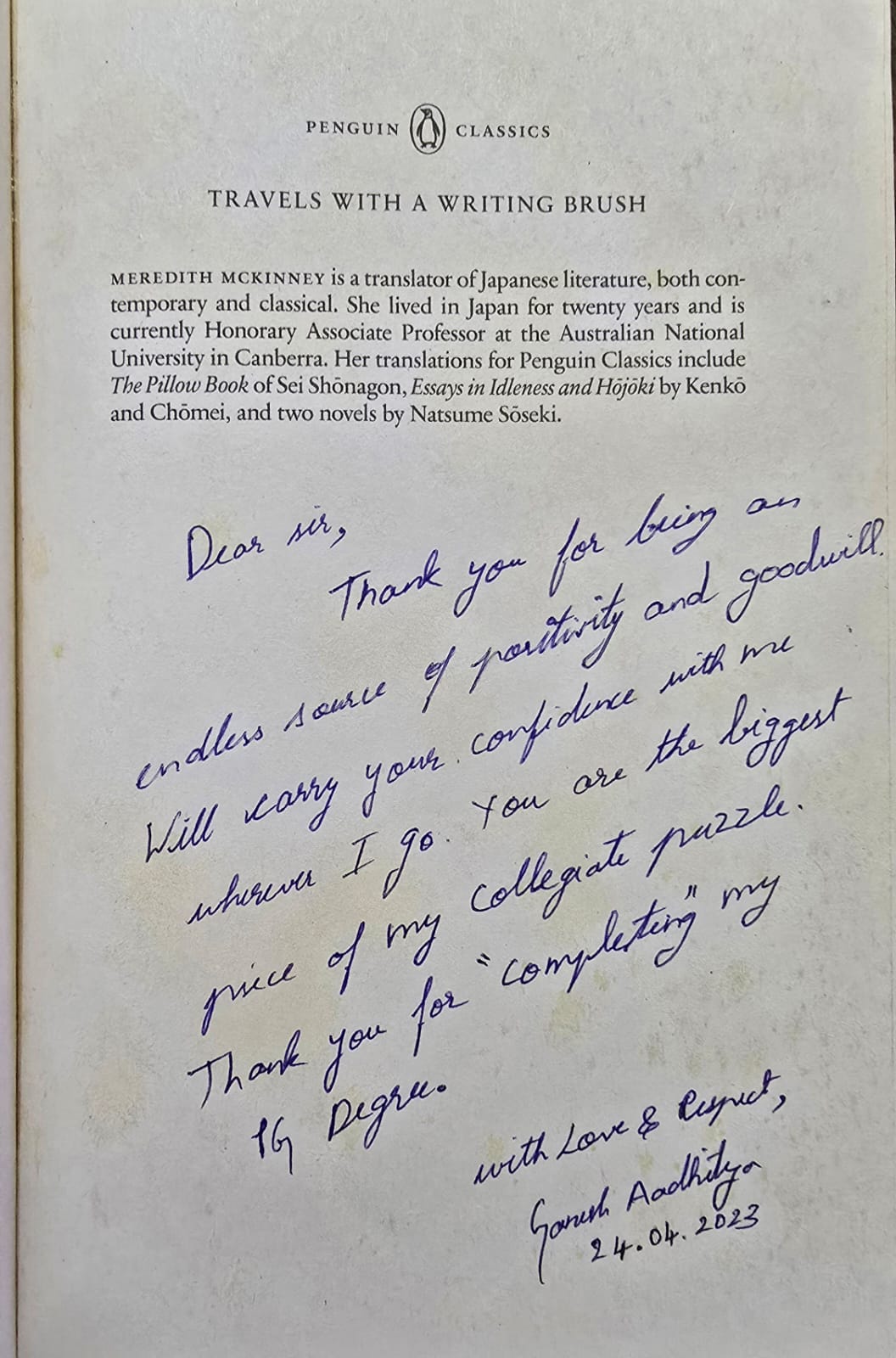
This book was given to me by one of our loveliest students, in April 2023!

And it has taken me a full two years to read this book! 😊 And at last here it is!

Here we go!

Well, first and foremost - to begin this lovely blogpost, I’ve got a series of seven rhetorical questions!

Where on earth do you find travel writing inspiring and impacting an entire nation’s imagination?

Where on earth do you find a literature of travel, documented as ‘Poetic Renderings’ or ‘Poetic Highlights’?

Where on earth do you find an inherent connection between travel and poetry embedded dep within a nation’s literary tradition?

Where on earth do you find places mentioned in poetry becoming significant literary landmarks for future travellers?

Where on earth do you find a unique literary tradition where the journey was not just a physical movement but also a source of profound poetic and emotional experience?

Where on earth do you find a nation’s literature and culture expounded through the specific lens of travel writing?

Where on earth do the evocative travel poems capture the aura and the essence of a place or experience?

The clue lies in the famous sobriquet –

The Land of the Rising Sun! 😊

Woven so intricately in this lovely book titled, Travels with a Writing Brush by Meredith McKinney on the Japanese tryst with the twin sisters of poetry and travel!

Meredith Mckinney, by the way, is a translator of Japanese literature, both contemporary and classical. She lived in Japan for twenty years and is currently Honorary  Associate Professor at the Australian National University in Canberra.

Secondly, in a way, this post is also a continuation of our past post on Japanese Culture, by Pico Iyer, one of the greatest travel writers of all time!

Pico Iyer calls Japan - the home of ‘collected inwardness’!

As Proust once observed, “a change in the weather is sufficient to recreate the world, and ourselves.” The phrase ‘collected inwardness’ here could connote a person who is calm, self-controlled, and introspective! Travel teaches you this ‘collected inwardness’ says Iyer. You may want to read that past post HERE on our blog.

Meredith in this amazing book here, extends the metaphor a bit further and says that, this ‘collected inwardness’ is a unique feature not only of travel, but also of ‘literature of travel’.

As Meredith notes, in her book (by contrasting the Japanese impulse with the Western impulse to documenting their travels) -

Travel gave fresh impetus to the writer the ‘illusory option’ of flight from their wearied present.

As such, the traveller doubled up as a writer and an adventurer seeking the exotic or the wild, as an exemplar of the exotic, a connoisseur of fascinating landscapes, and an observer of strange habits, rituals and customs.

To the Western travel writer then, a successful travelogue carries with it, a great sense of curiosity and a sharp sense of humour – which were both part of the travel writer’s narrative strategies.

However, their eastern counterpart in Japan begs to disagree, differ and defer on this notion of travel!

To the Japanese travel writer, and reader, for many centuries it was above all the poems that were the point.

Travel writings were either ‘poetic renderings’ or ‘poetic highlights’. 

This has important consequences for the literature of travel that may make it at first somewhat disorienting for the Western reader. Where we might expect a more or less continuous narrative of the journey, what we often find is a series of short, disconnected scenes or episodes, sometimes quite briefly sketched, that culminate in a poem, bridged perhaps by a vague linking expression such as ‘On I went, and then …’ that vertiginously elides what can be a substantial amount of intervening time and space.

The effect is a little like a series of glowing points on an otherwise dark map, a kind of montage of intense poetic experiences rather than a realistic description of the journey.

So what makes this book unique?

This book by McKinney titled, Travels with a Writing Brush: Classical Japanese Travel Writing from the Manyoshu to Basho is an anthology that stretches across a thousand years of Japanese travel writing. It contains an assortment of songs, diaries, tales, and poetry, offering a unique glimpse into how travel inspired the Japanese imagination throughout history.

McKinney’s profound observations on the Japanese and their travel sensibilities are phenomenal in their import through each of the pages of the book are quite endearing and alluring to the travel buff!

She foregrounds the waka sensibility that governs the prose of most literary travel writing until the Edo period! Where the poetic effect is reinforced by the prose itself!

She adds,

In classical Japanese literature, one definition of good poetry is poetry that touches the heart. Celebration and delight, emotions that we may look for in poetry, play a relatively minor role, as does the purely imagistic description that we in the West associate with haiku.

Longing and absence, rather than fulfilment and pleasure, are at the heart of Japan’s classical love poetry (one of the great poetic categories), and it was only natural that these became the dominant themes also in travel literature, in which the landscape itself evokes the aware of the lonely traveller savouring his longing for home and absent loved ones.

The anonymous author of A Gift for the Capital, a quintessential medieval travel chronicle, sums up the experience of the literary traveller in the following description –

And yes, do pay attention to the poetic cadence to the prose, as you read… 😊

There were times when I slept alone, blanketed in the wind off the high peaks; times when I woke to waves pounding the rocky shore, sleeves soaked from the wandering traveller’s sorrowing sleep. Times also when I chanced to hear in the grass by my pillow the small cry of insects weakening in the cold, and knew that autumn was at its end; or looking up from yet another bed in some fisherman’s rough hut, knew from the sky that the moon was rising now above a flood tide.

Wandering thus, drawn on along the road, I crossed the Shirakawa Barrier and, past the twentieth day, came to the banks of a broad river. This was none other than the Abukuma River.

I had heard tell of this remote place back in the Capital, and now standing beside it I felt the full force of how immensely far my journey had brought me. The ferryman drew up his boat, I and the other travellers hurried aboard, and as I gazed out over the wide water I saw that from the layered mountain range beyond smoke was rising.

I asked the boatmen about it, and they told me that it had begun in the same year the Kamakura government had fallen, and continued ever since. Strange indeed.

Disembarking and going on my way, I saw by the wayside a grave mound. It was evidently the doing of passersby, with a number of poems attached to nearby trees.

Someone explained to me that it was the grave of the long ago Chinese Prince Dong Ping, who had died here yearning for his distant home, and it was no doubt his longing that made the plants that grew upon his grave mound all lean westward toward China.

Moved by this tale, I was reminded of the similar story of the green grasses that grew on Wang Zhaojun’s grave. It seemed to me that any traveller who met his end beneath a foreign sky would surely long for the night smoke of his funeral pyre / to drift toward home, and I sighed at the folly of our worldly attachments. It moved me, too, to wonder if the dense line of pines that grew about the grave mound were what they call unai-matsu, the pines planted to mark a grave, and the thought put me in mind of certain old tales.

Home – what is it

 that still our hearts

 even when we have died

 and turned to dream

 remember it with love?

The greatest pleasure a literary traveller could experience was the pleasure of arriving in person at a place hallowed in poetry, notes McKinney.

Many other places visited by the travellers in these pages originally gained their poetic fame in similar ways; it was not the characteristics of the place itself so much as the presence of its name in literature (or sometimes in history) that lent it special power. The term for such place names, and by extension for the places that bore those names, was utamakura (poem-pillow), and their central role in travel literature was one of its defining features, she notes! 

This is not to suggest, of course, that the travellers in these pages were not men and women with their own stories, writing in varying ways from their own lived experience.

Rather, the waka sensibility and its great literary tradition gave expressive form and depth to the articulation of individual experience, and often also to that experience itself, says McKinney.

In such ways, both the land itself and the experience of those who travelled through it were overlaid with a complex palimpsest of the literary that integrated the two in much the same way that landscape and feeling might merge in poetry.

There’s one such poem by Sami Mansei from the early eighth century.

Mansei took the tonsure in 721, and is known by his Buddhist name. He was part of Ōtomo no Tabito’s poetic circle. This poem is one of the most frequently quoted poems in classical poetry and plays a key role in later travel poetry, although it was better known in a later variant form. It is a rare example of a Manyōshū poem that expresses a specifically Buddhist sensibility.

To what shall I compare

 this world?

 It is like a boat at daybreak

 rowing away and gone

 leaving no trace

Sample this, on the Bay of Shiogama –

Dawn’s paling moon

 and with it fishing boats

 rowing out across the bay

 of Shiogama

recede toward nothing

whereupon his companion says -

What point in looking

 at the salt-soaked shells you bring

 from Shiogama Bay

 since I was not there with you

 to see it?

And the reply –

What point indeed

 in the salty shells

 given this bitterness

 though it was all for you

 I gathered them at Shiogama?

Well, one added feature of this book is the philological fidelity that McKinney tries to adhere to, throughout the book.

Something akin to Achebe’s glossing in his novels, Meredith McKinney does an extensive glossing of seemingly native, obscure or untranslatable terms, like the waka, the renga, the tanka, the hokku and the like!

Sample this –

Journal of the Kyushu Road adheres strictly to the norms of the literary travel journal, in which the prose descriptions are essentially incidental to the poetry composed along the way.

As a leading poet of his day, Yūsai is made welcome along the way much as Sōgi and other renga poets were before him, and his journal reveals the central place that renga still held in the upper echelons of society.

The traditional tanka was still considered the paramount poetic form, but Yūsai’s journal also records numerous hokku that he composed for the renga sessions that he was invariably invited to lead, and he does not hide the fact that he found this role onerous at times.

He was a highly skilled poet but not a great one, and his poetry generally follows the taste of the day with much playful punning, often on place names (which loses much of its force in translation). His occasional serious tanka on time-honoured themes such as transiency and longing seem more poetic exercises than deeply felt, and the real energy is in his lighter poetry,

observes McKinney. She then discusses the transition from renga to haikai by the famous Matsuo Basho in the 17th century.

Thirdly, a special word about the epigraph to the book [from D. H. Lawrence], that’s gonna thrill the travel buff –

The great home of the soul is the open road. 😊

Fourthly, the translator’s preface, in which Meredith admits that, Classical  Japanese poetry is notoriously resistant to translation – especially the rhythm, a delight in punning word play, the crucial role of allusion, pivot words and the syntactic folding together of meaning, concision, ambiguity, linguistic nuance and more  besides: all these are virtually impossible to reproduce.

However, she also assures the reader that, she has tried her best to ‘honour the literary qualities of the writing, while simultaneously aiming as far as possible to remain faithful to the linguistic level of the text’ from Manyoshu to Basho! Her panoramic sweep of Japanese Travel writing that ranges well over a thousand years of their literary output, is simply outstanding!

Moreover, she observes that,

Although Japanese underwent considerable changes over the course of the thousand years covered here, its literary written language remained essentially remarkably stable.

Finally, this book was gifted to me by one of our best students ever – Ganesh Aadhitya, exactly two years ago. Hence, this post is also dedicated to you, dear Ganesh!

I should admit that, it took me some time to really start reading the book, and I could sense that, each page was really leading me deeper into the soul of Japanese Travel writing!

Thank you dear Ganesh. 😊

I would like to end this post with a suggestion for the avid travel buff! You can think of doing your higher research and / or present papers on themes that connect with Japanese travel writing just for you to switch gears to higher, ethereal and epiphanic planes of awareness and modes of realisation! 😊

PS: You may also want to read out past five-part series on Travelogues and Travel Writing in Literature HERE on our blog.

Featured post

Four Urgent Interventions to Reimagine Indian Academia ❤️

Why Having Great Faculty on the Rolls is the Real Asset of World-Class Universities Hindustan Times 18 November 2026 #newspaperinlearning I...