Shocking Data | On PhDs
that take Ages with TN Universities!
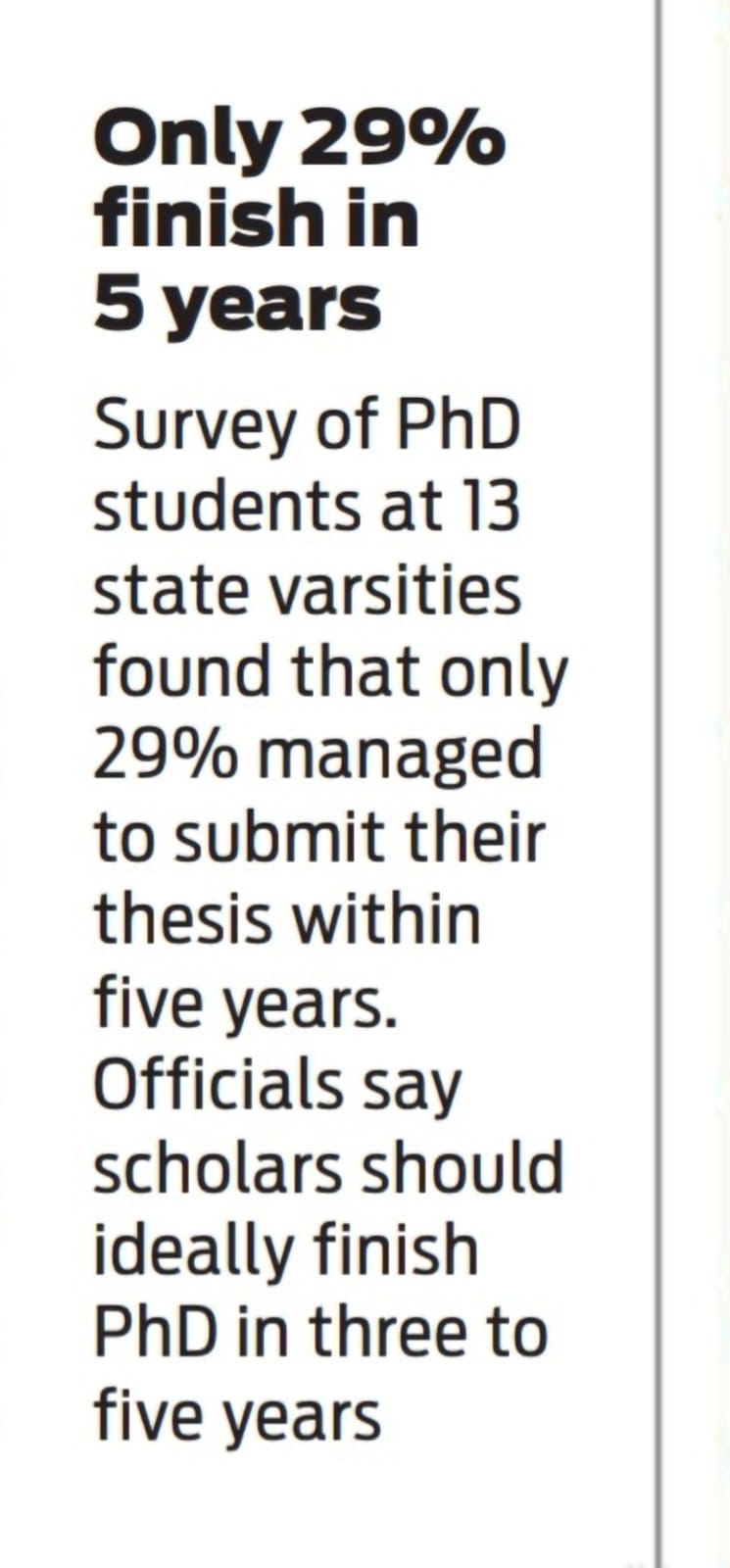
Only 29.4% of PhD
candidates managed to submit their thesis within five years!
#newspaperinlearning
What does it mean to think
like a doctoral student?
#newspaper | 2nd May 2025
Today’s New Indian Express
Data from 13 state universities
in Tamil Nadu have revealed that only 29.4% of PhD students are able to
complete the course within five years.
Alarmed by the figures, the Tamil Nadu
State Council for Higher Education (TANSCHE) has decided to take up a detailed
survey to identify the challenges faced by state institutions and PhD scholars
that are causing delays.
According to initial data collected
by TANSCHE from the 13 Universities under the Higher Education Department,
42,913 students had enrolled in PhD programmes in the last five years. Of them,
only 12,625 students (29.4%) managed to submit their thesis within five years.
Varsity officials said that
ideally PhD scholars should be able to finish their degrees within three to five
years, with the maximum time allowed to complete the programme being six years.
“Nearly 70% of the scholars are
unable to finish their PhD within five years. To address the problem, we need
to identify the root causes. A questionnaire is being prepared for the students
and this will provide us clarity on their problems,”
said TANSCHE vice chairman
MP Vijayakumar.
During his recent meeting with
vice chancellors, CM Stalin had advised them to prioritise research work.
As per the latest All India
Survey on Higher Education (AISHE) report of 2021-22, as many as 28,867
researchers enrolled for PhDs in the state that year, 2,854 received their
doctorates.
Alarming facts indeed.
Although TN leads India in PhD
enrollments, the question is, why-on-earth does it take a candidate beyond five
years to submit their PhD thesis?
In fact, the PhD journey is a highly
demanding intellectual endeavour, that requires a lot of commitment on the part
of the candidate as well as the supervisor!
Even in the United States, the situation
is almost the same, say researchers.
Globally, only 1.1% of 25- to
64-year-olds have a doctoral level education, and a doctorate is generally seen
as the highest academic achievement you can obtain.
However, in the US, despite
producing the highest number of doctorates, figures show that only slightly
more than 50% of those who take on a PhD actually graduate! (Lani 2020).
Even if you follow data all the
way back to the 1950s, the average reported completion rate has been only 61%.
But this is not just a US
phenomenon, and low figures are quoted for Europe (66%: European University
Association 2019) and the UK (70%: Jump 2013).
Australian Government 2020 data shows
that from 2010 to 2016, the national completion rate for master’s/PhD
programmes was a shocking 14.9%
says Nicholas Rowe, in his
book titled, The Realities of Completing a PhD: How to Plan for Success.
Jason R. Karp’s 2009 book titled, How
to survive your PhD has some interesting pointers in this direction.
Jason says -
Did you know that less
than 1 percent of the U.S. population has a PhD?
According to the Chronicle of Higher
Education and National Science Foundation, 43,354 PhDs were awarded by U.S.
schools in 2005 (their most recent data). Of these, 27,974 were awarded in
science and engineering disciplines, and 15,380 were awarded in liberal arts
and humanities disciplines.
Sounds like a lot of PhDs hanging
around, but these figures are actually quite small when you consider there are
over 300 million people living and working in the United States. These small
numbers are one reason why doctors, whether they’ve earned PhDs or MDs, hold
such a prestigious role in society today,
says Jason, and proceeds
to put forth some wonderful ideas on how to successfully submit one’s PhD on time!
-
Don’t enter a PhD programme thinking
that it will be your ticket to some cushy college professor job with three to
four months off every summer. Sure, it could happen, but that’s not what a PhD
really means.
A PhD is about learning, about working
your tail off, about striving for excellence, about the process of becoming a
scholar. And, when it’s all done, for the honour of being called “Doctor” with
all of its privileges and responsibilities.
A PhD is an Opportunity
there will be plenty of
opportunities when you are working on your PhD, opportunities including –
• Working side-by-side
with faculty and experts
• Conversing with other
graduate students about issues in your discipline
Taking a wide variety of
classes on various subjects
• Teaching undergraduate
students about your field
• Becoming involved with
research projects
• Presenting your research
at academic conferences
• Sharing your research
findings with scholarly communities by publishing your work
• Conveying your research
findings to the general public
The key to PhD success is the ability
to recognize these opportunities when they present themselves. You want to
choose a school that will offer you the maximum number of opportunities, one
that matches your research interests, too.
For example, maybe there’s a
certain person you admire in your discipline and working with him or her would
help you learn what you wouldn’t otherwise learn somewhere else. To be the
best, you need to rub elbows with the best. Choose a school that will give you
the best opportunities to learn and become successful.
Writing your research interests on paper
will force you to think about what you want to study and help make your ideas
more concrete. Try listing your research interests below, starting with some
general areas and then listing specific ones.
My General Research
Interests
1.
2.
3.
4.
5.
My Specific Research
Interests
1.
2.
3.
4.
5.
If you can list more than five
general or specific research interests, chances are you’re not focused enough.
As a doctoral student, your research will focus on a very specific area.
For example, a general
research
interest could be “child development,” but child development research alone is
not specific enough. Listing “factors that influence child development” is
still not specific enough, unless you want to spend the rest of your life
working on your PhD.
What about child
development do you want to study? The effect of nutrition on physical
maturation? How different types of parenting styles affect behavior? The effect
of single-parent homes compared to dual-parent homes on the development of
social skills?
Another general research
interest
could be “psychology,” and then your specific interests could include the
factors influencing deviant behavior among high school students, the effects of
serotonin on mood in clinically depressed patients, or the various factors that
influence memory.
Of course, your dissertation
will inevitably become even more specific than these issues as you learn.
Ask yourself what you are
most interested in studying. More importantly, what excites you?
Patience
If someone were to ask me
to pick one word to describe my PhD experience, the word would have to be
“patience.” My lack of patience led to a lot of self-inflicted, unnecessary
stress.
Academia moves slowly. Be prepared to
wait for your advisor to read your research manuscripts that you intend to
submit for publication, for your advisor to read your dissertation proposal,
for your committee members to read your proposal, for your advisor to read your
dissertation, etc.
Thinking Like a Doctoral
Student
What does it mean to think
like a doctoral student, and how exactly do you know whether or not you’re
thinking like one? Is thinking like a doctoral student different than thinking
like a normal person? What do doctoral students do that makes them unique?
Many people go through
their daily lives without really thinking too deeply about countless issues.
If you sit in a public
place and listen to the conversations that people have with each other, you’ll
notice that most of those conversations are superficial in nature.
People tend to talk about
smaller things rather than major thoughts or monumental feelings. We get so
wrapped up in our busy lives (and spend too much time watching TV) that we
spend little time actually thinking. Look at the books people read. When most
people graduate from college, they usually don’t continue reading the kinds of
texts they were “forced” to read while in school.
For example, how many
people do you know who read Shakespeare in their free time? Or physics
textbooks? Or essays on literary theory?
Instead of reading the
works of great scientists, philosophers, sociologists, economists, among
numerous other legends, people read romance novels, Dr. Phil’s latest weight
loss book, or People magazine to find out what Britney Spears has been up to
recently.
With all due respect to
romance novels, Dr. Phil, and Britney Spears, reading these things doesn’t do
much for your brain or your own personal development and enrichment. Except for
pure, cheap entertainment value, they’re largely a waste of time.
As a doctoral student,
however, you’ll spend a lot of time reading and thinking about what you read.
During the time you spend on your degree, you’re expected to eventually become
one of those scholars whose work you’ve been reading the last four or more
years.
While undergraduate
students want to know what and sometimes how, graduate students want to know
why.
Basically, as an
undergraduate, you learn what is already known, but as a graduate student,
especially as a doctoral student, you learn to add to the body of existing
knowledge in your discipline.
Think Big
You know you’re thinking
like a doctoral student if you like studying a subject so specific that you can
discuss it with only five other people in the world.
The first step
in thinking like a doctoral student is to think big. No one has ever achieved
something great without first believing it could be achieved, however seemingly
impossible at first.
A PhD is the highest
academic degree conferred by a university, after all. Believe it or not,
despite the greater salary, prestige, and respect given to MDs, a PhD is
considered a higher academic degree by most.
Less than one percent of the
population has PhDs, so if you have one, be proud; it’s a big deal.
Understand the Literature
The third step in thinking
like a doctoral student is to understand the prior body of work in your
specific area of study. Before you can develop your own ideas, you first need
to understand what research has been done before you entered the field—believe
it or not, people were doing research long before you were born—and that
requires a lot of reading.
What are the major
thoughts
and arguments for popular topics in your discipline? Have these thoughts and arguments
changed over the years? If so, why have they changed? What new information
exists that didn’t exist before? Gaining knowledge of your discipline and
establishing yourself as an authority are necessary to successfully move
forward.
Be Critical
The fourth step in
thinking like a doctoral student is to be critical. Don’t believe everything
you read and don’t take everything at face value.
Reason
The fifth step in thinking
like a doctoral student is to reason your way through a problem. Say you’re
presented with a problem or question in your discipline. First, write down what
the problem or question is!
Publications: Publish or
Perish
One of my fellow grad
students once told me that I should have more than just my dissertation as a
publication when I graduate. Although having as many publications as you can is
arguably important when applying for faculty positions (the infamous “publish
or perish” philosophy).
If you’re clever and think like a
doctoral student, you may be able to get two or even three publications just
from your dissertation alone.
There is no question among
the
academic professorate that the purpose of research is publication. Your
professors cannot get tenure without getting published and getting published
often.
Even the ones who are
already tenured still regard a publication as the Holy Grail; a long
publication list can lead to promotions, higher salaries, and professional
prestige.
As a scholar, you will not
be judged by your breadth or depth of knowledge, your service-related
activities, or, if you’re working in a scientific discipline, your dexterity in
the laboratory. No, you will become known and judged by your publications; so
when it comes to a publication, everyone wants a piece of the pie.
Intellectual Property
While working on your PhD,
you’re going to generate tons of written work, some of which will be based on
your own ideas. Therefore, it’s a good precaution to protect your intellectual
property.
There are four main categories of intellectual property: patents,
trademarks, designs, and copyright. While the majority of your doctoral work
will fall within the copyright category, patents, trademarks, and designs may
also apply to your work if you are working in a discipline in which you will
design or create things (e.g., architecture, engineering, dramatic arts, among
others).
Conferences
Regardless of your
discipline, one of the things you’ll do as a PhD student is submit your
research, most often in the form of an abstract (or synopsis) to present your
findings at a conference.
Presenting your research at a conference is a
wonderful opportunity to share your research with others in your discipline,
not to mention a great chance to develop yourself professionally. When you
attend conferences, make sure you bring business cards and hand them out
judiciously.
Well, I’ve just given a few
vignettes excerpted from the legends on how to complete your PhD within the stipulated timeframe, and make
sure you finish it well within the five-year plan! 😊
By creating a dedicated
workspace, mapping your timeline, and learning to say no to non-essential
commitments that could take away valuable time from your thesis work, you can
plan on submitting your thesis well ahead of the deadline.
Finishing your PhD on time
is indeed a significant achievement. By planning effectively, staying focused,
and taking care of yourself, you can navigate the final stages and submit your
thesis with confidence.
Best wishes! 😊
Works Cited
Rowe, Nicholas. The
Realities of Completing a PhD: How to Plan for Success. NY: Routledge,
2021.
Karp, Jason. How to
survive your PhD: The Insider’s Guide to Avoiding Mistakes, Choosing the Right Program,
Working with Professors, and Just how a Person actually Writes a 200-page paper.
Illinois: Source Books, 2009.
Lee, Anne and Rob
Bongaardt. The Future Of Doctoral Research: Challenges and Opportunities. NY:
Routledge, 2021.
PS: You may want to read
our past post on How to Identify Research Gaps? HERE on our blog.
Yet another article, on ‘Why
Research’ may be quite useful in motivating you towards the right kind of
research, HERE on our blog.


.png)

.png)



.png)
.png)


