Wednesday, 18 August 2010

Mathemagician Invites U...!

Mathemagician

At Spaces, 1, Elliots Beach Road, Besant Nagar

on 21 & 22 August 2010

Duration: 1 hour 15 minutes

Admission Free Call: 98404 74186

Cast & Crew:

Vocal: Bombay Jayashri

Actor: V. Balakrishnan


The Story

The monodrama interweaves dialogue, music and poetry, to take you to Babylon 500BC, the commercial centre of the ancient world. Castrated and sold into slavery by his father, Nikor is apprenticed to Plautus, the Chief Economist of Babylon.With his brilliance in mathematics and statecraft, he attains incredible fame and wealth as the state’s Chief Mathematician, Accountant General and Keeper of the Seals. When he finds his childhood friend Salla again, now the wife of a debauched prince, Nikor is haunted by questions about himself, and what Salla means to him.


The Music

 The monodrama has a subtext of live music – sung by Bombay Jayashree, and played by Sheejith Krishna. The raags and the lyrics – thumri, ghazal and geet, belong to the Radha-Krishna and Sufi genres of romance, in the tawaif (courtesan) and bhakti traditions.


Mathemagician is being staged at Spaces, Chennai, by JustUs Repertory, and at the Edinburgh Fringe Festival, by the Holy Cow Performing Arts Group, Scotland, on the same days: 21, 22 August 2010

Playwright/Director’s Note


As I was writing Mathemagician, I thought I was looking at issues universal and contemporary:
ravages of empire, effects of war on civilian life, ills of slavery, human trafficking, child abuse, gender issues, misuse of science and knowledge. All MCC-ians are Welcome..!

Friday, 13 August 2010

The Case for Short Words

Guide for Reading the Essay "The Case for Short Words":

1. The title of the selection "The Case for Short Words" gives you a clue to the author's opinion about short words. Did this essay convince you to use short words in your writing? Why or why not?
2. Which of the two student essays did you like better? What did you like about it?
3. What do all the words in the first four paragraphs of the essay have in common?
4. What well-known authors does Lederer quote to make his case for short words?
5. When Lederer compares short words to specific objects - like sparks, the dawn, or a blade, - he is creating powerful images. How does this help make his point?
6. In the last paragraph, the suggestion to set up a sign is not meant literally. Why do you think the author makes the suggestion?
7. Do you think the effectiveness of your writing would increase if you used more short words? Why or why not?

Critical Thinking:

Inspired by his students, a best-selling author and a teacher, Richard Lederer explains that the idea for his essay "was inspired by real-life examples of the power of short words." These examples came from the many fine essays submitted to him by his students in response to an assignment on the topic of long and short words. In making his case for short words, Richard Lederer relies on three different kinds of sources: his own writing, quotations of well-known writers and literary works, and students' writing.

A VERY INDIAN POEM IN INDIAN ENGLISH - Critical Summary

Introduction:

Nissim Ezekiel is one of those Indian poets writing in English who creates an authentic flavor of India, by his use of Indian English - Pidgin English on Bazar English, as it is often called. In this poem, the Indian flavor has been created by stressing the various mistakes which Indians commit in their use of English, by bringing in the hopes and aspirations of free India, and also the attitudes of her two hostile neighbors, China and Pakistan.


Poetic Inspiration for the Poem:


It all started as a comment by a friend who said that you write in English no doubt and you write English well but you don't seem to even know or realise that thousands of Indians speak what can only be called Indian English, So from that time in all his train journeys from Mithibai College back home, he started to take some interest in the way English was being spoken on the train. Every time he heard an obvious Indian English phrase like, "I'm not knowing only." he would take it down. When he had about a thousand of these, he thought of creating this present poem.


The Indian Living Conditions:


Ezekiel presents that the new generation is going after 'fashion and foreign things.' He presents the typical Indian make - up. The Indian living conditions are sought to be portrayed. The India of yester years is no longer to be seen here, as modernization and industrialization have speeded up the process of change.

The regrettable thing in the modern world is the act of violence and anti – social tendencies proving to be a menace. Still the positive aspects like regeneration, remuneration and contraception could be thought of as a way out of the present muddle. One can certainly hope for the better and propagate the best that is thought as unique.


Ancient Indian Wisdom:


In the second stanza, the readers get a peep into things - Indians as Gandhi's heir, he would opt for peace and non - violence. He is puzzled why others are not following Gandhi's advice - while in this estimate, the ancient Indian wisdom is correct, contrastively the modern generation takes it to whatever is western and fashionable - like other Indians, he too has to improve his English language. The student interest and petty agitations make him feel sickening line Antony's appeal to the Roman mob, he will call upon the fellow citizens to think of the past masters.


Thus in the third stanza, he pronounces, In order to get away from that which is disgusting, he wants to have a cup of lassi which is very good for digestion. It can be taken as equivalent to the western wine if only a little salt is added to make it a lovely drink. The poet confesses that he is the total abstainer from drinks while it is taken by addicts to gunch themselves, he for his part would turn to simple drinks like lassi. Thus, the poet tries to receive the old Gandhian days.


The World Situation Today:


In the fourth stanza, the poet is able to think aloud and offer his comments on the world situation today. The present conditions all over the world speak of a bad trend that give an edge to the production of dangerous weapons and try to be superior to others. The countries of the world often tie with each other in keeping themselves ahead of others in this mad competitive world. This retrace often leads to conflicts resulting in loss of precious human lives. If only one considers the other as the brother; the trend could be changed.

Unity in Diversity:


India is a land where the principle of 'unity in Diversity' is practiced. Here many communities live together even though there are some problems. This ideal situation in which one Co-exists with the other is described as Ram Rajya by the poet. He gives the hand of friendliness to the visitor and expects him to come again. The poet is optimistic when he says that he enjoys every moment of good company. So, he ends the poem by saying that he does not feel the necessity of celebrating ceremonies.


Common Mistakes ‘highlighted’ in the Poem:


Substrate influence on grammar is quite common. It is often frowned upon as "wrong", but eventually becomes a regular part of the new language variant. "The Patriot" contains a number of Indian English examples: the reduplication of verbs in "fighting fighting", the lack of indefinite and definite articles in "threw stone at Indirabehn" and "all people of world", the use of one instead of the indefinite article a in "one glass lassi", the excessive use of the definite article the in "not that I am ever tasting the wine", the excessive use of the continuous tense (the -ing form) in "I am standing for peace and non-violence", the omission of an obligatory object pronoun in "modern generation is neglecting" (instead of "neglecting this") etc. Again, this is a satirical poem rather than a genuine example of Indian English, but the phenomena exemplified are genuine enough.


Conclusion:


Nissim Ezekiel occupies a unique position among Indo-Anglian poets of post-Independence era. Nissim opposed the idealism and romanticism of the earlier group of Indian writers in English, and tried to look at any typical Indian situation with an Indian attitude, with a novel and dynamic Indian insight. He cleverly manipulated Indian English to bring out the Indian worldview.


Thus Ezekiel uses 'Indian English,' or 'Babu Angrezi' in his poetry to depict the characteristics of Indian attitude. He used irony as a weapon to depict the characteristic features of Indian attitude.

Tuesday, 10 August 2010

I CIA Test - Portions for I BSc Pbt/Zoo Students..:

Dear Students of I BSc Pbt/Zoo (Reg),

You will be tested on the following three texts, for your I CIA which is to be held on 16 Aug at 11.30 am.
1) Ezekiel's "A Very Indian Poem in Indian English"
2) Kipling's "If"
3) Lederer's "The Case for Short Words".

Clarifications, can be made, (not when the exams are around, but much ahead) directly, between 1.30 and 2 pm on all working days, at the Dept of English, or through email at rufusonline@gmail.com
Regards and all best wishes,
Rufus

Monday, 2 August 2010

Guest Lecture - II - on 31 July - A Report...:

The second series of Guest Lectures, for students of Literature, [or rather, for students having a love of literature] was inaugurated by Dr.Stephen Jebanesan, Warden, Selaiyur Hall, MCC at 9.45 am at the Sel Hall Indoor Theatre.

Prof.Daniel David introduced Dr.Bennet Sundersingh, from National College, Trichy.

Dr.Bennet started off with the modus of preparing for UGC-NET Exams, and outlined the new format of paper III. He started from Chaucer's contribution to literature, his narrative poetry, the "Mutability Cantos" of Spenser, [The Faerie Queene], the curtal sonnet form, invented by Gerard Manley Hopkins, and used in three of his poems, etc. He explicated on the various genres and the important adherents to those genres, from ballads, sonnets, plays and novels. While making a comparison between the Jew of Malta - Barabas, the Jew of Venice - Shylock, the Jew of Oliver Twist - Uncle Faggins, he emphasized the fact that studying facts of history become simpler by making these subtle connections between characters in literature. He asked a lot of interesting questions like, 'how Mephistophilis was related to Beelzebub?', on why Greene called Shakespeare an 'upstart crow', 'sieze the day' poem of Marvell, 'Sieze the Day' - a novel by Saul Bellow, etc.

He asked for an elaboration on the nine muses, and had special facts about Dryden, Swift and Pope, and their unique contributions to literature. He also gave info on closet plays, which were meant to be read, than to be performed, on the influence of "Gulliver's Travels" in Carroll's "Alice in Woderland," which inspired the comedy film "Honey, I shrunk the kids".

"Having a chronological, historical sense, as to who/what comes after who/what, helps a lot in easy approach to that particular literature", he said.

In the second session, Dr.Bennet touched upon Literary Criticism, and expounded the various theories of the Literary Critics, right from Aristotle down to Antonio Gramsci. Dr.Bennet finished his talk at 1:20 pm., and then interacted with students at the Guest Room.

The afternoon session, which started at 2:20 pm, saw Prof.Daniel David give a splendid explication on Structuralism. (excerpts on that, to follow...)

[Our sincere thanks to Dr.Stephen Jebanesan, Warden, Selaiyur Hall, for being a great source of support and encouragement to us. We also thank the L&D Secretary, Selaiyur Hall, for facilitating in the successful conduct of the program. ]

Thursday, 29 July 2010

Guest Lectures for Students of English Literature, Part - II..:

Dear Students of English Literature,

We invite you for the second in a series of Guest Lectures by eminent Academicians.

This Saturday, 31 July, Dr.Bennet Sundersingh, Tiruchirappalli, is giving a special lecture on preparing for the UGC-NET Examinations.

The first session will be inaugurated at 9:30 am by Dr.Stephen Jebanesan, Reader in English, & Warden, Selaiyur Hall.

The second session will be from 2 to 4.30 pm, and Prof.Daniel David, Asst Professor of English, SFS, MCC, speaks on Structuralism.

There will be refreshment breaks in both the sessions, and also a time for personal interaction and discussion.

All of you are invited...! Be there!

Regards, Rufus

Sunday, 25 July 2010

Lectures by Eminent Academicians - Saturday, 24 July

The first in a series of UGC preparatory lectures, started with Dr.Seshasayee, Head, Department of English, A.M.Jain College, delivering an effective and motivating lecture on Language, Grammar, and Structural Linguistics to our students from 10 am to 12.45 noon, on Saturday, 24 July 2010. 


Excerpts from Professor's lecture:
"A car driver does not need to know about the various nuts and bolts of the car. He just needs to know how how to drive a car! On the other hand, a car mechanic has to have a good working knowledge about everything relating to the functioning of the car! The same is the case with the linguist!" he said.

"There's a kind of mental / psychological block, when we utter the word "linguistics". But it is not as tough as it is made out to be!", he said.  

He outlined the aims and objectives of Traditional grammarians, for whom the grammar book takes the position similar to that of a Holy Book. You've got to obey it, without questioning it. Then he spoke on the Latinate fallacy, which argued against William Lylye's proposition that all grammar rules are Latin-based. The Latin Fallacy, which believed that what applies in Latin must also apply in English, was abandoned as the prescriptive approach to grammar came under challenge from Linguistics scholars, when the science of linguistics came to the fore in the late 19th century, who claimed that English could not be satisfactorily described or explained in terms of the rules governing Latin. a prescriptive grammar is one that lays down the rules for English language usage, while a descriptive grammar synthesises rules for English usage from the language that people actually use. A prescriptive grammarian believes that certain forms used are correct and that others, even though they may be used by native speakers, are incorrect.

Then in the 19th century came Robert Lowth, the author of one of the most influential textbooks of English grammar. Lowth's method included "correctness" - to teach us what's right and what's wrong, thus criticising "false syntax"; his examples of false syntax were taken from Shakespeare, Milton, Swift, Pope, etc.

Then appeared Lindley Murray, often called "the father of English grammar", who based his grammar on Lylie, but didn't say that the roots are Latin. Instead he adopted it as logical rules which we call "logical fallacy". Following Murray, came along Otto Jespersen, who along with Paul Passy, he was the founder of the International Phonetic Association, and concentratred more on morphology and syntax.

Traditional grammarians refuse to accept the fact that language keeps changing. But the fact is, there's no point in asking today's student to write like a Shakespeare, or a Milton, or even that of a 19th century writer. It is difficult to adopt the writing style of the past. Language must constantly be in a state of flux. But the Traditional grammarians based their study on writing. They totally ignored the spoken part. They believed that writing is primary and speech is only secondary. Hence, Traditional Grammar is normative and prescriptive. You can't question why it's prescribed. That is why, it is unscientific.

Thus Traditional Grammar was replaced with Modern Grammar, which is descriptive. Modern grammar doesn't tell you which is right or which is wrong. In other words, it prescribes the language as it is being used by the native speakers. So here we find the shift from the grammarian to the native speaker.

Prescriptive grammar has a collected corpus. It does not say what is right or what is wrong. It just says whether it is correct or incorrect. On the other hand, Modern grammar tells us whether a particular usage is acceptable or not acceptable. Because, what is unacceptable today may become acceptable at a later period of time.

Consider the sentence:

"I didn't do nothing."

[In Traditional grammar, this is not correct, as they go by the logical rule - two negatives make a positive] but the other way round, to emphasize that I did nothing, I say, "I didn't do nothing"

Modern grammar says that it is unacceptable because native educated speakers do not use it. They depend on 'Social Acceptance' as the sole criterion.

That is, "I seed you" is not incorrect. On the other hand, it's unacceptable.

Georgina, thanking Dr.Seshasayee
Linguists see language as a part of human behaviour. Though there are more than 5000 languages, there are some commonalities among them. A linguist thus studies language as a human aspect, and try to formulate general theories based on that - General Linguistics. GL is not language-specific, followed by a variety of linguistics, like micro-linguistics, in which language is studied for the sake of itself, along with the elements of syntax and phonology. It contrasts with macro-linguistics, which includes meanings, and especially with sociolinguistics, which studies how language and meaning function within human social systems.

Then he spoke about the two ways in which language can be studied - the synchronic and the diachronic, and also elaborated on the common language theories, concerning language. He then outlined the basic characteristics of language, and then proceeded to expound the concepts of Fedinand de Saussure (the father of 20th century Linguistics) - la langue, le langue, la parole, etc.

He then spoke about Received Standard, Regional Standard, and Modified Standard, and also elaborated on dialect, idiolect etc. He then talked on the basic concepts of Structural Linguistics, and the three broad aspects of language - Phonological level, grammatical level, and the semantic level. He also outlined the difference between phonetics and phonology, and also gave a morphological rendering of a few sentences as illustrations.

To sum up, - the lecture, not only helped in giving the students a refreshing view on the subject, but also helped in dispelling certain notions about the subject, which were preventing the ordinary student from venturing into the field boldly. The fresh perspective into Language, Grammar and Linguistics was indeed an intellectual treat to the student of literature. Thank you sir. You made our day..!

Our sincere thanks are due to our beloved Professor Dr.Stephen Jebanesan, Professor of English, and Warden, Selaiyur Hall, for giving us the needed infrastructure as well as the much required motivation to keep the lectures going. Thanks are also due to all the members of Staff of the English dept, and especially, Prof.Wesley Santharaj, for his invaluable help, Prof.Dinesh, for his support and guidance, Prof.Jayanthi, for her presence and motivation, Prof.Jubi, Dept of Journalism, for covering the occasion, Prof.Rayson, for his presence and moral support, and Anand, student from SFS, Selaiyur Hall, for videographing the whole event for us. Thank you...! Thanks and kudos - a million - to our self-motivated students who make the best use of the once-in-a-lifetime - opportunites that come their way. It's indeed you - who keep us going..! Thank you...!

Friday, 23 July 2010

I MA Students scoring music..:

III BA English Lit Students..:

II BA English Lit Students performing a play..:

Prof.David, "our Chocolate Professor," giving a lovli Hindi number..:

Students of English Lit @ the Freshers' Party..:

Prashant, III BA giving a soulful number...:

Freshers' in the English Dept..:

Shloka and Ankita (I MA) preparing to give a special number

Freshers' Party started with a delicious and sumptuous lunch, hosted on behalf of the freshers. Rita (II MA) gave the opening prayer, followed by a variety of performances.

Cultivating a Lifetime Reading Habit..:

This could change your life
Set times: You should have a few set times during every day when you’ll read for at least 5-10 minutes.

Always carry a book: Wherever you go, take a book with you.

Make a list: Keep a list of all the great books you want to read. You can keep this in your journal, in a pocket notebook, on your personal home page

Find a quiet place: Find a place in your home where you can sit in a comfortable chair (don’t lay down unless you’re going to sleep) and curl up with a good book without interruptions. There should be no television or computer near the chair to minimize distractions, and no music or noisy family members/roommates. If you don’t have a place like this, create one

Reduce television/Internet: If you really want to read more, try cutting back on TV or Internet consumption. This may be difficult for many people. Still, every minute you reduce of Internet/TV, you could use for reading

Keep a log: Similar to the reading list, this log should have not only the title and author of the books you read, but the dates you start and finish them if possible.

Go to used book shops: it is very fun to browse through the new books people have donated. Make your trip to a used book store a regular thing.

Have a library day: Even cheaper than a used book shop is a library, of course. Make it a weekly trip.

Read fun and compelling books: that really grip you and keep you going. Even if they aren’t literary masterpieces, they make you want to read — and that’s the goal here. After you have cultivated the reading habit, you can move on to more difficult stuff, but for now, go for the fun, gripping stuff.

Make it pleasurable: Make your reading time your favorite time of day. Have some good tea or coffee while you read, or another kind of treat. Get into a comfortable chair with a good blanket. Read during sunrise or sunset, or at the beach.

Blog it: One of the best ways to form a habit is to put it on your blog. If you don’t have one, create one. It’s free. Have your family go there and give you book suggestions and comment on the ones you’re reading

Set a high goal: Tell yourself that you want to read 50 books this year (or some other number like that). Then set about trying to accomplish it. Just be sure you’re still enjoying the reading though — don’t make it a rushed chore

Have a reading hour or reading day: If you turn off the TV or Internet in the evening, you could have a set hour (perhaps just after dinner) when you and maybe all the members of your family read each night. Or you could do a reading day, when you (and again, your other family members if you can get them to join you) read for practically the whole day.

Thanks to: Leo Babauta

ARE YOU A MEMBER...?

"When I got [my] library card, that was when my life began," says Rita Mae Brown, prolific American writer and social activist. "Your Library is your Portrait," says Holbrook Jackson. "Books are the ever burning lamps of accumulated wisdom," says George William Curtis. Indeed, this is the best time to check out some of the good libraries in the City, and a compendium of the same, numbering around 115, is available HERE.

Thursday, 22 July 2010

FRESHERS' PARTY..:

Dear Students of I BA/I MA English Lit.,

Join us for the Freshers' Party, hosted by your seniors on Friday, 23 July 2010. This, we hope, would be a freshers' party with a difference. Do come and be a part of the show.

Regards and all best wishes,
Rufus

Monday, 19 July 2010

UGC-NET Preparatory Lectures..:

Dear Students of I MA/II MA English, We are planning on a series of lectures as part of your UGC-NET exam preparation, starting this Saturday. Speakers include eminent scholars drawn from all over the country. This Saturday, 24 July 2010, we are having two lectures - the first one, from 10 - 12:30, and the second lecture will be from 2 to 4 pm on the same day. All of you are invited...! Be there! Regards, Rufus

Wednesday, 23 June 2010

MA Admissions - Reg

Dear Students,
The list of students admitted to the MA English Course at MCC, has been displayed in our College Website. 
Regards,
Rufus

Wednesday, 16 June 2010

Tuesday, 15 June 2010

Admissions 2010-11 - An Appraisal...:

Admissions for the year 2010-11 for all the Under-graduate courses have seen a phenomenal rise over the previous years, and is almost over. While BA English and BCom classes closed receipt and sale of applications as early as June 03, 2010, many other departments also followed suit by the end of the week.

The guidelines for UG Admissions are very open and straightforward. The Department Admission Committee recommends 80% of the sanctioned strength of students, while the rest is filled in by the Principal.

Merit has been the primary criterion for the admissions this year. Departments follow strictly the norms and regulations while making their recommendations. With a view to enriching the traditional cosmopolitan character of the College, the Departments take into consideration candidates from other states as well as other countries.

Classes begin on June 16 for the II/III UG Classes, and II PG Classes, while orientation for the freshers will be on, at the Anderson Hall at 8.15 am, the same day.

Wish you a rewarding and fruitful new academic year ahead.

Regards and all best wishes,
Rufus

Monday, 14 June 2010

Welcome Back...!


Dear Students, Welcome to yet another eventful year at our own Madras Christian College. "Desire is the starting point of all achievement, not a hope, not a wish, but a keen pulsating desire which transcends everything," said Napoleon Hill. Indeed, desire is the key to motivation, but it's determination and commitment to an unrelenting pursuit of your goal - a commitment to excellence - that will enable you to attain the success you seek. Your College is growing by leaps and bounds not only academically but also infrastructure wise, in both letter and in spirit. Under the aegis of a new, energetic and dynamic leadership, let's together march ahead in making our college the numero uno! Indeed, our own web log too has bounced back with double energy after a brief hiatus. I earnestly hope to make this academic web log a meaningful exercise in communication to my dear students. With warm regards and all best wishes, Rufus

Sunday, 13 June 2010

Welcome Back...!

Dear Students,
Welcome to yet another eventful year at our own Madras Christian College. "Desire is the starting point of all achievement, not a hope, not a wish, but a keen pulsating desire which transcends everything," said Napoleon Hill. Indeed, desire is the key to motivation, but it's determination and commitment to an unrelenting pursuit of your goal - a commitment to excellence - that will enable you to attain the success you seek.

Your College is growing by leaps and bounds not only academically but also infrastructure wise, in both letter and in spirit. Under the aegis of a new, energetic and dynamic leadership, let's together march ahead in making our college the numero uno!

Indeed, our own web log too has bounced back with double energy after a brief hiatus. I earnestly hope to make this academic web log a meaningful exercise in communicating with my dear students.

With warm regards and all best wishes,
Rufus

Wednesday, 21 April 2010

Retiring Professors on the Dais...:

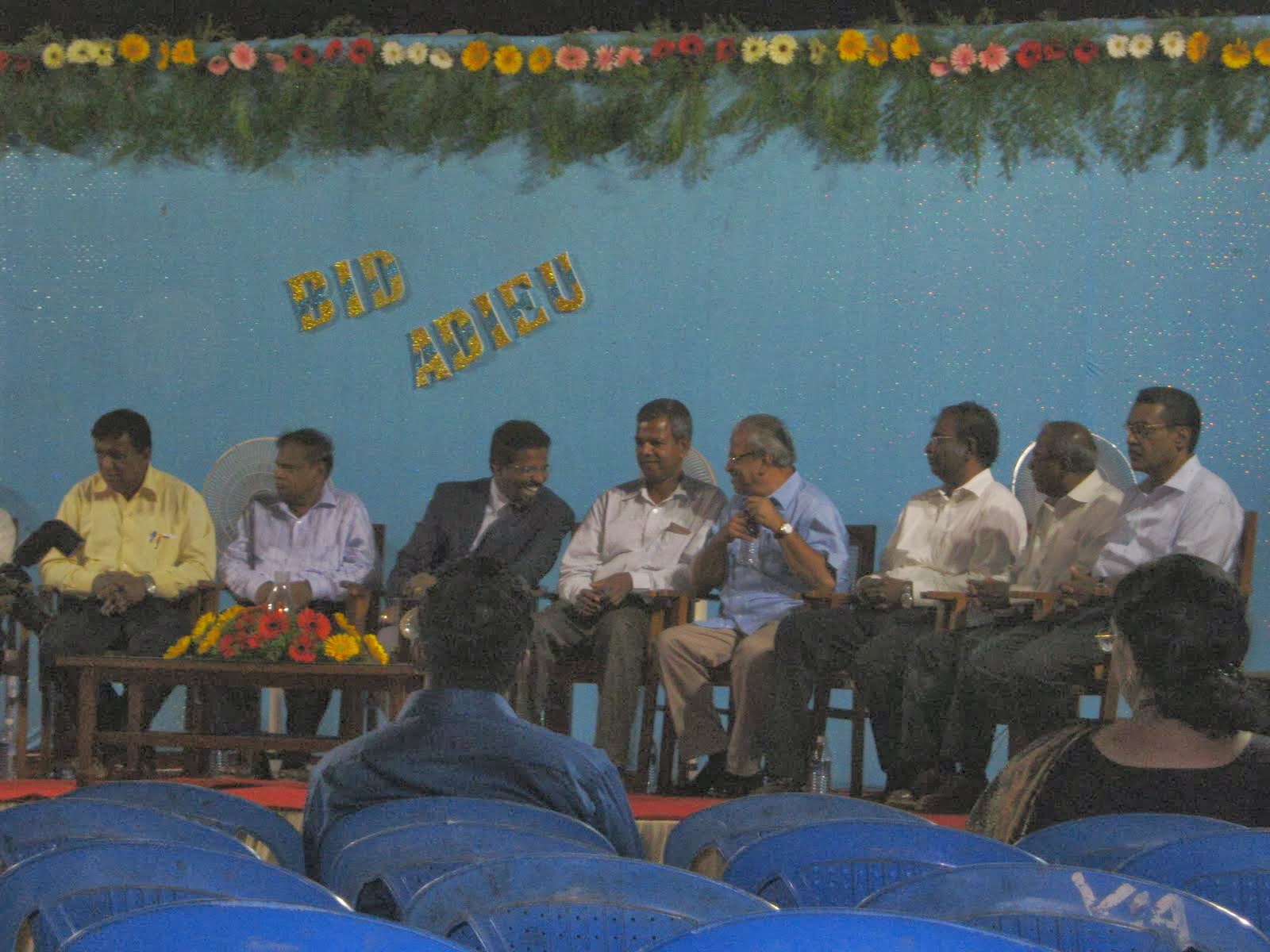
Three emiment Professors from the Dept of English, seated from right to left - Prof.Cherian, (seated first from right) Prof.Victor, Prof.Nirmal, and the other retiring Professors at the felicitation function hosted in their honour.

Dr.Nirmal calls it a day, @ MCC..:

Dr.Nirmal Selvamony, being greeted by the Principal, at the felicitation function for retiring Professors.

Featured post

Welcoming the Winter Guests | A Dawn Birding Adventure in Namma Chennai Today 💚

The First Flock | Welcoming Seven Magnificent Migrants to Namma Chennai #intothewildwithrufus #birding 6th September 2026 Today, as part of ...