Saturday, 11 February 2023

She said, “First listen to the condition; then think it over. It’s not an ordinary condition!"

The Day's Newspaper in Language Learning | A Report

Since today happened to be a Saturday, and the air was filled with festive cheer, with the Inter-Hall Sports Meet just hours away, I had informed our II MA English class a wee bit in advance, [through the Class Rep Dinesh], that we would be having a Newspaper Quiz today, based on the day's Newspaper.

In this regard, I had also brought along copies of the day’s Times of India, for each and every student.

Students were very enthusiastic and vibrant in their responses right from the start.

One of the questions was –

Find out the typographical errors in page six of today’s Times of India.

Gladson came up with the right answer in no time.

Similarly, Gayathri, Jean and Angela also came up with quick successive answers.

The quiz was however getting heated up with Princy, Alan and Fanny giving a tight tug to the finish, with Fanny bagging the honours at the end of a rewarding photo finish.

Well, today we had the opportunity to learn a lot of amazing words in the process as well!

Some of them are –

Ostrich-like attitude – A person who refuses to face reality or recognize the truth. A reference to the popular notion that the ostrich hides from danger by burying its head in the sand.

Madventure – An adventure of an extreme nature, that can be applied to any adventure whereby a normal person would consider you to be mad for partaking in the said activity.

Road milling – Milling is the process of removing the top layer of asphalt to a specified and even depth without disturbing the underlying subbase. This allows new asphalt to be laid down without increasing the height of the road and saves you time if the subbase doesn't need to be fixed.

Goof up – a stupid mistake.

Gaffe – A gaffe is a stupid, embarrassing or careless mistake.

Bedlam – “A scene of uproar and mad confusion”. It takes its origin from the colloquial pronunciation of Bethlehem, [lunatic asylum] short for "Hospital of Saint Mary of Bethlehem" in London, which was founded 1247 as a priory, mentioned as a hospital by 1330 and as a lunatic hospital by 1402.

Bloodbath Nation – An intimate and powerful rumination on American gun violence by Paul Auster.

amongst a host of other interesting vocabulary as well.

There were a host of other intriguing articles, like the Bachelors’ Padayatra in which –

Around 200 bachelors from Mandya district had resolved to undertake a unique padayatra to MM Hills temple in Chamrajanagar district seeking divine intervention to find brides for themselves. Men in the district, especially those involved in agricultural activities, have been finding it difficult to find brides.

"The district was once notorious for female foeticide and we are paying the price today," said a woman farmer leader.

Mandya district, which is witnessing an acute shortage of brides for youths who are into farming and those living in villages, will witness a unique padayatra to the famous MM Hills temple in neighbouring Chamarajanagar district this month.

Yet another article on the ‘One condition in Love’ was equally intriguing.

This Speaking Tree post by Sumit Paul roots for “A little distance is needed in love/ This is the only key to survival of love”. It goes thus -

I read somewhere that a young woman and man fell in love and, as it happens, immediately wanted to get married.

The woman said, “Only on one condition.” She was very cultured, sophisticated and rich.

The man said, “Any condition is acceptable, but I cannot live without you.”

She said, “First listen to the condition; then think it over. It’s not an ordinary condition. The condition is that we will not live in the same house. I’ve a vast land, a beautiful lake surrounded by beautiful trees, gardens and lawns. I’ll make you a house on the other side, just opposite where I live.”

He said, “Then what’s the point of marriage?”

She replied, “Marriage is not destroying each other. I’m giving you your space. I’ve my own space. Once in a while, walking in the garden we may meet. Once in a while, boating in the lake, we may meet accidentally. Or sometimes, I can invite you to have tea with me, or you can invite me.”

The man said, “This idea is simply absurd.”

The woman said, “Then forget all about marriage. This is the only right idea — only then can our love go on growing, because we always remain fresh and new. We never take each other for granted. I’ve every right to refuse your invitation, just as you have every right to refuse my invitation; in no way are our freedoms disturbed. Between these two freedoms grows the beautiful phenomenon of love.”

Of course, the man couldn’t understand and dropped the idea.

But Rabindranath Tagore had the same insight, as did Kahlil Gibran, who wrote: ‘If this is possible, to have both space and togetherness, then…The winds of heaven dance between you.’

Yet another intense read, was on Google Doodle honouring the first female lead in Malayalam Cinema – P. K. Rosy on her 120th birth anniversary.

The article goes like this -

Less than a century after Nangeli, the eponymous subaltern woman, chopped off her breasts in protest against the Travancore kingdom’s ‘mulakkaram’ (lower caste women were not allowed to cover their breasts then) P K Rosy, a Dalit, became the heroine of first Malayalam movie ever made. 

She ironically played the role of an upper caste woman, and the movie's release led to widespread rioting. On Friday, Google celebrated Rosy's 120th birth anniversary with a doodle.

On the whole, it was a very rewarding time with the day’s Newspaper for all of us in class today. Keep up the spirit, class.

PS: You may want to read our past post on our Newspaper Club HERE

Friday, 10 February 2023

'Mass culture was labelled as a drug which ‘lessens people’s capacity to experience life itself’

Culture, Popular Culture, Mass Culture, Subculture, Counterculture

[Working Definitions]

Raymond Williams calls culture, ‘one of the two or three most complicated words in the English language’. He suggests that, culture can be used to refer to ‘a general process of intellectual, spiritual and aesthetic development’.

Popular Culture: One way of defining popular culture is to suggest that it is the culture that is left over after we have decided what is high culture. Popular culture, in this definition, is a residual category, there to accommodate texts and practices that fail to meet the required standards to qualify as high culture. In other words, popular culture is classified as inferior culture. For example, high culture might want to insist on formal complexity. In other words, to be real culture, it has to be difficult. Being difficult thus ensures its exclusive status as high culture.

After 1660 culture in England was decisively split along class lines so that the ‘polite’ and ‘proper’ values of the gentry aimed to dominate the ‘vulgarity’ of the ‘common’ people. By 1830 that split has been reshaped and reformed so that popular culture - in distinction to the high culture of the gentry - now in some degree expresses the values of the working class.

In Keywords (1976) Raymond Williams suggests that ‘popular’ is used to describe a culture ‘made by the people for themselves’. This requires a counter-definition: ‘popular’ to mean the mass media imposed on people by commercial interests.

In the West, from at least the 1890s popular culture and its distance from high culture became largely incorporated into the great contemporary media - newspapers, film, radio, television - whose condition of existence was modern technology, particularly in visual reproduction.

In Britain the generation that learned to read because of the 1870 Education Act began in the 1890s to buy weekly and daily popular journals. On 4 May 1896 a newspaper costing a halfpenny was launched [at a time when other dailies cost one penny]. The Daily Mail, started winning sales of half a million by 1898 and a full million by 1900.

Development of the popular press was followed by the cinema, especially in the decade after 1910. By 1920 Hollywood, [consisting of production, distribution and cinema ownership together], made up America’s fourth largest industry, after farming, steel and transportation. During the 1920s Hollywood was making 850 feature films per year, and at a peak in 1930 in the United States. 110 million cinema tickets were being sold each week.

Radio in Britain grew rapidly after the British Broadcasting Corporation was given an exclusive licence to broadcast in January 1923.

Television transmission was introduced in 1936. In the United States 3 per cent of the households owned sets in 1940, 88 per cent in 1960. The rise of television was matched by the decline of the mass audience for the cinema from 1950 onwards. During this period the divide between high and popular culture becomes decisive.

Literary Value as Hegemony: At present the prevailing notion of literary value is inextricably bound up with the conventional account of literary study. The high culture/popular culture opposition was founded in a conception of value: while literary value is present in the canonical work, it is absent from the texts of popular culture. Raymond Williams was probably the first to denounce literary value as an institutional construction.

Mass culture is the inevitable outcome of mass society and mass production. It was labelled as a drug which ‘lessens people’s capacity to experience life itself’. Critics have also termed it as a sign of impoverishment, which marks the de-individualization of life: an endless search after what Freud calls ‘substitute gratifications’. The trouble with substitute gratifications, according to the mass culture critique, is that they shut out ‘real gratifications’.

Subcultures are “pieces” of a larger culture or society, differing in some way from “mainstream” culture. It can be defined as - a relatively diffuse social network having a shared identity, distinctive meanings around certain ideas, practices, and objects, and a sense of marginalization from or resistance to a perceived “conventional” society.

Subcultures are important because they provide affirming spaces. In their opposition, they reflect back at our hypocrisies, forcing us to ask “oppositional to what?” Conformity? Racism? Intolerance? Violence? Hyper-consumption? Beauty standards? Subculturists may not be heroes, but if we listen, they may teach us something. For criminologists then, “subculture” was (and sometimes still is) used to describe a delinquent or criminal gang to be stopped or reformed by various authorities.

Countercultures involve extra-institutional challenges to cultural authorities. Theodor Roznak (1969/1995) used the term counterculture to describe the youth cultures of the 1960s. Counterculture seems to fill the conceptual gap between social movement and subculture. J.

Milton Yinger (1960) distinguished between “contracultures” in conflict with dominant society and subcultures, groups with distinctive norms that may or may not openly conflict with the larger culture. They place a premium on individuality, having perhaps even less coherence than many subcultures. Observing “The Counterculture” of the 1960s, Roznak noted a broad rejection of “technocratic society” and championing of creativity and self-fulfillment, exemplified by the hippies.

*****

Works Cited

Knowledges: Culture, Counterculture, Subculture. By Peter Worsley

The Hippie Narrative: A Literary Perspective on the Counterculture. By Scott Macfarlane

Subcultures: The Basics. By Ross Haenfler

American Countercultures: An Encyclopedia of Nonconformists, Alternative Lifestyles, and Radical Ideas in U.S. History. Edited by Gina Misiroglu

Cultural Theory and Popular Culture: An Introduction. Fifth edition. By John Storey

Thursday, 9 February 2023

The 'Family Farm' Culture of Norway | Arne Naess

Green Transition | Naess & the Nordics

Coincidentally, just two days ago - this 7th February, in the MPhil class we were having a discussion on the Nordic countries and their tryst with going green, with special reference to Norway, the birthplace of Arne Naess.

So it was all the more exciting to read an intriguing news feature in today’s The Hindu which says that –

The Nordic countries are ready to offer their technologies and expertise to India as it moves towards a green, digital, and innovative future. Over the last decades, Nordic countries have been pioneering green technologies. Together, the Nordics and India can power the green transition the world needs.

Coming back to Arne Naess,

Well, Arne Naess, Norway’s best-known philosopher, is credited with coining the term “deep ecology”. This intriguing distinction that he made between what he called deep and shallow ecological thinking, was indeed a huge blow to the Western preoccupation with the environmental crisis.

Today's The Hindu

While talking about the “Family Farm Culture” of Norway, Arne Naess remarks -

Norway is the only Nordic country with family farms, and there is a definite agriculture, not just agribusiness. To protect this culture and to make it economically possible for its practitioners to survive, Norway “subsidizes” its agriculture.

That is, there is a transfer of income so that the farmers can offer the public their products at low prices, prices that are not high enough to cover farm expenses.

In an important sense, it is not the farmer, but the public, that is subsidized and protected against further increases.

Quite ironically, today, we are asked to destroy the farm culture in favor of city culture.

PS: You may want to read this entire intriguing essay by Arne Naess, on our blogpost HERE

Pic Courtesy: Getty/istock/The Hindu

Wednesday, 8 February 2023

"Ideologies of womanhood have as much to do with class and race as they have to do with sex"

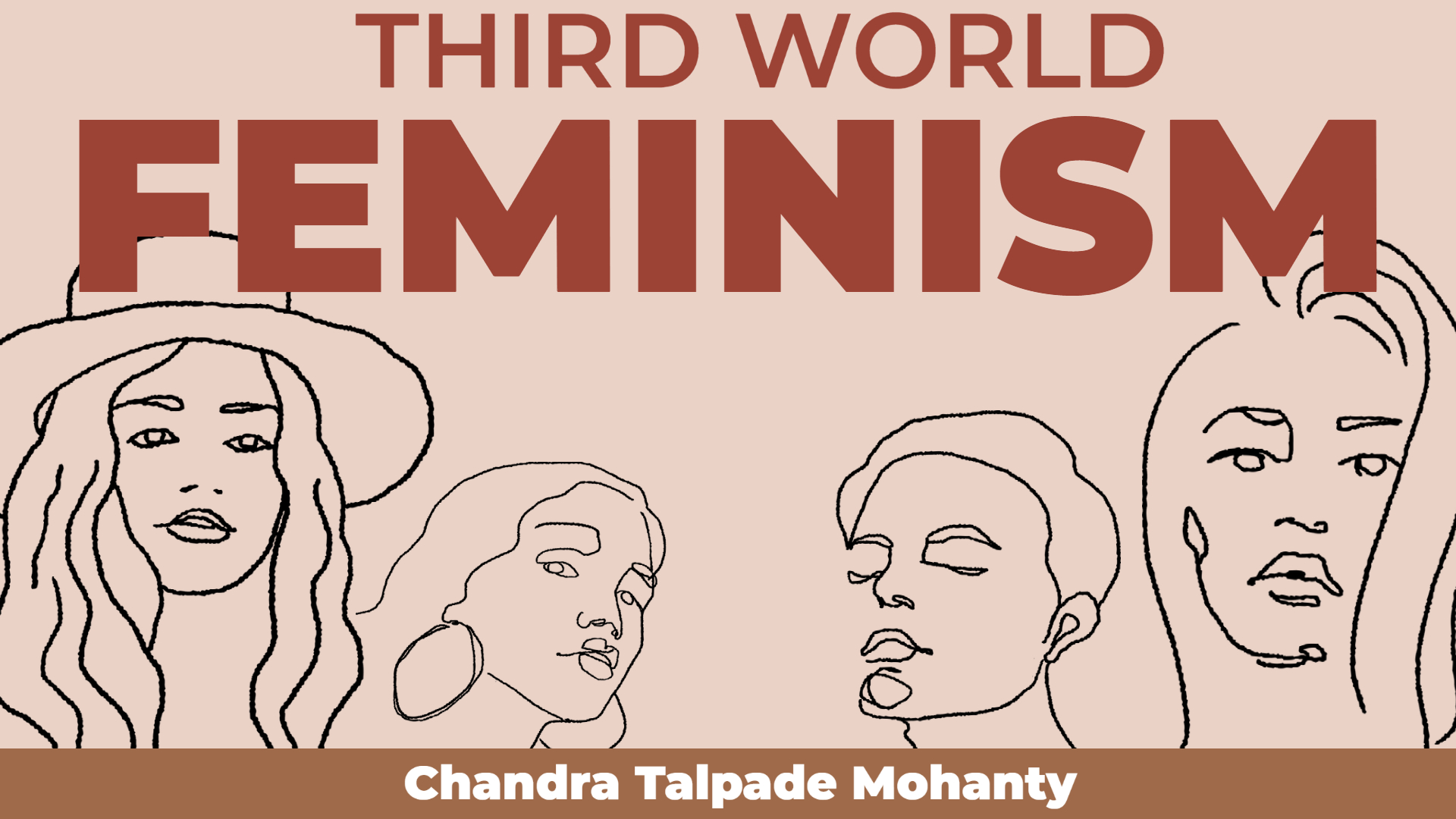
“Cartographies of Struggle: Third World Women and the Politics of Feminism”

By Chandra Talpade Mohanty [Abridged Version] 

The US and the USSR are the most powerful countries

in the world but only 1/8 of the world’s population.

African people are also 1/8 of the world’s population.

Of that, 1/4 is Nigerian. 1/2 of the world’s population is Asian.

1/2 of that is Chinese.

There are 22 nations in the middle east.

Most people in the world are Yellow, Black, Brown, Poor,

Female, Non-Christian and do not speak English.

By the year 2000 the 20 largest cities in the world

will have one thing in common.

None of them will be in Europe, n

one in the United States.

 - Audre Lorde, January 1, 1989

The Urgency of Our Predicament in a Eurocentric World

I begin this essay with Audre Lorde’s words as a tribute to her courage in consistently engaging the very institutional power structures that define and circumscribe the lives of Third World women. Her words provide a poetic cartography of the historical and political location of Third World peoples and document the urgency of our predicament in a Eurocentric world. 

In fact, one of the distinctive features of contemporary societies is the internationalization of economies and labor forces. In addition, the massive migration of excolonial populations to the industrial metropolises of Europe to fill the need for cheap labor has created new kinds of multiethnic and multiracial social formations similar to those in the United States. 

‘Third World Feminism’: Questions of Definition 

Charting the ground for an analysis of Third World women and the politics of feminism is no easy task. First, there are the questions of definition: Who/what is the Third World? Do Third World women make up any kind of a constituency? Can we assume that Third World women’s political struggles are necessarily ‘‘feminist’’? How do we/they define feminism? 

These are all questions of great importance in this particular cartography of Third World feminisms. I write this cartography from my own particular political, historical, and intellectual location, as a Third World feminist trained in the United States, interested in questions of culture, knowledge production, and activism in an international context. 

Histories of Third World Women’s Engagement with Feminism: In Short Supply 

Definitions: Third World Women and Feminism Unlike the history of Western (white, middle-class) feminisms, which has been explored in great detail over the last few decades, histories of Third World women’s engagement with feminism are in short supply. 

There is a large body of work on ‘‘women in developing countries,’’ but this does not necessarily engage feminist questions. 

Third World Women as a Political Category 

Just as it is difficult to speak of a singular entity called ‘‘Western feminism,’’ it is difficult to generalize about ‘‘Third World feminisms.’’ 

In much of my scholarship, I have chosen to foreground ‘‘Third World women’’ as an analytical and political category; thus I want to recognize and analytically explore the links among the histories and struggles of Third World women against racism, sexism, colonialism, imperialism, and monopoly capital. 

Nation-States that Constitute ‘Third World Peoples’ 

Geographically, the nation-states of Latin America, the Caribbean, subSaharan Africa, South and Southeast Asia, China, South Africa, and Oceania constitute the parameters of the non-European Third World. In addition, black, Latino, Asian, and indigenous peoples in the United States, Europe, and Australia, some of whom have historic links with the geographically defined Third World, also refer to themselves as Third World peoples. 

With such a broad canvas, racial, sexual, national, economic, and cultural borders are difficult to demarcate, shaped politically as they are in individual and collective practice. 

Suspicion over the term ‘Feminism’ 

The term ‘‘feminism’’ is itself questioned by many Third World women. Feminist movements have been challenged on the grounds of cultural imperialism and of shortsightedness in defining the meaning of gender in terms of middle-class, white experiences, internal racism, classism, and homophobia. 

All of these factors, as well as the falsely homogeneous representation of the movement by the media, have led to a very real suspicion of ‘‘feminism’’ as a productive ground for struggle. Nevertheless, Third World women have always engaged with feminism, even if the label has been rejected in a number of instances. 

Major Areas of Concern for Third World Feminism in the US 

Cherrie Moraga and Gloria Anzaldúa delineate the major areas of concern for a broadbased political movement of U.S. Third World women: 

1.      how visibility/invisibility as women of color forms our radicalism;

2.      the ways in which Third World women derive a feminist political theory specifically from our racial/cultural background and experience;

3.      the destructive and demoralizing effects of racism in the women’s movement;

4.      the cultural, class, and sexuality differences that divide women of color;

5.      Third World women’s writing as a tool for self-preservation and revolution; and

6.     the ways and means of a Third World feminist future. 

Political Struggles of Women in India, Indonesia and Korea: The Common Link 

The common link between political struggles of women in India, Indonesia, and Korea, for instance, is the fight against racist, colonialist states and for national independence. 

To sum up, Third World women’s writings on feminism have consistently focused on the idea of the simultaneity of oppressions as fundamental to the experience of social and political marginality and the grounding of feminist politics in the histories of racism and imperialism; the crucial role of a hegemonic state in circumscribing their/our daily lives and survival struggles; the significance of memory and writing in the creation of oppositional agency; and the differences, conflicts, and contradictions internal to Third World women’s organizations and communities. 

Third World Women’s Argument for Rewriting of History 

In fact, the challenge of Third World feminisms to white, Western feminisms has been precisely this inescapable link between feminist and political liberation movements. 

In fact, black, white, and other Third World women have very different histories with respect to the particular inheritance of post-fifteenth-century Euro-American hegemony: the inheritance of slavery, enforced migration, plantation and indentured labor, colonialism, imperial conquest, and genocide. 

Thus, Third World feminists have argued for the rewriting of history based on the specific locations and histories of struggle of people of color and postcolonial peoples, and on the day-to-day strategies of survival utilized by such peoples. The urgency of rewriting and rethinking these histories and struggles is suggested by A. Sivanandan in his searing critique of the identity politics of the 1980s social movements in Britain. 

But how do we attempt such a history based on our limited knowledges? After all, it is primarily in the last two or three decades that Third World historians have begun to reexamine and rewrite the history of slavery and colonialism from oppositional locations, especially on the significance of writing for Third World feminists - the significance of producing knowledge for ourselves. 

Ideologies of Womanhood: Class, Race & Sex 

Ideologies of womanhood have as much to do with class and race as they have to do with sex. Thus, during the period of American slavery, constructions of white womanhood as chaste, domesticated, and morally pure had everything to do with corresponding constructions of black slave women as promiscuous, available plantation workers. It is the intersections of the various systemic networks of class, race, (hetero)sexuality, and nation, then, that position us as ‘‘women.’’ 

‘Production’ of Knowledge ‘about’ Third World Women 

Anthropology and its ‘‘nativization’’ of Third World women thus forms a significant context for understanding the production of knowledge ‘‘about’’ Third World women. 

Knowledge production in literary and social-scientific disciplines is clearly an important discursive site for struggle. The practice of scholarship is also a form of rule and of resistance, and constitutes an increasingly important arena of Third World feminisms. 

After all, the material effects of this knowledge production have ramifications for institutions (e.g., laws, policies, educational systems) as well as the constitution of selves and of subjectivities. 

Conclusion 

To summarize, this chapter delineates the urgency and necessity to rethink feminist praxis and theory within a cross-cultural, international framework, and discusses the assumption of Third World women as a social and political category in order to suggest new beginnings and middles, and to argue for more finely honed historical and context-specific feminist methods. 

I also write out of the conviction that we must be able and willing to theorize and engage the feminist politics of women, for these are the very understandings we need to respond seriously to the challenges of race, class, and our postcolonial condition.

Notes for Students | 57 years ago!

From ‘Rules & Notes’

College Handbook, MCC, 1966

ON EXAMINATIONS

In College examinations you should write your name on your answer-paper, but in University examinations only your number; otherwise the rules are much the same for both :-

1. Complete silence must be kept in the examination hall and nearby.

2. Come in when the first bell rings, sit in your place, and fill up the details required on the front of your answer book. Question-papers will be given out when the second bell rings.

3. You may not come into the examination hall more than half an hour after the examination starts, nor leave it until half an hour has passed (in one-hour tests, you must stay until the end). Once you leave, you may not come back in again.

4. You may not bring into the examination hall any notes or books or Tables. You must bring your own pen (using black or blue-black ink) pencils, and instruments if needed. You may bring a bottle of ink. The College will provide a booklet of Tables in Mathematics, Statistics, Physics and Chemistry examinations, in exchange for a deposit of one rupee.

5. Use both sides of the paper. If it is unruled, write at least twenty lines to the page. You can have more paper if you need it, but all the paper issued to you must be handed in at the end, including any blank or spoiled leaves. Do your rough work on the answer paper, at the bottom of the page.

6, You may not leave the room during the examination, without the invigilator's consent. If you have to visit the toilet, he will have to come with you.

7. When you finish writing your answers, or when the bell rings for the end of the examination, go quietly out of the room leaving your paper on your own table for the invigilator to collect. Move well away from the hall before discussing the paper with your friends, so, as not to disturb other candidates.

CHANDRAN D. S. DEVANESEN

Principal

1966

***

Tuesday, 7 February 2023

"Cultural Studies: A Critique of Culture’s Hegemonic Effects" - Simon During

Simon During | ‘Introduction’ to The Cultural Studies Reader

[Abridged Version of the Text with Subheadings Added]                                   

Culture as Industry

As the old working-class communal life fragmented, attention moved from locally produced and often long-standing cultural forms (pub life, group-singing, holidays at camps, and close-by seaside resorts etc.) to culture as organized from afar – both by the state through its educational system, and by what Theodor Adorno and Max Horkheimer called the “culture industry,” that is, highly developed music, film, and broadcasting businesses.

Culture as Hegemony: Not Coercion but Consent

The old notion of culture as a whole way of life became increasingly difficult to sustain. From the early 1970s, culture came to be regarded as a form of “hegemony” – a word associated with Antonio Gramsci, an Italian Marxist of the 1920s and 1930s. “Hegemony” is a term to describe relations of domination which are not visible as such. It involves not coercion but consent on the part of the dominated (or “subaltern”).

Cultural Studies: As a Critique of Culture’s Hegemonic Effects

As culture was thought about less as an expression of local communal lives and more as an apparatus within a large system of domination, cultural studies offered critiques of culture’s hegemonic effects.

Culture as ‘Signifying Practices’

At first such critique leant heavily on forms of semiotic analysis. This meant in effect that culture was broken down into discrete messages, “signifying practices” or “discourses” which were distributed by particular institutions and media. To take a rather simplified example: a semiotic analysis of cigarette-smoking among workers would analyze smoking not as a life-practice, that is, in terms of its importance as a rite of passage, its use in structuring the flow of time and so on, but in terms of its being a signifier produced by images like the “Marlboro Man,” which connote masculinity, freedom and transcendence of work-a-day life.

Individuals as ‘Constructs of Ideology’

In the 1970s, a hard form of structuralism did emerge. For this theory, individuals were constructs of ideology, where ideology means the set of discourses and images which constitute the most widespread knowledge and values – “common sense.” Ideology was required so that the state and capitalism can reproduce themselves without the threat of revolution.

State’s Claim to Neutrality is False

Here, as for Hoggart and Williams, the state’s claim to neutrality is false, but this time for more classically Marxist reasons – because it protects the exploitative “relations of production” (i.e., class differences) necessary to capitalism.

Dominant Ideology: Constructs an Imaginary Picture of Civil Life

For Althusser, dominant ideology turned what was in fact political, partial and open to change into something seemingly “natural,” universal and eternal. However, dominant ideology is not limited to politics or economics. Its primary role is to construct an imaginary picture of civil life, especially the nuclear family as natural and, most of all, each individual as “unique” and “free.”

Dominant Social Values Internalised through Identification with Ideology

They identify with ideology because they see themselves pictured as independent and strong in it – as an adolescent boy (or, indeed, adult) might picture himself, in a fantasy, as the Marlboro Man. Dominant social values are internalized through this kind of identification.

The Three Influential Texts in Cultural Studies

The richness of the research promoted by the CCCS during the 1970s makes that research impossible adequately to represent here. But three particularly influential texts – Paul Willis’s Learning to Labour (1977), David Morley’s The “Nationwide” Audience (1980) and Stuart Hall and Tony Jefferson’s Resistance through Rituals: Youth Subcultures in Postwar Britain (1976) can rewardingly be described.

Paul Willis’s Learning to Labour: “Counter-school Culture”

First, Paul Willis’s Learning to Labour. Willis used participant observer techniques to describe a group of disaffected boys in a working-class school (the “lads”). He showed how they create a “counter-school culture” in which they reject the official logic which legitimizes their education.

David Morley’s The “Nationwide” Audience

David Morley’s The “Nationwide” Audience is one of the first ethnographic studies of an audience - the audience of Nationwide, a BBC news-magazine program widely watched through the late 1960s and 1970s, and which broadcasted mainly local stories, somewhat like a US breakfast show. He organized open-ended group discussions between viewers, with each group from a homogeneous class or gender or work background (trade unionists, managers, students etc.). He had to go out into the field to discover what people actually thought about its ideological orientation – that “everyday life” view of the world presented to the audience. The program is “structured in dominance” because it skews and restricts its audience’s possibilities for interpreting the material it claims to present without bias.

Resistance through Rituals: Youth Subcultures in Postwar Britain

The third, and earliest, book, Resistance through Rituals: Youth Subcultures in Postwar Britain, is a collection of essays, each by different authors, each of which comes to grips with the fragmentation of traditional working-class culture in a different way. In general, the authors accepted that the working class was being split: one section being drawn into skilled jobs that would enable them to live like certain elements of the middle classes, another into deskilled, low-status and often service jobs. However, they argued that jobs of this latter kind were especially taken by disadvantaged youth, who, inheriting neither a strong sense of communal identity nor values transmitted across generations in families, develop subcultures. These subcultures negotiate with, and hybridize certain hegemonic cultural forms as modes of expression and opposition.

Influence of French Theorists on Cultural Studies since the late 1970s

In the late 1970s things changed. Cultural studies came increasingly under the influence of forms of thought associated with French theorists, in particular Pierre Bourdieu, Michel de Certeau and Michel Foucault.

Individuals Live in Institutions [or] Fields

For French theory, individuals live in a setting constituted by various institutions, or what we can call, following Bourdieu, “fields” – families, work, peer groups, educational apparatuses, political parties, and so on. Family life, for instance, depends upon images of the perfect family (mum, dad and a newborn baby, say) and members may feel pleasure when they reproduce that image, even if only for a moment.

Hierarchical Fields: Have a Fixed Purpose

Very hierarchical fields (like schools and offices) are most disciplined and rationalized: in them all activities are directed to a fixed purpose – education in a school, profit in a business. Further, each field has characteristic signifying practices more or less tightly attached to it: the same person may well talk, walk and dress differently at school (or work) to the way they do in the family, and differently again when socializing with their peers.

The Accelerated Globalizing of Cultural Production

Cultural studies’ affirmation of otherness and negation of meta-discourse must be understood also in terms of the accelerated globalizing of cultural production and distribution from the 1970s on.

Cultural Populism

Conceiving of cultural studies as the academic site for marginal or minority discourses had another, very different but no less visible and globalizing consequence, one which took it further from its original attack on mass culture. The discipline began to celebrate commercial culture, in a move we can call, following Jim McGuigan, “cultural populism”.

Transnational Cultural Studies

But perhaps the most profound topical change in cultural studies has been its focusing on cultural flow. Cultural studies’ objects are decreasingly restricted or delimited by distance and locality at all. Cultural studies which addresses such cases is often called “transnational cultural studies.” It’s eroding so-called “postcolonialism,” first nurtured in literary studies, which was so important a feature of the late 1980s and early 1990s intellectual landscape. Much critiqued on the grounds that it prematurely celebrated the end of colonialist relations of exploitation and dependency, postcolonialism increasingly has had to come to terms with “globalization” – a word often heard, rarely clearly understood. What’s globalization, then? Not simply, as it often seems, Thatcherism writ large, globalization is best understood as the development of global markets and capital so as to skew highly capitalized national economies towards service, information, financial instruments, and other high value-added products away from traditional primary commodities and massproduction industries.

“Is globalization reducing global cultural differences?”

This problem is not to be posed in the traditional fashion, i.e. “is globalization reducing global cultural differences?” – the answer to that being increasingly clearly “no, at least not in any simple way” since globalization is articulating all cultures and communities to one another in a process which also makes for new fragmentations and mixes, new niche and local markets; new opportunities for self-expression and alliance.

Engaged cultural studies encourages and takes notice of culture’s capacity to express and invoke less restricted (more “other,” counter-normative) ways of living.

***

Featured post

Welcoming the Winter Guests | A Dawn Birding Adventure in Namma Chennai Today 💚

The First Flock | Welcoming Seven Magnificent Migrants to Namma Chennai #intothewildwithrufus #birding 6th September 2026 Today, as part of ...