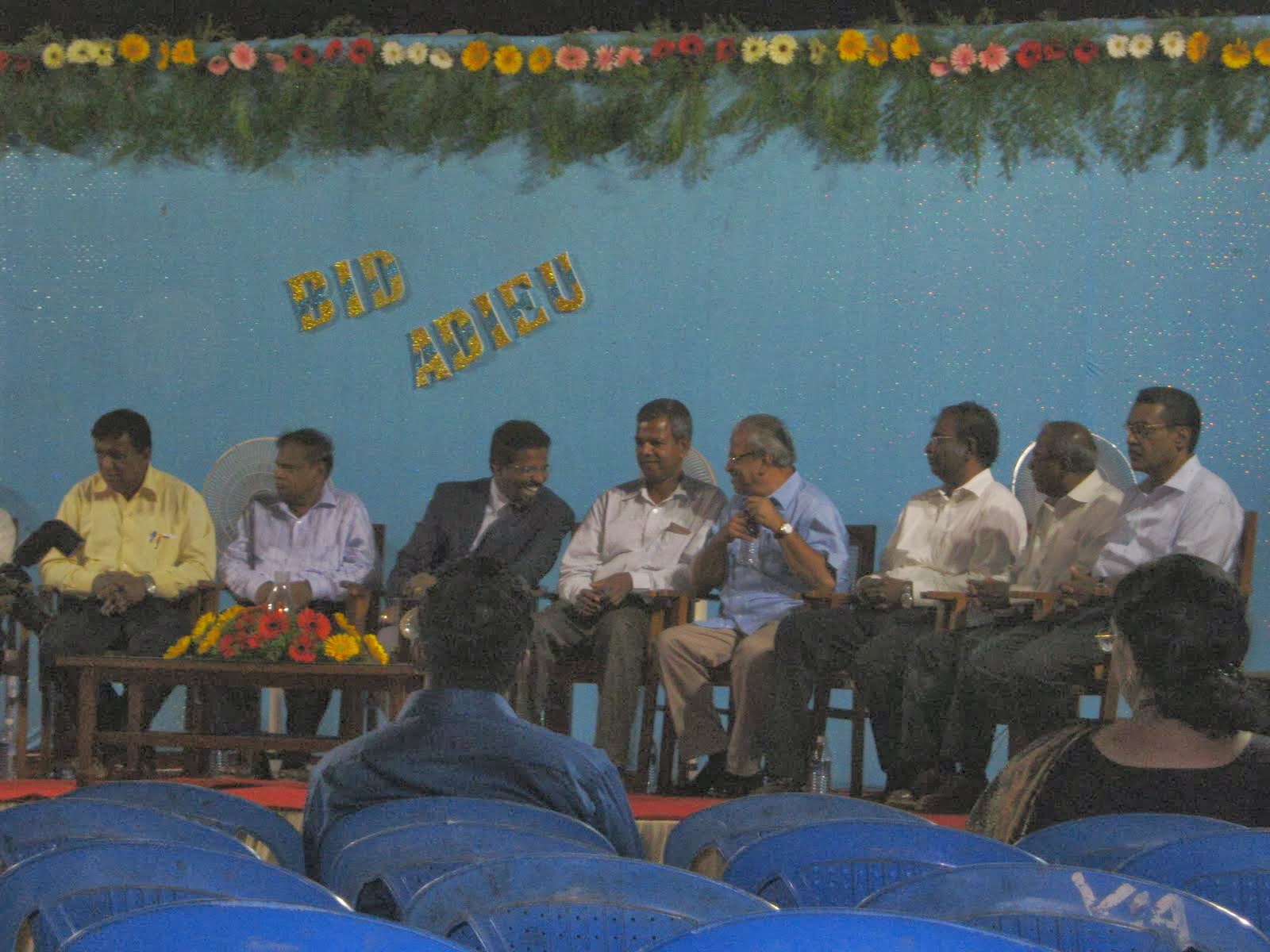
 Three emiment Professors from the Dept of English, seated from right to left - Prof.Cherian, (seated first from right) Prof.Victor, Prof.Nirmal, and the other retiring Professors at the felicitation function hosted in their honour.
Wednesday, 21 April 2010
Retiring Professors on the Dais...:
Three emiment Professors from the Dept of English, seated from right to left - Prof.Cherian, (seated first from right) Prof.Victor, Prof.Nirmal, and the other retiring Professors at the felicitation function hosted in their honour.
Dr.Nirmal calls it a day, @ MCC..:
 Dr.Nirmal Selvamony, being greeted by the Principal, at the felicitation function for retiring Professors.
FOUR DECADES IN MCC CAMPUS...!
 The College bid adieu to a host of luminaries, at a function hosted to felicitate the retiring Professors. In Pic: Prof.Victor Frederick, Dept of English, along with Dr.Ganesh, the Principal, Prof.David, Dr.Stephen, Dr.Lakshminarayanan, & Dr.Gabriel.
Thursday, 11 March 2010
Mimesis - 2010 - A Review
The Annual Inter-Collegiate Literary Festival - Mimesis 2010, conducted by The English Association, MCC, took off to a flying start on 09 March 2010.
The grand attraction of Mimesis 2010, was the Drama Competition. A Theatre Workshop was held and it was headed by Mr. V. Balakrishnan of Theatre Nisha fame.
A variety of Literary and Creative competitions like Quiz, ShipWreck, Be the Playwright, Drama competition (Mime, Musical drama, Monoacting...), Face Painting, Scene Sketching, Freeze Zone etc were conducted.
The two-day programme had a grand finale on 10 March. The event saw enthusiastic participation of many City Colleges and also from our own student volunteers, who along with the President, the HoD, and the other Staff members, made it a grand success.
Tuesday, 9 March 2010
English Literary Festival - 2009 - '10
 A Theatre-model kept on display at the English Literary Festival
English Literary Festival - 2009 - '10
 A Model of a Theatre, crafted by a first year BA student, kept on display at the Selaiyur Hall Indoor Aud.
Saturday, 23 January 2010
“Roman Fever” – Edith Wharton – A Critical Appreciation

Edith
Wharton was born near Washington Square to wealthy and distinguished parents
rooted in colonial times. She was educated privately at home and abroad
acquiring an early command of foreign languages and an easy familiarity with
English and continental society. Her first writings were poems published
anonymously in 1880. At 23, she married Edward Wharton of Boston. They lived,
at first, in New York city, then successively in New Port, Rhode Island and
Lennox, Massachusetts, with frequent visits to Europe. In 1907 she settled
permanently in France.
Her
ethical sense, her poetic sensibility and compression were evident in her first
collection of stories – The Greater Inclination (1899). Her other works include
– The Valley of Decision (1902), The Descent of man (1904), The House of Mirth
(1905), Ethan Frome (1911), The Fruit of the Free (1915) and The Tales of Men
and Ghosts (1910). The Tales of Men and Ghosts contains some of her best
stories of the supernatural. During the war years she gave much of her energy
to the organisation of relief activities. Fighting France (1915) and The Main
(1918) are war novels. After the war Edith Wharton returned to New York. The
Age of Innocence (1920), her greatest novel, was awarded the Pulitzer Prize and
has remained a landmark.
Edith
Wharton’s stories were centered upon the changing society of New York city
during her own lifetime. She viewed this genteel, formalised society with a
woman’s eye; and being primarily a satirist, she was interested in the dynamics
of the society itself.
The
setting of the short story “Roman Fever” is important, simply because it
symbolises the emotional state of the two principal characters – Mrs. Alida
Slade and Mrs. Grace Ansley. The setting revives memories for “two American
ladies of ripe but well-cared for middle age.” They have come back to Rome for
a holiday in the company of their younger daughters.
Sunday, 1 November 2009
BELIEVE IN YOURSELF..! Excellent Tips for Writing a great Semester Exam:

Dear Students,
The following tips, it is ardently hoped, would help you face your exams with the right attitude of mind and in the proper perspective.
The following tips, it is ardently hoped, would help you face your exams with the right attitude of mind and in the proper perspective.
Before the Examination:
1. Get a normal night’s sleep before the examination date.
2. Reach the Exam Centre early and relax or discuss with close friends.
3. BE SELF-RELIANT: Check if you have taken your Hall Ticket, your College ID Card etc along with the required stationery needed for the exam. Do not borrow anything like pens, pencils, eraser etc from anybody in the Examination hall.
4. Check again the time and place of the Examination Centre.
5. On the examination day, leave home early so that you will don’t get caught up in traffic jams / hardships / tight-corners etc., as no student is permitted inside the examination centre 30 minutes after the commencement of the exam.
6. Have a light breakfast too, as energy is essential for good thinking.
7.DO NOT LEAVE VALUABLES like mobile phone, jewellery, cash etc outside the EXAMINATION VENUE. It might not be safe at all.
During the Examination:
1. Read the question paper and the instructions thoroughly. Mark the questions which you find you can answer. Ask the invigilator for clarifications, if any.
2. Make a rough time scheme and decide how much time you should allot to each question.
3. Leave 15 minutes at the end to review the answers and make corrections, as needed.
4. Before you start on any particular question, make sure you understand it/interpret it correctly.
5. Answer the easiest and shortest question first.
Answers should be brief and conforming to what is asked in the question.
6. If you get stuck up, proceed to the next question and come back at the end if there is time.
Leave a margin of 3 cm at the left side of the answer sheet, if there is no printed margin.
7. Mark the question numbers clearly in the left margin.
8. Clearly understand the difference between the usages "Define", “Distinguish”, “Compare”, “Describe”, “Illustrate”, etc.
9.ORGANISE YOUR ANSWER SHEET: write legibly; use reasonably large size letters; don’t cram; space the lines. NUMBER ALL YOUR PAGES.
10. Do not write your name or any symbols that reveal your identity, anywhere in the answer sheet.
8. Clearly understand the difference between the usages "Define", “Distinguish”, “Compare”, “Describe”, “Illustrate”, etc.
9.ORGANISE YOUR ANSWER SHEET: write legibly; use reasonably large size letters; don’t cram; space the lines. NUMBER ALL YOUR PAGES.
10. Do not write your name or any symbols that reveal your identity, anywhere in the answer sheet.
Morning Session starts at 9.30 am.
Afternoon Session starts at 2 pm.
Afternoon Session starts at 2 pm.
Finally, be honest, and do your best..! God will take care of the rest..!
Here's wishing you happy writing! All the very best..!
Saturday, 31 October 2009
II Year BA / BSc / BCom - Part II English Notes - Reg:
Dear Students,
You can download or print them by clicking on the respective buttons found on top of the document.
Regards,
Rufus
Thursday, 29 October 2009
I BA English - Grammar Notes - Reg:
Dear Students of I BA English Litt.,
Your Grammar notes have been uploaded HERE
Regards and all best wishes,
Rufus
Your Grammar notes have been uploaded HERE
Regards and all best wishes,
Rufus
Wednesday, 28 October 2009
II BA English - II CIA Test - THE VICTORIAN AGE - Reg
Dear Students of II BA English Litt.,
Your Internal Marks for your II CIA for the paper "THE VICTORIAN AGE" have been uploaded on our academic website HERE.
Clarifications/corrections, if any, can be made to me personally/by email/ or by phone on or before Friday, 31 October 2009.
Regards and all best wishes,
Rufus
I MA English - Assignments - Reg..:
Dear Students of I MA English Litt.,
The following are the marks for your assignments as part of your paper - "The History of Language".
Aparna, K - 80
Gladys Lydia - 80
Koil Thangam Addlin - 80
Parvathy Nair - 80
Smitha Susan Zachariah - 80
Allen David Isaiah - 80
Dinesh, A - 80
Roland Rencewigg - 80
Clarifications/Corrections, if any, can be made to me personally/by email/ or by phone on or before Friday, 31 October 2009.
Regards and all best wishes,
Rufus
I BA English - Grammar Assignments - Reg:

Dear Students of I BA English,
The following are the marks for your paper on "Grammar and Linguistics" for students who come under my purview.
Abipriya Juliet, M - 75
Anju Susan Philip - 75
Anu Ruby Jenifer, S - 75
Charutha Lal - 75
Diana Milcah, J - 77
Divya Gracy, R - 75
Gunasundari, S - 75
Jothy Sara Jose - 78
Kunga Lhamo - 75
Monika, M - 75
Narmada, D - 75
Phebi Priyanka, S - 77
Pranisha, R - 75
Rama Devi, R - 75
Ranjitha, V - 75
Rinchen Bhuti - 75
Santhiya, T.P.N - 75
Shirley Inba Vinothini,B - 75
Sharon Ruby,B - 77
Therasa Jancey Rani, X - 77
Abjy P. Kurian - 75
Amel P. Titus - 75
Esra Prasath, A - 75
Irwin Selvan - 75
Jenson Jacob - 55
Nijo A. Varghese - 75
Sasikumar, K - 75
Soundar Raj, M.J - 68
Timios Thangavijayan. K - 63
Vijay, S - 75
Anju Susan Philip - 75
Anu Ruby Jenifer, S - 75
Charutha Lal - 75
Diana Milcah, J - 77
Divya Gracy, R - 75
Gunasundari, S - 75
Jothy Sara Jose - 78
Kunga Lhamo - 75
Monika, M - 75
Narmada, D - 75
Phebi Priyanka, S - 77
Pranisha, R - 75
Rama Devi, R - 75
Ranjitha, V - 75
Rinchen Bhuti - 75
Santhiya, T.P.N - 75
Shirley Inba Vinothini,B - 75
Sharon Ruby,B - 77
Therasa Jancey Rani, X - 77
Abjy P. Kurian - 75
Amel P. Titus - 75
Esra Prasath, A - 75
Irwin Selvan - 75
Jenson Jacob - 55
Nijo A. Varghese - 75
Sasikumar, K - 75
Soundar Raj, M.J - 68
Timios Thangavijayan. K - 63
Vijay, S - 75
Clarifications/Corrections, if any, can be made to me personally/by email/ or by phone on or before Friday, 31 October 2009.
Regards and all best wishes,
Rufus
II BA English - Assignment Marks - Reg:

Dear Students of II BA English,
The following are the marks for your Assignment as part of your paper on "Practical Introduction to Literature" for students who come under my purview.
Angel, G - 65
Deborah, K - 67
Joanna Daniel - 76
Karishma Rachel Jacob - 73
Manisha, R - 75
Parline Maria, A - 64
Anand, K.S - 75
Arun Kumar, J - 72
Cerin P Simon - 60
Jeffrey Kevin - 70
Johnnyraj, S - 70
Midhun K. Varghese - 70
Paul Israel - 66
Rajeswaran, S - 71
Samuel Praise, P - 72
Siju Philip Rajan - 72
Wesley, P - 73
Arun Kumar, J - 72
Cerin P Simon - 60
Jeffrey Kevin - 70
Johnnyraj, S - 70
Midhun K. Varghese - 70
Paul Israel - 66
Rajeswaran, S - 71
Samuel Praise, P - 72
Siju Philip Rajan - 72
Wesley, P - 73
THE VICTORIAN AGE:
Angel, G - 70
Haritha, B - 72
Karishma Rachel Jacob - 76
Kezia Gnana Kumari, W - 70
Sruthi Grace Abraham - 74
Arun Meshach, A - 40
Cerin P. Simon - 65
Midhun K. Varghese - 63
Prashanth Isaac, J - 73
Samuel Praise, P - 73
Haritha, B - 72
Karishma Rachel Jacob - 76
Kezia Gnana Kumari, W - 70
Sruthi Grace Abraham - 74
Arun Meshach, A - 40
Cerin P. Simon - 65
Midhun K. Varghese - 63
Prashanth Isaac, J - 73
Samuel Praise, P - 73
Clarifications/Corrections, if any, can be made to me personally/by email/ or by phone on or before Friday, 31 October 2009.
Regards and all best wishes,
Rufus
I BA English - Grammar Class - Reg:
Dear Students of I BA English Litt.,
There will be a special class for I BA English Literature students on Thursday, 29 October 2009 at 10 am in your class room.
Students who need any clarification regarding their marks and subject, can clarify the same, in this class.
Regards and all best wishes,
Rufus
II BA Tam/Phil - Internal Assessment Marks - Reg
Dear Students,
Your Internal Assessment Marks for the III Semester (with individual mark allocation) have been displayed today at 9 am at the Eng.Dept Notice Board.
Your Internal Assessment Marks for the III Semester (with individual mark allocation) have been displayed today at 9 am at the Eng.Dept Notice Board.
For a e-copy of your marks, II BA Philosophy click HERE.
II BA Tamil Lit Class click HERE.
For corrections/clarifications, if any, email/phone/ or meet me on or before 31 October 2009.
You can collect your assignments on Thursday, 29 October 2009, between 9 am and 1 pm in the English Dept Staff Room.
Regards and all best wishes,
Rufus
Regards and all best wishes,
Rufus
Monday, 26 October 2009
I BSc Pbt/Zoo - Internal Mark Statement Reg:
Dear Students,
For I BSc Pbt Marks Click HERE
For I BSc Zoo (Reg) Marks Click HERE
Your individual marks have been displayed at the Eng Dept Notice Board at 10 am today. You can also collect your assignment books there.
Clarifications/Corrections, if any, can be made to me personally/by email/ or by phone before Friday, 30 October 2009.
Regards and all best wishes,
Rufus
For I BSc Pbt Marks Click HERE
For I BSc Zoo (Reg) Marks Click HERE
Your individual marks have been displayed at the Eng Dept Notice Board at 10 am today. You can also collect your assignment books there.
Clarifications/Corrections, if any, can be made to me personally/by email/ or by phone before Friday, 30 October 2009.
Regards and all best wishes,
Rufus
Tuesday, 20 October 2009
Ornithological Species of Identical Plumage...
 Snapped at the Bird watching session at Nanmangalam, organised by OSLE-India, and coordinated by Hopeland, 'Flora and Fauna Convener' of OSLE-India, on Saturday, 17 October 2009.
 If you are an eco-enthusiast and interested more in Bird watching,
contact Mr.Hopeland, Zoology Dept, MCC @ 9940567784
Saturday, 17 October 2009
Part II English - I BSc Pbt/Zoo - Assignments - Reg:
Dear students of I BSc Pbt/Zoo (Reg),
This is the last call for submission of your assignments. You are expected to hand in your assignments to me personally, and not place it anywhere else in the Department. The last date for submission of your assignments is Monday, 19 October 2009 till 2.00 pm.
Regards,
Rufus
II BA English - I CIA Internal Marks / II CIA Test Portions Reg:

Dear Students of II BA English Litt.,
Your Internal Marks for your I CIA test have been uploaded on our academic website HERE.
Corrections/clarifications, if any, can be made to me on or before Monday, 26 October 2009.
If you need a "review report of your answer sheet" by your course teacher, on what exactly went wrong in your answers, your strengths and weaknesses in your test paper, and how you could possibly write better answers, mail me at rufusonline@gmail.com for an insightful analysis of the same. This review report is available to all my students who feel the need for it.
PS: Your II CIA Test on "THE VICTORIAN AGE" will be on "Jane Eyre". As the test is an "Open Book" test, you are expected to bring your own copy of "Jane Eyre" for the test. Borrowing texts during the course of the exam is not permitted.
Regards and all best wishes,
Rufus
Your Internal Marks for your I CIA test have been uploaded on our academic website HERE.
Corrections/clarifications, if any, can be made to me on or before Monday, 26 October 2009.
If you need a "review report of your answer sheet" by your course teacher, on what exactly went wrong in your answers, your strengths and weaknesses in your test paper, and how you could possibly write better answers, mail me at rufusonline@gmail.com for an insightful analysis of the same. This review report is available to all my students who feel the need for it.
PS: Your II CIA Test on "THE VICTORIAN AGE" will be on "Jane Eyre". As the test is an "Open Book" test, you are expected to bring your own copy of "Jane Eyre" for the test. Borrowing texts during the course of the exam is not permitted.
Regards and all best wishes,
Rufus
Friday, 16 October 2009
HAPPY DIWALI WISHES..:
Dear Stu dents, loving friends and beloved well-wishers,
This greeting comes to wish you happiness and joy of the season.
May This Diwali be as bright as ever.
May this Diwali bring joy, health and wealth to you.
May the festival of lights brighten up you and your near and dear ones lives.
May this Diwali bring in u the most brightest and choicest happiness and love you have ever Wished for.
May this Diwali bring you the utmost in peace and prosperity.
May lights triumph over darkness.
May peace transcend the earth.
May the spirit of light illuminate the world.
May the light that we celebrate at Diwali show us the way and lead us together on the path of peace and social harmony.
"WISH U A VERY HAPPY DIWALI"
 dents, loving friends and beloved well-wishers,
This greeting comes to wish you happiness and joy of the season.
May This Diwali be as bright as ever.
May this Diwali bring joy, health and wealth to you.
May the festival of lights brighten up you and your near and dear ones lives.
May this Diwali bring in u the most brightest and choicest happiness and love you have ever Wished for.
May this Diwali bring you the utmost in peace and prosperity.
May lights triumph over darkness.
May peace transcend the earth.
May the spirit of light illuminate the world.
May the light that we celebrate at Diwali show us the way and lead us together on the path of peace and social harmony.
"WISH U A VERY HAPPY DIWALI"
Tuesday, 13 October 2009
Standard Tips for writing a good CIA Test..:

Exams are meant to provide you a with a practical and periodic assessment to check what you have learned and what is missing, and as such it is designed to take the best out of you - your potential - your creative abilities and the way you present them with pen and paper. In short, it is designed to challenge! It's also common knowledge that you will not be able to write as much as you know. So, how to give your best in an exam? Just try some or all of these points below:
1. Begin early: You, dear student, are the central element in your education (no matter who you may be). If this is the night before your exam, what follows may be too late. In future, make every effort to stick with the program. Read the syllabus; attend lecture; keep up with the reading; ask questions. If you need help, ask: See your Professor during Office Hours or before or after class. If you have a disability, inform your instructor early in the semester and make appropriate arrangements well in advance of Exam Day. But in any case, prepare yourself for the exam now. Work on your reading, writing, and study skills. Don't wait for the next exam. Do it now. You are the principal player in your education. Accept your responsibility. Please don't say no one told you.
2. Remember: It takes two to learn and it is likely your professor is not an ogre! A good question from you during class would be welcome. If you have any other kind of problem or concern, discuss it with your instructor before or after class or during office hours. Communicate your concern. In the meantime, do your job. Learn to listen critically, develop skills in taking notes, develop good study habits.
3. Importance of Study Sheets: Have a study sheet always! If you have a study sheet in hand and you have reviewed your lecture notes, the next job is to review them again focusing on what the question asks you to do. To be sure, you will have to write something. But what? First, as a rule, the more intelligent prose you write the better. Quality is always the key. So, think before you write. Good writing is succinct(brief). As a rule it is re-written writing. But you have only one shot with an in-class essay! To be on target aim to be prepared.
4. Going to War: That means getting your thoughts organized in order to write clearly. Your essay should have good organization. As Aristotle suggested: A Beginning; A Middle; An end. If 'The Philosopher' and 'Master of Those Who Know' does not impress you, then recall the standard issue of the United States Army:
i. Tell 'em what you're gonna tell 'em;
ii. Tell 'em;
iii. Tell 'em what you told 'em.
Writing a CIA Test is the academic equivalent of going to war, well, anyway, defending something worthwhile. Boy Scout or NCC Cadet..! Be Prepared.
5. What to include?: If your thoughts are organized, what do you include in your essay? In general be specific. A good essay has a thesis: It says in simple sinewy prose: I will argue that.... A good essay uses carefully selected examples. Like a good poem or a good piece of science or a good historical argument, memorable essays make a general claim supported by specific examples.
1. Begin early: You, dear student, are the central element in your education (no matter who you may be). If this is the night before your exam, what follows may be too late. In future, make every effort to stick with the program. Read the syllabus; attend lecture; keep up with the reading; ask questions. If you need help, ask: See your Professor during Office Hours or before or after class. If you have a disability, inform your instructor early in the semester and make appropriate arrangements well in advance of Exam Day. But in any case, prepare yourself for the exam now. Work on your reading, writing, and study skills. Don't wait for the next exam. Do it now. You are the principal player in your education. Accept your responsibility. Please don't say no one told you.
2. Remember: It takes two to learn and it is likely your professor is not an ogre! A good question from you during class would be welcome. If you have any other kind of problem or concern, discuss it with your instructor before or after class or during office hours. Communicate your concern. In the meantime, do your job. Learn to listen critically, develop skills in taking notes, develop good study habits.
3. Importance of Study Sheets: Have a study sheet always! If you have a study sheet in hand and you have reviewed your lecture notes, the next job is to review them again focusing on what the question asks you to do. To be sure, you will have to write something. But what? First, as a rule, the more intelligent prose you write the better. Quality is always the key. So, think before you write. Good writing is succinct(brief). As a rule it is re-written writing. But you have only one shot with an in-class essay! To be on target aim to be prepared.
4. Going to War: That means getting your thoughts organized in order to write clearly. Your essay should have good organization. As Aristotle suggested: A Beginning; A Middle; An end. If 'The Philosopher' and 'Master of Those Who Know' does not impress you, then recall the standard issue of the United States Army:
i. Tell 'em what you're gonna tell 'em;
ii. Tell 'em;
iii. Tell 'em what you told 'em.
Writing a CIA Test is the academic equivalent of going to war, well, anyway, defending something worthwhile. Boy Scout or NCC Cadet..! Be Prepared.
5. What to include?: If your thoughts are organized, what do you include in your essay? In general be specific. A good essay has a thesis: It says in simple sinewy prose: I will argue that.... A good essay uses carefully selected examples. Like a good poem or a good piece of science or a good historical argument, memorable essays make a general claim supported by specific examples.
6. Time is short: Because time is short your essay should show economy of expression. Make it lean and to the point. Truth is simple. Writers kid themselves more often than they fool their readers.
Be simple, direct, detailed. With Democritus 'Don't speak at length, speak the truth.' Fifty minutes is short, thirty minutes is twenty minutes shorter. So you must select in advance what you judge worthy of your time.
7. Finally, number all your pages: (they're worth the time spent!). Try not to over-write (especially question numbers!), and always see to it that you make your presentations memorable.
["Show me your answer sheet and i'll tell you who you are!" goes the adage! Indeed, your Answer sheet reflects you!]
Write a good and concise introduction to the essay lasting ½ to 2/3 of the first page. Why is this crucial? Examiners are human (oh yes!) and they will form an impression, willy nilly, of whether yours is a 1st class, second class or a weak answer before they turn from the first page. Your intro, therefore is a chance for you to show that you have all the knowledge and skills they are looking for and the rest of the essay will simply confirm it. Bring the essay to a close neatly but don't write a long and fatuous closing paragraph ("thus it can be seen that...") unless you really do have a number of threads left to tie together.
These skills are not natural and, to a great extent, the hope is that there's nothing like a bit of intensive practice to hone these skills to perfection.
Wish you all the very best!
[Thanks a ton to Prof.Robert Hatch. Well, you're words are a real shot in the arm, Professor!]
Tolerance
 Introduction:
 In his essay “Tolerance” E.M.Forster talks about the need for a sound state of mind, and a right psychology to reconstruct Europe. Architects, contractors, broadcasting corporations etc must be inspired by the proper spirit in the people for whom they are working. People today are indifferent to civic beauty, and they have no taste at all. According to Forster, until we are concerned and worried about our society, reconstruction of Europe would not become a possibility at all.
Love for Private Life – Tolerance for Public Life:
Most people, when asked what spiritual quality is needed to rebuild civilization, will reply ‘Love.’ But according to Forster, love is a great force in private life; it is indeed the greatest of all things: but love in public affairs does not work. The idea that nations should love one another, or that a man in Portugal should love a man in Peru of whom he has never heard – it is absurd, unreal, dangerous etc. In the rebuilding of civilization, something much less dramatic and emotional is needed, namely tolerance. Tolerance is indeed a negative virtue, but this is the sound state of mind which will enable different races and classes and interests to settle down together to the work of reconstruction.
Tolerance is Common Sense:
According to Forster, if you don’t like people, put up with them as well as you can. Don’t try to love them: you can’t, you’ll only strain yourself. But try to tolerate them. On the basis of that tolerance a civilized future may be built. There is no other foundation besides tolerance, for the post-war world.
Moreover, tolerance is very essential for the establishment of peace. It is also common sense, because in the post-war world we shall have to live with all kinds of people – from different races, languages, ethnicities etc.
Conclusion:
To conclude, Forster feels that tolerance is not a great eternally established divine principle, but just a makeshift, suitable and apt for an overcrowded and overheated planet. It carries on when love gives out, and love generally gives out as soon as we move away from our home and our friends. Tolerance is needed in the shop, among strangers, in the queue, in the telephone booth, in the street, in the office, at the factory and above all between classes, races, and nations. It is a dull virtue but still requires imagination, as it helps in empathizing with others, which is a very desirable spiritual exercise too.
Monday, 12 October 2009
I BA English - Grammar and Linguistics - I CIA Marks - Reg:
Dear students of I BA English Litt.,
Your I CIA Marks for the paper "Grammar and Linguistics" have been uploaded on our academic website HERE.
Clarifications and/or corrections, if any, can be made to me directly or via email, at rufusonline@gmail.com on or before Wednesday, 21 October 2009.
Regards,
Rufus
I BSc Pbt/Zoo - II CIA Syllabus for Test..:
 Dear Students of I BSc Pbt/Zoo(Reg),
You will be tested on the following four components for your II CIA.
1. Units 1 to 30 of Essential English Grammar
2. Any one essay with internal choice from "English Reader"
3. Any one poem with internal choice from "English Reader"
4. One letter-writing with internal choice.
[PS: Last date for submission of assignments is 14 October 2009.]
Regards and all best wishes, Rufus
Subscribe to:
Posts (Atom)
Featured post
Welcoming the Winter Guests | A Dawn Birding Adventure in Namma Chennai Today 💚
The First Flock | Welcoming Seven Magnificent Migrants to Namma Chennai #intothewildwithrufus #birding 6th September 2026 Today, as part of ...
