

What Makes George Washington University, Unique?
Today | In Campus
On George Washington University, J. Krishnamurti and Jayakanthan
#reflections
Today we had Ms. Regina from George Washington University, visiting us in the Office of International Programmes.

This was the second round of discussions we had with them today. Their delegation had visited us earlier - last month for initiating discussions on possible avenues for collaboration between the two institutions.
Indeed, we had a very rewarding time of discussions today.
Well, it was so nice to get to know about the pride of place occupied by George Washington University in academia.
“The White House is just around three minutes away from our University”, said Ms. Regina.
“The World Bank and the International Monetary Fund are located inside our Campus. Moreover, we’ve our own Metro Station – Foggy Bottom Station, located within Campus”.
“We’ve around 26,500 students with students from over 125 countries enrolled in GWU. The US State Department is beside us, while the SCOTUS (Supreme Court of the United States), is just ten minutes away from our Campus, she added.
This proximity to top notch institutions makes GWU a cut above the rest - offering students extraordinary access to internships, networking opportunities, and cultural experiences in the nation's capital, said Ms. Regina.
They’ve got a Career Centre where they handhold the student from the first week of their enrollment to their exit. They also have periodic Career Outcome Classes.
The George Washington University was chartered in 1821 by the United States Congress. It is also the first university founded under Washington, D.C.’s jurisdiction, and one of the nation’s six federally chartered universities.
The university offers degree programs in seventy-one disciplines, enrolling around 11,500 undergraduate and 15,000 graduate students.
Well, after bidding adieu to Ms. Regina, we stayed back to wish the birthday kid Stephanie Silviya Miracline, a very Happy Birthday. Stephanie is interning with the Office of International Programmes along with a host of other vibrant students.
This was followed by a lively and spirited time of discussions between faculty and students on Jayakanthan and J. Krishnamurti, that went on and on! when suddenly we realised that it was 2.20 pm and we decided to call it a day! 😊
A rewarding day indeed!
On the MCC Magazine | Reflections
24th April 2025
#reflections
Today, I was quite overjoyed and thrilled beyond measure, when I got a call from Dr. B. M. Arthur, (former Professor of Physics, MCC) and one of the senior-most MCC-ians (He’s 97 years old now).
He said he had just called to congratulate the MCC Magazine Committee on having his article published in the MCC Magazine.
“The MCC Magazine has come out so well. Congratulations to you and your team. I can’t forget all the beautiful things that happened in MCC from 1942 onwards. Thanks a lot. God bless you all”,
said Dr. Arthur, with such a graceful and peaceful voice that was laced with contentment and satisfaction on him. Thanks a lot to his nephew Prof. Samuel for facilitating the phone call today.
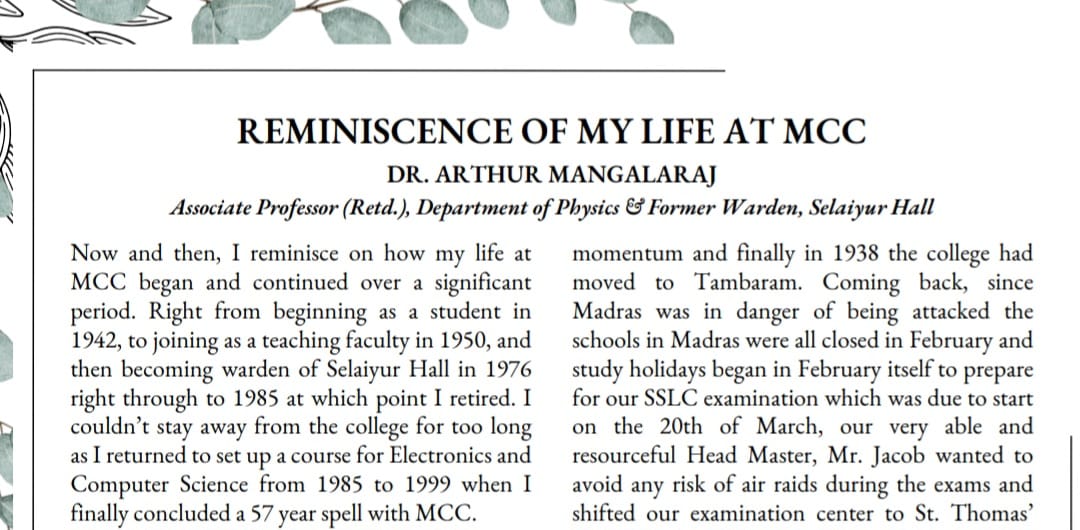
Interestingly, and coincidentally, his student Dr. Narasinga Rao, 87 years old now, (who is fondly called the grandfather of Undergraduate Research in Oklahama, US), has also given rich encomiums to his teacher Dr. Arthur, in this same Volume of the MCC Magazine.

Coming back -
Well, publication of the MCC Magazine is indeed a collective effort. We had 19 meetings this year, and I should acknowledge the commitment and dedication of all the members of the MCC Magazine Committee, who had sacrificed many of their precious Saturday holidays voluntarily, to spend the entire day in Campus, editing and proof-reading the manuscripts all through the year.
 |
| Meeting of the Magazine Committee | Saturday, 20th July 2024 |
And finally, when the red-letter day arrived, and when we saw the MCC Magazine of 264 pages in beautiful print, we were so delighted!
Special thanks to Dr. Jojan Job, Dr. Jayalakshmi, and Ms. Joseline Breeya for (the three J’s) 😊for being there almost every Saturday of this past academic year, to ensure that the Magazine saw the light of day on farewell day, 21st April 2025.
 |
| Release of the MCC Magazine by our Principal Dr Paul Wilson on Farewell Day | 21 April 25 |
The Madras Christian College Magazine was first published in the year 1883.
What began initially as a Monthly Magazine, with articles from MCC-ians and beyond, evolved into an Annual Magazine over the turn of the century.

The MCC Magazine is unique in several ways.
It’s not just ‘yet another College Magazine’ that churns out articles by the dozen, annually in nonchalant fashion! 😊
Quoting Milton –
It’s indeed the precious life blood of master-spirits of the College - a heritage document that’s kept, embalmed and archived for a life beyond life!

So unlike usual college magazines that sport just poems, essays and college reports, the MCC Magazine serves as a Heritage Document, a veritable Archive, a wealthy treasure-trove that has a majority of contributions from the alumni, and from retired faculty members as well.
One interesting facet of the MCC Magazine is that, it’s neatly structured into various sections – (a practice that’s in vogue even today) – with sections exclusively for book reviews, scientific writing, college musings, campus jottings, campus flora and fauna, world events, students’ corner, and other miscellaneous college notes.

Yet another interesting feature that’s a part of every Volume of the College Magazine is the famous quote by James Russell Lowell that adorns the front inside page of each and every Volume of the MCC Magazine right from the days of its inception.
Interesting, isn’t it? 😊

It also sports the Commemoration Address (usually given by the senior most retiring faculty member, each year), Graduation Day Address, Principal’s Reflections, Profiles of retiring faculty members, etc.
Some of the highly engaging articles featured in this Volume are as follows –
Our Principal Dr. Paul Wilson’s article reimagines a dynamic tertiary education landscape through end-user’s framework, that conceives of the curriculum as dynamically co-created through interactions among students, teachers, and communities.
Ms. Narayani Ganesh’s reminiscences on her father Gemini Ganesan, on how MCC provided her father’s life with good memories and experiences that helped shape his personality and turned him into a fine human being, is yet another testament to the ‘holistic nourishment’ provided by MCC.


The feature article titled, “Alice Mary Barnes: Her Legacy at MCC and Beyond” By Ms. Anne M. Dayanandan, the first Archivist of the College, is a tribute and a heartfelt ‘thank you’ to Prof Edward and Alice Barnes when we enjoy the cool green campus that is their legacy. The land that supports bird life, animals, insects, and vegetation that makes it a natural laboratory and is treated as a ‘wildlife sanctuary’, a rich legacy bestowed on MCC by the Barnes couple in the early 1930s.
‘Carvings In the Woods’, by Dr. Mekala Rajan, Head, Department of English, is a euphoric tribute to the aura of campus life, and its power to transform anyone who comes under its pristine and majestic influence.
Dr. Anulin Christudhas’s tribute to her teacher Dr. Manu Thomas Mathai, is a heartfelt testimony to the profound impact of a professor of MCC on a student’s academic journey.
Ms. Koteeswari’s article and Haritha Ramachandran’s poetic tribute highlight the sylvan ‘Forested Tapestry of College Memories’, while Dr. David Wesley’s script featuring an imaginary conversation between Rev. John Anderson and Rev. John Braidwood, titled, ‘The Three-Fold Cord’, a phrase used by Anderson to refer to the bond between himself, Rev. Johnston, and Rev. Braidwood.
Dr. Jojan Job’s article titled, ‘AGYEYA - A MAN OF MANY PARTS AND A LONG- FORGOTTEN ALUMNUS’, is a soulful tribute to an illustrious old boy of our College, a forgotten revolutionary, who was imprisoned during the Indian freedom struggle, a man who joined the Independence movement along with Bhagat Singh and Chandra Shekhar Azad, a soldier who served during the World War.
Ms. Nalini (Harris) Prakash’s article documents the first women’s hostel for MCC, in 1940, up until the time a building suitable to be a hostel was acquired in Guindy in 1950. On 27th June 1950, the women’s hostel at Guindy was inaugurated and it existed there for the next 18 years, says Ms. Nalini.
‘A Checklist of the Butterflies of MCC’ by our alumnus Mr. David Phinehas N, is a unique document, that catalogues the butterflies of MCC, during his Zoology undergraduate studies at MCC, carried out from July 2019 to April 2022.
This article assumes significance because of the fact that, for 22 years since 2000 there has been no update of the butterflies of MCC campus. The present checklist by David aims to fill this gap and note if there have been any significant changes in species composition over the nearly six decades of butterfly population studies on the campus.
“An Annotated Checklist of the Trees of Madras Christian College Campus – An Analysis” by Dr. G. Gnanasekaran et al. documents the rich tree diversity of MCC campus.
“Designing the International Guest House in Campus” by Ms. Cecilia Philipson documents the ‘Indianness’ that proved an inspiration for designing the International Guest House.
Dr. C. Annal Deva Priya Darshini’s article titled, “A Clock in the Quadrangle – Origin of the College Sundial” is a document of the College Sundial - which is ‘accurate to a minute’.
The article by the College Librarian Dr. P. Yesudoss et al. stresses the importance of utilization of academic libraries which is crucial to enhancing academic success, research productivity, and the advancement of knowledge within higher education institutions.
“Christian Contributions to Freedom Struggle” is a valuable article by Dr. B. Narasingaraja Naidu, which documents the role of the Christian community in the Indian Freedom Struggle.
We have a melange of articles of all hues in the vernacular, starting from Dr. N. Lakshminarayan’s highly engaging poem on ‘Journeying into the World of Books’.
We also have a poignant short story by Dr. Paul Prabu Santharaj titled, ‘New Path’, based on the Chennai Floods, followed by an insightful article that provides rare insights into the life and contributions of Tamil Pandit Maraimalai Adigal, Professor of Tamil in MCC, by Dr. J. Sudarvizhi.
Dr. Gnana Chandra Johnson has presented a very profound article on ‘Divine Love in Christian Literature’, while Dr. Sadasivam has portrayed the unique poetic sensibility of Velliveethiyār, a woman poet of the late Sangam period.
The Tamil Mandrams of the various Halls have been featured in Dr. Sebulon Prabu Durai’s article.
Dr. Jayalakshmi has shared some of her nostalgic memories in Hindi, and we also have an article in Malayalam titled, ‘Religious Diversity in India: Myth or Reality?’ by Mr. Aaron George Jacob.
This Volume also has a host of spirited poetry in Tamil and in Hindi by our students – past and present.
I thank our beloved Principal and Secretary Dr. P. Wilson for trusting in me and for entrusting this noble task to me.
I profusely thank Dr. Jojan Job, Dr. V. Jayalakshmi, Dr. J. Sudarvizhi, Dr. Marilyn Gracey Augustine, Dr. G. Gnanasekaran, Dr. D. Selvakumari, Dr. Sebulon Prabu Durai, Dr. Raja Sornam, Prof. Esther Hebrews, and all the other faculty members for their constant support and invaluable guidance in editing this Volume of the College Magazine.
I also thank our student volunteers who had helped us during the various stages of the typesetting of this Volume.
A special note of thanks to Dr. Jojan Job and Ms. Joseline Breeya for the vibrant cover design and the exceptional layout of the Magazine.
On behalf of the Editorial team of the College Magazine, I thank all the contributors for their highly insightful articles, that serve as invaluable documents towards cherishing and preserving the life, legacy and heritage of our College.
Finally, our sincere thanks are due to everyone who has played an invaluable role in keeping this knowledge alive and relevant.
Thank you for being an important part in archiving this rich legacy.
Viva la MCC!
PS: You may want to read our past post on how the MCC Magazine was the only go to, for many significant national / international events of the past, HERE
Today’s Memorable Farewell Function for Retiring Professors
@ MCC | Soulful Parting Thoughts
21st April 2025 | Anderson Hall
The Farewell Function for Retiring Staff is such a solemn and ceremonial affair in Madras Christian College.
MCC has always gone that extra mile when it comes to hosting the ceremonial farewell for her retiring staff members. Indeed, the farewell function day starts right in the morning, and goes on up until late into the evening, sometimes even up to 11 pm and beyond!
 |
| Our Former Professors - Our Treasure! |
Today was host to yet another time of departing -
Of our beloved retiring staff members. Ten of them are retiring this year. A huge loss for MCC indeed!
Well, bidding adieu to the wonderful colleagues, to the blissful flora and fauna of the woods, to the beloved students, and to the heavenly ambience of the sylvan Campus, can indeed evoke a range of emotions.
At the same time, a farewell function such as this, provides a lovely supportive space where such retiring professors (who have for decades dedicated their lives to the service of the student community), are given their ‘last lecture as Professor’ moment, to share their valuable thoughts, their ‘institutional memories’, and their parting words of advice for their juniors.
I would like to quote excerpts from Dr. Paul Prabhu Santharaj’s speech today. It was such an amazing talk much-needed for all of us academics!
 |
| Dr. Paul Prabhu on Song... |
Just excerpts –
A few years ago, there was a junior faculty member who was scolding a student. She told him, ‘After all, you are a student, and you are speaking like this!’
Never ever say like that, he admonished.
They’re not ‘After all’, here.
They are our bosses. (ejamaan)
We are here as their servants. (velaikaarar)
If you have such a negative perception of the student of mind, where you say, ‘After all, you’re a student… you are not fit to teach in MCC. Please go elsewhere… and find yourself a job’, he said.
Teaching is not a job!
Teaching
is not a responsibility!
It’s
a way of life! (athu oru vaalkkai murai)
Only those who are loving and caring are really qualified to be teachers!
Love is the foundation!
If you have an issue with a colleague, don’t write to the Principal. Go straight to the person and talk to them. There’s nothing like unto love.
Anything in this world can be achieved through love.
Speak to them directly. Smile at them.
In our college, as far as I know, we don’t go by might is right! We always go by what is right!
Dr. Paul Prabhu also thanked a whole list of loving souls, who had supported him and believed in him during his stint in MCC right from his student days.
He ended on a lovely note, saying –
I don’t know if I can claim to be intelligent!
I don’t know if I can claim to be a good researcher!
But I can claim with all humility, that
I was a good teacher!!!
he signed off!
More to follow…. The function is still on…
List of Retiring Professors
1. Dr. Paul Prabhu Santharaj, HoD, Tamil
2. Dr. P. Gopalakrishnan, Associate Prof, Sanskrit
3. Dr. S. D. Christopher Chandran, HoD, Pol. Science
4. Dr. V. Jacquiline, HoD, Economics
5. Dr. Tamilarasi, HoD, Commerce
6. Dr. Florence John, Associate Professor, Commerce
7. Dr. T. Robinson, HoD, Mathematics
8. Prof. A. Jyothi Salomi, Associate Professor,
Mathematics
9. Dr. P. Samuel Asirvatham, HoD, Physics
10. Prof. Leslie Lawrence, Assistant Professor, Botany
Our Dearest Professors,
May your next chapter be filled with captivating narratives, mesmerizing stories, unforgettable characters, and plot twists that leave you breathless in the most delightful ways. Until our paths cross again in the vast library of life, happy reading and may your own story continue to unfold beautifully!
Viva la MCC!
PS:
You may want to watch yet another memorable Farewell Speech given by Dr. Miriam
Samuel, last year same time in MCC, HERE
Arts and science colleges enter the arena of entrepreneurism
Today’s The Hindu
21st April 2025
#MCC-MRFInnovationPark
#MadrasChristianCollege
#newspaperinlearning
The MCC-MRF Innovation Park at Madras Christian College. MRF has contributed ₹30 crore from the MRF Foundation to the establishment of the park.
With the spread of start-up culture, colleges are improving their incubation cells and forging partnerships with the key players in the entrepreneurial ecosystem. As a result, more students pursuing arts and science courses are venturing into entrepreneurship.
.png)
Apart from engineering colleges, arts and science colleges in Tamil Nadu are becoming hotbeds for entrepreneurial activity. With innovation and start-up culture spreading, colleges are improving their incubation cells and forging partnerships with the key players in the entrepreneurial ecosystem.
As a result, an increasing number of students pursuing arts and science courses are stepping beyond the traditional careers and venturing into the world of entrepreneurship, bringing fresh ideas and energy to the start-up scene.
At the Madras Christian College (MCC), the seeds for an incubation cell were sown in 2020. In 2022, the start-up support programmes were launched. The incubation cell has been helping students with funding of up to ₹1 lakh. Professors are also given research and development grants.
Becoming big ventures
A handful of start-ups incubated at the MCC have become big ventures. For example, a company, called Vividobots, raised up to ₹2.5 crore and has set up a separate research and development unit at Ambattur. Another start-up, called Allytriz Technologies, has been recognised as one among the top 100 promising start-ups of 2024-25.
PS: You may want to read our past post on how The Week had come out with a prophetic feature (future) in their June 2013 Issue, 12 years ago, HERE.
Interestingly this issue of The Week features MCC among the TOP TEN in the Nation, and the article foregrounds Innovation Parks and Experiential Learning as the Way forward for academia.
Can our Thoughts be Hacked?
#newspaperinlearning
#ResearcherAsSeer #AuthorAsProphet
#ResearcherIsNotAReporter
19th April 2025 | The Times of India
In today’s Times of India, I came upon this astounding article that highlights the promises and the dangers of the rapidly advancing Brain-Computer Interface (BCI) technology.
In an engaging discussion, Rajesh PN Rao, Director of Neural Systems Laboratory at University of Washington, talks about the rapid advancements in neurotechnology along with its promises and dangers!
Brain-Computer Interface lets paralysed patients to text, email and browse the web using brain signals. The BCI also stimulates the spinal cord of a person with paralysis to help them walk, says Rajesh Rao.
When asked if BCIs can ‘hack’ our thoughts, Rajesh nods in the affirmative! 😊
Any device that runs software and is connected to the internet opens itself up to the possibility that a malicious actor could hack into it. BCIs are no exception. If the security protocol is not strong enough, the BCI could be hacked and a virus could, in principle, be planted.
A BCI that can both “read” and “write” the brain (record and stimulate) carries an even bigger risk – a future hacker could influence the user’s brain by biasing brain activity towards one choice or another, erase recently stored information by perturbing memory regions of the brain, or even write new information into the brain,
says Rajesh Rao.
Fine! Now let’s take our eyes off the Times of India, and Rajesh Rao!
Let’s for a moment visualise this well-known episode from the TV series Star Trek first shown in 1966, that had such a huge fan following, leading to numerous spin-off series, films, and other transmedial avatars.

In the episode “The Menagerie”, Captain Christopher Pike is shown as severely crippled by a radiation accident.
(While observing a cadet training cruise aboard an old J-class freighter, the ship’s engine core suffered a baffle plate rupture. This results in several cadets being exposed to a large dose of delta radiation. Captain Pike, without hesitation, exposes himself to the deadly radiation in order to save the lives of the Starfleet cadets. Owing to the intense delta radiation exposure, he is left paralyzed, unable to speak, and badly scarred).
As a result, he is confined to a sophisticated life support chair, and he can only communicate through a light integrated into his wheelchair that allowed him limited interaction with the world through a system of lights and beeps (one for “yes,” two for “no”).
Commodore Mendez, the commander of Starbase 11, describes the condition of Captain Pike as follows –
“He is totally unable to move, Jim. His wheelchair is constructed to respond to his brain waves. He can turn it, move it forwards, backwards slightly. Through a flashing light he can say ‘yes’ or ‘no’. But that’s it, Jim. That is as much as the poor ever can do. His mind is as active as yours and mine, but it’s trapped in a useless vegetating body. He’s kept alive mechanically. A battery-driven heart. ...”
Here, the only way that Captain Pike can communicate with the environment is by means of a device that can read brain signals (aka biosignals) and convert them into control and communication signals.

Although in the 1960s, this was pure science fiction at its creative best, such a device is called a brain–computer interface (BCI).
A Brain-Computer Interface (BCI) then, is a system that establishes a direct communication pathway between the brain and an external device, such as a computer, prosthetic limb, or other technology.
Electrodes are surgically implanted directly into the brain tissue. This provides the highest quality signals. The measured brain signals are then processed and analyzed by computer algorithms.
These algorithms identify specific patterns in the brain activity that correspond to the user's intentions or commands. Once the brain signals are interpreted, the BCI system translates them into commands that are sent to the external device, allowing the user to control its functions.
BCI technology is a rapidly evolving field with immense potential to improve the lives of individuals with disabilities and to revolutionize how humans interact with technology, enhancing human interaction with technology! and furthering our understanding of the brain itself.
In short, a BCI allows you to control things with your mind.
Lick (J. C. R. Licklider) is yet another seer of the sixties, (1960s) who pioneered pathbreaking ideas on Interactive Computing, thereby envisioning modern interactive computing in all its avatars. It is quite interesting to note that, even before the internet came into vogue, Lick had conceived the idea of a global computer network! And how!
In March 1960, Lick had published a seminal research paper, “Man-Computer Symbiosis,” in the Journal titled, IRE Transactions on Human Factors in Electronics.
In this paper, he proposes a close partnership between humans and computers to enhance human intellectual capabilities and decision-making.
I quote –
The hope is that, in not too many years, human brains and computing machines will be coupled together very tightly, and that the resulting partnership will think as no human brain has ever thought and process data in a way not approached by the information handling machines we know today. (Man-Computer Symbiosis, March 1960)
This blogpost intends to highlight the five key words that form the crux of Lick’s research paper.
Proposed
Envisioned
Conceived
Hoped
As we know today
An impactful research paper would then ‘propose’, ‘envision’, ‘conceive’, ‘hope’ and foresee the future that’s different from ‘how it is envisioned today’, in the respective thrust area.
Researching hence is NOT Reporting!
Many of our researchers today, are just content with passing off their ‘reporting’ as ‘researching’.
If so, then almost all our newspaper reporters should have been given their doctorates long time ago, ain’t they! 😊

A good research paper then, looks at a problem prospectively from the researcher’s unique perspective - by ‘proposing, envisioning, conceiving, foreseeing, hoping’, etc!
Now, coming back –
After Lick, we have an American-born British neurophysiologist, cybernetician, and robotician - Dr. Grey Walter who is credited with demonstrating one of the earliest reported demonstrations of a brain-computer interface in 1964.
During a lecture, he connected electrodes to a patient’s brain (who was undergoing surgery for other reasons) and linked them to a slide projector. The patient was able to advance the slides using only their thoughts.
Although he presented this insightful work to a group called the Oster Society in London, unfortunately [unlike Lick], Dr. Walter did not publish this principal step forward.
As a result, there was little progress in BCI research for almost four decades after that. Only a dozen labs were engaged in serious BCI research. Only after the year 2010, did BCI research really gather steam.
So the takeaway from this blogpost is simply this –
Lick had a unique, overpowering idea within him. He analysed this idea, researched on it further, and published it. As a result for the next many years, related research flourished.
However, Dr. Grey, although he too had such overpowering ideas welling up within, he failed to publish the same in journals or books, resulting in a stagnation of research in the field for more than forty years from then on!
Speaks to the importance of having your unique thoughts and ideas published in scholarly research papers as and when they well-up within you! 😊
PS: You may want to read our past post on How to Identify a Good Conference/Seminar? HERE on our blog.
Works Cited
Bernhard Graimann, et al. Ed. Brain–Computer Interfaces: Revolutionizing Human–Computer Interaction. London: Springer, 2010.
The First Flock | Welcoming Seven Magnificent Migrants to Namma Chennai #intothewildwithrufus #birding 6th September 2026 Today, as part of ...

